24 September 2018

To PhD

Today, I'm in limbo. And in London.

I'm sitting in a tiny room that's not particularly cheap, not particularly cheerful, but is precisely (according to the Google Maps tool) 4,977.87 miles from the front door of my home in Texas. I'm here right now because I've just enrolled for a PhD. I'm excited to start, but I'm also homesick for my wife, my children, at least 2/3 of my pets, and more than 95% of the square footage of my house.

This, of course, raises a question:
Why is my already-expensively-over-educated ass currently planted in a chair at a desk in front of a window that has a great view (with full sound effects) of three separate sets of very active railroad tracks?

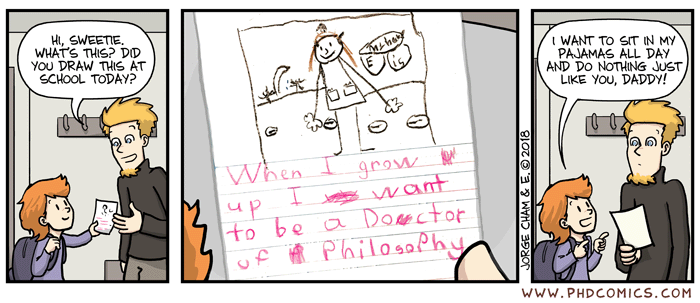
Like many simple questions, there's no simple answer. But I'd be lying if I said the pajamas weren't a factor.


It's late here, and I'm tired, so answers will have to wait. I'll start with them tomorrow, and I'll begin by talking about what I'm going to try to study.

20 August 2018

The re-re-reboot is upon us.

It's the dawn of a new academic year. What does that mean for the perpetual student? That's right!! It's the dawn of a new degree program.

In a little less than a month, I'll be flying out to London to start a PhD in Law at Queen Mary University of London. And we all know that the "P" in PhD stands for "Procrastination" - which makes this the ideal time to dust off this blog and get back up and running.

I recently made an attempt to re-reboot the blog at Wordpress. But a quick attempt to find the new Wordpress blog through a Google search stongly suggested that it's much wiser to come back here. I'll be taking most of that site down and re-directing it here as soon as I get around to it.

I'll have more in a bit.

19 April 2017

Copyright, Moral Rights, Charging Bulls, and Fearless Girls

Let's talk bulls. 

Specifically, let's talk about why the creator of a sculpture of a bull that may be better known for having it's big bronze balls rubbed than for its artistic merit may have a very strong copyright infringement case against the investment firm that commissioned another, more recent sculpture of dubious artistic merit, and possibly against the City of New York as well. And when I say "very strong," what I'm saying is that either someone at the investment firm consciously decided to accept a significant legal risk, or they failed to seek competent legal advice before commissioning their sculpture. 

From an IP lawyer's perspective, any lawsuit that is filed over this incident will be watched very carefully. The facts involved in this dispute raise quite a few questions of first impression for US courts, particularly where moral rights and fair use are concerned.  A number of people have already given their opinions of the case, with some saying that the artist has a strong case and others of the view that he has no case at all. In my view, there's a solid case for copyright infringement and for infringement of moral rights, but there's also a strong fair use defense on both counts. On the whole, it's one that could go either way. The only thing I'm sure of is this: it's going to be - if filed, of course - a fun case to watch.

The backstory, in brief:

In 1987, an Italian sculptor named Arturo Di Modica, moved by what he saw as America's resiliance in the face of a financial crisis, decided to create a tribute. Over the next two years, he raised money, sculpted an 11-foot tall, 1.5 ton bronze sculpture of a charging bull, and - without a permit, but with the help of 50 or so of his closest friends, a forklift, and the remarkable lack of vigillance of the New York Police Department - installed the sculpture in front of the New York Stock Exchange in the middle of a December night in 1989. After a bit of initial controversy, the sculpture was given a permit and has been allowed to remain in that spot ever since. Over time, it's developed a patina (except over its carefully sculpted testes, which are rubbed for luck by stockbrokers and tourists), and become part of the Wall Street landscape.

Last month, a Boston asset management firm commissioned a life-size sculpture of a little girl, arms akimbo, firmly staring forward with her pony tail and dress blowing out behind her. They had the sculpture placed directly in front of the Charging Bull, along with a label that advertises one of their funds. This sculpture was intended to remain in place for one week, but was also an immediate hit with tourists. As a result, New York City recently announced that they have issued a permit allowing Fearless Girl to remain where it is until at least 2018. 

And Di Modica is freaking out. The 76 year-old sculptor, represented by well-known civil rights attorney Norman Siegel, held a press conference last week. At the press conference, a "distraught" Di Modica demanded that the city remove the sculpture and pay damages for violating Di Modica's intellectual property rights. 

Di Modica's likely claims:

The IPKat has a copy of the letter of complaint that Di Modica's attorneys sent to New York City. The letter does not specify exact causes of action the same way that a complaint will, but there's enough in there to give us a sense of what will likely be in play if he files suit. (And, for reasons that I'll get to later, I think there's a strong possibility that this will wind up in court.)

Based on the letter, Di Modica is positioned to claim at least three separate violations of his intellectual property rights:

  • A claim for copyright infringement under 17 U.S.C. §106, on the basis that Fearless Girl is an unauthorized derivative work.
  • A claim for infringement of moral rights under 17 U.S.C. §106A, on the basis that Fearless Girl changes the meaning of Charging Bull in a manner prejudicial to Di Modica's honor as an artist.
  • A trademark infringement claim brought under the Lanham Act. 
In this post, I'm going to deal with the copyright claims only. The trademark claim will require a whole different analysis, and this post is going to be long enough with just the copyright stuff. 

First, let's start by listing the legally relevant facts, to the best of our current knowledge. I'll point out facts that may be disputed as we come to them. Unless otherwise noted, facts are taken from the letter of complaint.

Key Facts:

  • Di Modica a copyright registration for Charging Bull, which was issued before the Fearless Girl sculpture was created. 
  • Di Modica owns Charging Bull. This fact may be disputed if the case goes to court, on the basis that Di Modica said that the statute was a "Christmas gift" to the city. However, it appears that the City probably does not have title. Di Modica tried (unsuccessfully) to sell the statue in 2004, and it appears that the statue is still permitted to remain at its current location on a "temporary" basis. 
  • State Street Global Advisors commissioned the Fearless Girl statue.
  • Fearless Girl was placed with NYC permission.
  • Fearless Girl was placed on a temporary extension of the cobblestone traffic island that Charging Bull sits upon. (Visible in the picture at the top of this article.)

Infringement of Exclusive Rights Under 17 USC §106:

Virtually all the commentary I've seen on this dispute focuses on the issue of moral rights, but I think there's a solid economic rights claim as well. 

Di Modica will likely claim that Fearless Girl infringes his exclusive rights under 17 USC §106(2), which gives copyright owners the exclusive right "to prepare derivative works based upon the copyrighted work." This is made clear in several places in the letter of complaint:
"The statue of the young girl becomes the "Fearless Girl" only because of the Charging Bull: the work is incomplete without Mr. Di Modica's Charging Bull, and as such it constitutes a derivative work of the Charging Bull." (p. 1)
"Furthermore, SSGA and McCann New York made conscious decisions to visually link the young girl statue to the Charging Bull...they extended the cobblestone paving...into the adjacent plaza. In so doing [they] created another unifying element between the Charging Bull and the young girl that serves to transform the young girl into the "Fearles Girl." (p. 2)
"In effect, the Charging Bull has been appropriated and forced to become a necessary element of a new, derivative work: "Fearless Girl: Girl Confronts Charging Bull." (p. 2)
If Di Modica can show that Fearless Girl is a single work that combines the girl statue and the Charging Bull statue, he will have established that the new work is a derivative of Charging Bull. (It's also possible that he can prove that it's a derivative even if they're not a single work, but that's more than I'm going to get into here.)  I think he's got a fairly good shot at showing that the two are one work. 

There's not a lot of case law on how to determine when something is a single work or multiple independent works, but there are a couple of cases, including one from the Southern District of New York. In Carter v. Helmsley-Spear, 861 F. Supp. 303 (SDNY 1994), the court had to address a claim that a "number of sculptural elements" in the lobby of a building were a single work. The court found that the works appeared to be interrelated, that they shared thematic elements, and that the artists had consciously worked to ensure that the different elements "worked together." (861 F. Supp at 314-15). On that basis, the court found that the bulk of the elements formed a single work. That decision was overturned on appeal on other grounds, but the 2nd Circuit endorsed the District Court's determination that a "thematically consistent, inter-related work whose elements could not be separated without losing continuity and meaning" was a single work. Carter v. Helmsley-Spear, 71 F. 3d 77, 84 (2nd Cir 1995). 

If that's the test applied to this case, Fearless Girl has some problems. The pairing is thematically consistent - it's a small girl staring down a charging bull. It's inter-related - not only are the two sculptures positioned on the same surface, but an extension of the surface was constructed specifically to accommodate the girl sculpture. The elements are not separable without losing continuity and meaning. Based on the news reports, it should not be difficult to prove that there was an intent to use Charging Bull as the focus for the girl's fearlessness. If she's positioned somewhere where she isn't staring down something, she has nothing to be fearless at. And if she's positioned in front of a different focus (City Hall, the White House, etc), she's no longer fearless at the same target. 

It's not a slam dunk. But I think the evidence of intent to make use of Charging Bull in positioning the girl is likely to overcome any hesitation that might result from theoretical separability. Overall, I think it's likely that the Fearless Girl installation will be found to be a derivative work that incorporates Charging Bull. 

This does not mean, of course, that Di Modica will win. An unauthorized derivative work is an infringement, but, as every American IP lawyer knows, fair use is a defense to infringement. 

The fair use factors are well known:
In determining whether the use made of a work in any particular case is a fair use the factors to be considered shall include—
(1) the purpose and character of the use, including whether such use is of a commercial nature or is for nonprofit educational purposes;
(2) the nature of the copyrighted work;
(3) the amount and substantiality of the portion used in relation to the copyrighted work as a whole; and
(4) the effect of the use upon the potential market for or value of the copyrighted work. 17 USC §107.
The first factor will clearly favor Fearless Girl. Courts assessing this factor look to see if the new use is "transformative" - that is, does the new use simply "supersedes" the original, or if it "adds something new, with a further purpose or different character, altering the first with new expression, meaning, or message." Campbell v Acuff-Rose, 510 US 569, 579 (1994). That's a given in this case - the transformation of the purpose and character of Charging Bull is why Di Modica is so pissed off in the first place. And it's clear that transformative works "lie at the heart of the fair use doctrine's guarantee of breathing space within the confines of copyright." Id. 

The first factor will strongly favor Fearless Girl. The second, and probably the 4th, not so much. Charging Bull is a purely artistic work, which is at the core of copyright, so the second factor will (as it almost always does) favor plaintiffs. The fourth will probably also favor plaintiffs, although it's a closer call. The key question for the 4th factor typically involves market substitution. In this case, the original sculpture has been entirely (and involuntarily) incorporated in the new work. It has been replaced by the new derivative. Parodies that reduce the demand for the original because they're effective are usually viewed favorably on 4th factor analysis, but I don't think there's ever been a case where the claimed fair use effectively removed the original from the market before. Ultimately, I think that's likely to be decisive, particularly if the court takes into consideration State Street's intent to use the new work to market a fund.

The third is going to be very difficult to analyze. Fearless Girl is arguably a parody, and it's clearly a commentary on the original, but it's also one that has arguably been constructed with a purpose of advertising a product rather than strictly for its own sake. Parody for parody's sake tends to push toward fair use, even when 100% of the original work has been used. Parody to sell something else is much less clear. This is likely to be the decisive factor in the fair use analysis, and I have no idea how it will come out. 

Overall, I think Di Modica is more likely than not to show that Fearless Girl is a derivative work, and (to paraphrase the immortal Leo McGarry) it's 6 to 5 and pick 'em on the fair use defense.

Infringement of Moral Rights Under 17 USC §106A:

In addition to the economic rights claim, Di Modica will probably also bring a claim for a violation of his moral rights. Moral rights are a central component of copyright in many civil law jurisdictions, particularly in Europe, but they are a recent addition to American law. When we ratified the Berne Convention, we were required to ensure that:

author[s] shall have the right to claim authorship of the work and to object to any distortion, mutilation or other modification of, or other derogatory action in relation to, the said work, which would be prejudicial to his honor or reputation.
Berne Convention, Art 6bis
That requirement is difficult to incorporate in the already closely-balanced relationship between 1st Amendment free expression rights and copyright, but we ultimately enacted the Visual Artists Rights Act (VARA), which provides in relevant part that:

(a)Rights of Attribution and Integrity.—Subject to section 107 and independent of the exclusive rights provided in section 106, the author of a work of visual art—
(3) ...shall have the right—
(A) to prevent any intentional distortion, mutilation, or other modification of that work which would be prejudicial to his or her honor or reputation, and any intentional distortion, mutilation, or modification of that work is a violation of that right,
17 USC §106A
This provision came into effect in 1990, and there is absolutely no American case that is close to a match for the facts involved here. We're in uncharted territory, and I don't think it's possible to predict how the case will turn out. 

That's particularly true since there's a major distinction between the facts involved with these statues and cases like Helmsley-Spear or Phillips v. Pembroke Real Estate, 459 F. 3d 128 (1st Cir 2006), where courts refused to allow authors to invoke §106A: in those cases, the authors were attempting to invoke moral rights to prevent property owners from making changes to real estate. We don't have that with Charging Bull. That may be very important. This isn't a case where an author is trying to force someone to leave a building unchanged to protect a work of art; it's a case where an author is objecting to the appropriation of his work of art into a new work. I can see a court deciding that this is a case that falls much closer to the core of what moral rights are intended to protect. 

As far as the merits of moral rights go:

On the facts that are listed above, Di Modica can almost certainly show that he is the author of a covered work of visual art, as defined in 17 USC §101. That leaves two remaining elements. Di Modica must show that:
  • Fearless Girl is a "distortion, mutilation, or other modification" of Charging Bull; and
  • That the modification of Charging Bull is "prejudicial to his or her honor or reputation."
I the interests of full disclosure, I've been involved (and may have instigated) a few debates over whether Fearless Girl is a modification of Charging Bull. I think it is, at least under American law; but I doubt I'm in the majority on that view. It's certainly true that there have been absolutely no physical modifications to Charging Bull of any kind, so if a court rules that physical alteration is required, Di Modica will lose the moral rights claim.

That said, the legislative history of the bill suggests that derivative works are modifications:
with respect to modifications of a work, only an artist who retains the copyright in his or her work is able to invoke title 17 rights in defense of the integrity of that work, and then only where a modification amounts to the creation of a derivative work. H.R. Rep 101-514 (1990 U.S.C.C.A.N. 6915, 6918)
To me, this suggests that if Fearless Girl is a derivative work, she's a modification by definition. That conclusion can only be bolstered if there's a fair use defense - it's hard to simultaneously argue that you're transforming something and yet not modifying it. This is another area where I think the extension of the cobblestone will ultimately be important. Charging Bull was not physically modified, but the surface that Charging Bull is standing on was physically extended specifically to permit the placement of Fearless Girl on the same surface. 

At a minimum, I think there's a solid argument to be made for modification. 

Prejudicial to the artist's honor is another area where there's not a lot of case law to draw from. The best discussion I could find was in a recent 1st Circuit case, Massachusetts Museum of Contemporary Art Foundation v Büchel, 593 F. 3d 38 (1st Cir 2010). The court in that case didn't provide any bright-line test for prejudice, but it did suggest that the bar for showing this treatment may be very low, and that a showing that unfavorable reactions resulting from the modification might be enough. 

I suspect that some of New York City Mayor Bill de Blasio's Twitter output may make an appearance as evidence of actions prejudicial to the artist's honor:
That's the fun thing about Twitter, of course: it pre-positions your mouth right where your feet will be later. 

I'm not going to pretend to know how the moral rights claim will go, but I think there's at least enough of an argument to require a court to put a great deal of thought into a very new area of law.

But wait, we're not done yet!

Even if there's a violation of moral rights, we still have to deal with fair use - the §106A rights are explicitly subject to §107. I already went through the fair use analysis, and I'm not going to repeat those details. But there are two additional factors that will complicate any fair use analysis: there's a total lack of case law on how fair use and moral rights interact, and (more importantly) there's legislative history that suggests that the nature of protected visual art weighs against fair use:

Fair Use.–Section 7 of the bill amends 17 U.S.C. 107, and states that section 107's fair use provisions apply to violations of new section 106A as well as to violations of section 106. The Committee does not want to preclude fair use claims in this context. However, it recognizes that it is unlikely that such claims will be appropriate given the limited number of works covered by the Act, and given that the modification of a single copy or limited edition of a work of visual art has different implications for the fair use doctrine than does an act involving a work reproduced in potentially unlimited copies
H.R. Rep 101-514 (1990 U.S.C.C.A.N. 6915, 6932)
I've got no idea how the moral rights claim might turn out, and even less idea how a fair use defense will turn out. If there's a case, it's got the potential to be groundbreaking.

Will He Sue?

Throghout this post, I've assumed that there is going to be litigation in this matter. I think there's a strong possibility that there will be.

Di Modica is clearly unhappy about the situation. He's also sued people over Charging Bull at least twice in the past. In 2006, he sued WalMart (and a bunch of others) over their use of photographs of Charging Bull. In 2009, he sued Random House over their use of photographs. And he's currently represented, and his lawyers are making a very public stink over the affair.

On the flip side, Bill de Blasio has already made the City's position clear:
I can't see him backing down. It's an election year, he's got enough trouble already, and he has much more to lose by backing down and potentially pissing off voters than by standing his ground over what is easily depicted as unreasonable demands by an artist.

All in all, I think there's a strong chance that this will become a litteral federal case, and sooner rather than later. When it does, and no matter who ultimately prevails, new legal ground will be broken. 

13 March 2017

Why the doomed #revote2017 campaign matters.

This is a post about a failure that will be announced to the world early next week. 

A group of individuals launched a legal challenge to the 2016 presidential election before the inauguration. I'm calling it a legal challenge and not a "lawsuit" for reasons that I'll get to in a bit. For now, let's just say that the case was legally hopeless from the very start - and that was before the people who filed it invented new ways to get legal procedure wrong. On Friday, the Supreme Court of the United States will vote to put the final nail in the coffin of this case, and early next week the results of that vote will be officially announced. 

Despite the inevitability of the failure, this is something that we should be paying attention to. The pattern of promotion and fundraising we've seen with this case, which has been branded as #Revote2017 by its proponents, is one that I'm confident we will see again. 

For those of you who are unfamiliar with the Revote2017 campaign, here's a very brief rundown: 

A group of individuals, proceeding pro se (without a lawyer), asked the1st Circuit Court of Appeals for a Writ of Mandamus barring Trump's inauguration and asking that the court declare that "persons who exercised election related powers" in 2016 "failed to fulfill the spirit and intent" of the law. The 1st Circuit, in a one-paragraph order, rejected the request within a day. The individuals then appealed to the US Supreme Court. That was on January 18th.

The Supreme Court's wheels grind slowly, so the case has been slowly moving through the system ever since. The people who filed the case have used that time to engage in constant promotion of their efforts via social media, particularly on Twitter. They are pitching their case as something that might get a new election, stirring up hope among some of the more credulous on the left. 

The more credulous, in this case, include at least one celebrity. Rosie O'Donnell has been supporting the Twitter campaign built around this hopeless exercise. The proponents of the campaign, meanwhile, have been using the Twitter campaign to sell this false hope for real money. They have a GoFundMe campaign running, with over $25,000 raised. $10K of that is apparently from Rosie; other donors have included people who say they are on a fixed income. It is unclear how this money is being spent, or what will happen to it after the Supreme Court kills the case in a few days. 

So what does this teach us?

If nothing else, this confirms something we already know (or at least should) - that we should not be looking at the tendency toward bubble-driven thinking as a sin of the right, but as a broader problem. What we see with the Twitter campaign around Revote2017 is classic groupthink. The true believers reinforce each other both positively and through rejection of anyone who tries to inject an alternative perspective. 

This, in turn, is something that people can leverage as a source of income. At this point, I have no idea whether or not the people who filed the case are soliciting funds in good faith. I'd like to believe that they are, but they are making it difficult. Their actual expenses are likely to be very low - the Supreme Court requires a set number of filings printed to very exacting standards, which isn't cheap, but actual evidence of additional expenses is absent. They've claimed to have filed additional requests with the Supreme Court, but those requests don't appear on the docket. They have said that expenses involve lawyer fees, but the Supreme Court docket lists no lawyer. Good faith or not, the ultimate effect is the same - people have been given hope, they are investing in that hope, and they will feel very let down in a few days. 

That's bad because we need people to become more involved, not less. Yanking people around and letting them down is a surefire recipe for discouraging future involvement. Taking people's money in exchange for a false hope is not a viable way of building a strong, organized, motivated electorate. 

So what can we do about efforts like this?

This is another of those areas where no one person can possibly do enough, but there are lots of little things that different people and institutions can do. I'll start with the things that specialized institutions can do, and work on through the list to the things all of us should be doing.

The legal profession:

I'll start with the courts, in the unlikely event that a clerk or judge reads this, because there is something the courts can do. The 1st Circuit dealt with this case very preemptively. The entire denial was less than one page long, and included the sentence, "Petitioner cites no precedent legitimately supporting her novel constitutional claim, and we see no basis for concluding that there is a clear entitlement to relief."

A lawyer's immediate reaction to the phrase "novel constitutional claim" is ingrained early in the legal education process:


Pro se litigants aren't necessarily going to pick up on the burn of that statement the way that lawyers do. We get that courts run on precedent, and "novel" or "unprecedented" aren't words that usually signal success. Normal people can easily see "novel argument" and read it as a sign that they're blazing new ground, that they're revolutionary trail breakers. 

Courts need to recognize that, particularly in the crowdfunding era, there may be people beyond the named litigants with a stake in a pro se case. Courts should be at least alert to the possibility that a hopeless pro se case might be used as a vehicle for financial gain. Taking a small amount of extra time to re-craft language used in boilerplate denials of pro se cases to make things more clear to people without a legal background may make it easier to fight efforts to use the cases for financial gain. 


State Bar Associations and regulatory bodies also have a role to play in combatting efforts to raise money from hopeless pro se cases. Collecting money from other people to advance a pro se case may implicate unlicensed practice of law concerns, particularly if money is being collected far in excess of likely actual expenses. It may be necessary for licensing authorities to pay more attention to these efforts, particularly given the possibility that many donors may fall victim to these efforts. In addition, the authorities in individual states need to be prepared to collaborate more closely on these issues; online fundraising efforts will generally not respect state or national boundaries.

Local authorities should keep cumulative effects in mind when they consider these problems. Individual fundraising campaigns may be relatively minor. Individual losses may be restricted to $10 or $20 per person. But the number of individuals affected could cumulatively result in a loss of respect for the law and the legal profession. The corrosive effects of many small incidents spread across the country should not be underestimated.

Bar Associations should also be alert to the possibility that individual lawyers may lend their names to pro se efforts without formally entering an appearance in the case, or placing their name or signature on any filing. Licensing authorities should take steps to ensure that any lawyer assisting pro se litigants is meeting professional responsibility standards, particularly when money is being raised to advance the pro se case. 


Individual lawyers, and particularly those of us who are active on social media, should stay alert for efforts to raise money for hopeless pro se cases. We should not remain silent in the face of such efforts. We should not be afraid to bring concerns to appropriate authorities. Whenever possible, we should take the time to explain the issues as simply and clearly as possible. 


All of us:
The efforts to advance hopeless pro se cases are just another form of challenge to reality-based living, and we should treat them as such. When someone asks you to contibute to a lawsuit that has no lawyer, look at the situation very closely before you proceed. If a friend is becoming invested in such a cause, talk to them. Individually, none of us might be able to do much; collectively, we can do a lot. 

We also should not be afraid to call out celebrities who lend their megaphones to cases like this without taking the time to conduct even minimal due dilligence. As far as I'm concerned, Rosie O'Donnell is a major villain in this particular situation. Had she called her lawyer and asked, she would have been told that this case has no chance. Instead, she donated to the campaign and has been promoting it. 


At this point, I've said my piece. What I haven't done (yet) is provide an explanation of why the case is hopeless. If you're good with taking me at my word on that, you can stop reading here. For everyone else, here's a short rundown on some of the more glaring legal problems that utterly doom the case, as well as an explanation of why serious court watchers already know what will happen to this case at the Supreme Court's conference on Friday.

The first step in bringing a case to a court is to file a case before a trial court - in the federal system, that's the US District Court. The Revote2017 people skipped this step and went right to the Circuit Court of Appeal with their demand that the court stop the inauguration. That's a fatal omission.

What these litigants did was file an appeal of nothing - not only was there was no lower court decision, there was no lower court case. The legal process simply doesn't work that way. Appeals courts don't issue sweeping mandates to public officials in the absence of a lower court case. And the Supreme Court doesn't overturn appeals courts that reject cases that have skipped the entire first critical step in a legal case.

Nor do courts make decisions like that without some form of formal factual record. Right now, the petition is demanding a new election because everyone knows that the Russians interfered. But the courts don't operate based on what everyone knows; they require things to be proven. (Even at the preliminary injunction stage, you typically have to provide more than just a naked assertion.) No court has formally determined that the Russians interfered, the extent of the interference, or that the interference was clearly illegal. Without findings on any of those things in the record, the Supreme Court will not step in. And without a trial court case there's no way to properly put those things in the record.

And all of that is before we get to the question of whether the Constitution permits the Supreme Court to invalidate a presidential election and order a new one. 

That's a sampling of a few of the legal problems. Here's the procedural clue that demonstrates that the case is dead. The docket for the case shows that the government (the defendant) waived their right to respond to the Supreme Court filing, and that the case was then distributed for conference. That's the sign of death. Had any Justice been interested in having the case heard by the Supreme Court, the court would have requested a response. That didn't happen, which means that the case is on the "dead list" and will be disposed of with a couple of lines in an order that will be issued early next week.

01 January 2017

Guess Who #1

It's a new year, and I'm going to start something I've been thinking about for years: a "guess who" puzzle. I've taken lots of pictures over the years. Lots of them have been of statutes, because statues don't screw up your shot by moving suddenly.

I'm going to post a picture of (part of) a statue. Take a guess and try to identify the featured person, and, for extra credit, where in the world the statute can be found. If nobody gets it within the first day or so, I'll start providing hints.

Here's the first one:


Good luck!

23 December 2016

No, Donald, Boeing isn't going to run right out and "price-out" a Super-Hornet that's "comparable" to the F-35.

It wasn't the first time, and - disturbingly - it probably won't be the last, but Donald Trump used his Twitter account to cause sharp and unexpected after-market stock price moves for two different companies yesterday. (Did those swings benefit Donald or his family? Probably not, but we know so little about his finances that it's impossible to be sure.) Yesterday, it stock prices for uranium mines rose after Trump sent a tweet about the need to expand our nuclear arsenal. This time, Lockheed Martin's market cap took a $1.2 billion dollar beating, while Boeing shares went up, after The Donald sent this:


I just have a couple of thoughts on this:

First, it appears that investors need to start taking "Twitter risk" into account when picking stocks. If you want a stable investment, you'll need to look for companies that are unlikely to attract Trump's interest, in industries and sectors that are unlikely to attract Trump's interest. Otherwise, you need to be prepared for the possibility that the value of your investment might abruptly fluctuate by a few percent depending on what a POTUS with no known capacity for self-restraint decides to Tweet. 

Second, while I'm sure Boeing's CEO was very polite during the meeting with the President-elect, and made all the appropriate noises at all the appropriate times, I'm fairly sure that both CEOs present were mentally making a gesture that involves rapidly moving a lightly-closed fist in an up-and-down motion. And after the meeting, an excited and invigorated Boeing CEO didn't immediately turn to his assistant and start snapping orders cancel people's Christmas holidays so they can drop everything to "price-out" a new super hornet variant. Instead, a mildly exasperated CEO turned to his assistant and said something to the effect of, "get someone to dust off that thing we did last year when we were trying to get the Navy to pick up a few more hornets and send it to the schmuck's people," before turning to the Lockheed CEO and saying, "I don't know about you, Marillyn, but I need a drink."

Here's the thing. This whole thing around the F-35 and price overruns is very transparently Trump trying to establish that he's a big-league businessman, a super negotiator, and is going to negotiate great deals for the USA. But the thing is, compared with Lockheed and Boeing's CEOs, Trump is not big-league. Estimates of the value of the Trump Organization's holdings are all over the place, but most of the estimates are in the $3.5 billion range. The market cap for Lockheed's stock is over 20 times that; Boeing's is even higher. If Lockheed is the New York Yankees of business, Donald Trump is the Staten Island Yankees. He's not playing in their league, has never played in their league, and was not in any danger of getting an invitation to play in their league. 

I'm sure that Trump's grand plan is to use the threat of going to Boeing to try to negotiate Lockheed down on the F-35. The thing is, his "I asked Boeing to price out an alternative" thing isn't going to give him a lot of leverage in that regard. 

First, a new fighter plane project, even one done on the cheap by basing from an existing airframe like the Hornet, is likely to run into the tens of billions, minimum. "Pricing out" a project like that is a multimillion dollar enterprise - an investment that Boeing is highly unlikely to undertake when they have no real hope of repayment. 

Second, Trump doesn't sign the checks on the F-35, Congress does. Congress has had no problems signing off on military purchases the President and DoD didn't want in the past, ant that's not particularly likely to change now.  That's particularly true given that Lockheed was careful to spread the F-35 project and its components across about 40 states. It's literally harder to find a Senator who doesn't have an interest in keeping the F-35 going than one who does. 

Bottom line: Trump undoubtedly thinks he was acquiring leverage to use against Lockheed with that Tweet. He didn't. He screwed with their stock price a little, but that's all.

14 December 2016

We need to investigate Russia's interference in the election because it's a threat to our country. But we need to stop pretending it's why Trump won.

Our intelligence services are saying, "with high confidence," that Russia engaged in successful hacking of a number of people and institutions connected with the Clinton campaign, and was responsible for leaking the information they received to the public with the intention of interfering in our elections, and possibly with the specific intent of helping the Trump campaign. (I doubt that it will ever be truly clear whether they genuinely wanted a Trump victory, or merely wanted him to come close enough to delegitimize and cripple Clinton.)  That's bad. That's a threat to the stability of our country. It's something that we have to address, or face the probability that it will happen again.

But we also need to acknowledge that the Russian hacking and leaks, as bad as they were, did not cause Trump's victory.

That's likely to be a controversial statement, so let me break down my reasoning on this:
In order for the Russians to have made the difference, there would have to be tens of thousands of voters in Michigan, Wisconsin, and Pennsylvania who did not vote for Clinton, but would have voted for her were it not for things revealed in the leaked emails.  Maybe there were that many people who were that pissed off by the controversial risotto recipe, but I have serious doubts.

There simply weren't very many new revelations in either the DNC leaks or the Podesta emails, and no new narratives were spun around the leaks. The leaks simply reinforced (sometimes naturally, sometimes after sufficient spinning) existing narratives. The narratives were already there prior to the leaks.

Seriously, people didn't suddenly start believing that the DNC had tried to do what it could to help Clinton overcome Sanders in the primary when it was revealed that the interim Chair of the DNC had, at a bare minimum, assisted the Clinton campaign with debate prep during the primaries, and possibly had done so using information obtained as a result of her affiliation with CNN. People started to believe the DNC was trying to do what they could to help Clinton based on things like the scheduling of the debates on holiday weekends, the threat to bar anyone who participated in independent debates from official ones, and the refusal to let candidates like Lessig enter the debates at all.

People didn't suddenly formulate an opinion regarding Clinton's relationship with Wall Street when they saw the leaked transcripts from Podesta's email. People, both on the right and from the Sanders camp, had been demanding those transcripts for months before the leak and had been criticizing Clinton's big-money speaking engagements for even longer.

The people who got angry about things that turned up in the Russian-sponsored leaks were already angry about those very issues. In order for the leaks to make the difference between victory and defeat, tens of thousands of them would have had to care about those issues to begin with, but still be definite Clinton voters, but then be pushed over the edge to either not vote at all or to vote for a different candidate because of unconfirmed leaks which were - at that time - being widely reported as potentially being linked to the Russians.

Seriously, how likely is that.

No, if the Russians have succeeded at anything, it's at convincing people that their attempt at intervention actually did anything to sway the 2016 election. It didn't. The harm that it has indubitably done to us will come later, and will in part result from all the "but if only" bullshit theories that are spun around their minimal interference.

There are reasons that Trump won, and that Clinton lost. We will find them closer to home than Russia.

12 December 2016

If you think Mitch McConnell committed treason, you need to stop and read the Constitution.

The title on this one should be self-explanatory, really.  Russia intervening in our elections is very, very bad. The fact that the United States Senate Majority Leader was too concerned with partisan advantage to agree to a unified approach to an external threat is even worse.  But he did not commit treason. This is immediately clear to anyone who reads the Constitution, and even more clear to anyone who has read the Federalist Papers.  Sadly, that hasn't stopped a distressing number of Democrats from demanding that McConnell be charged with treason.

There is the one and only crime which is defined in the United States Constitution. The definition is found in Article III, Section 3, Clause 1, and the relevant language is very clear:
Treason against the United States, shall consist only in levying war against them, or in adhering to their enemies, giving them aid and comfort.
Let's break that down and apply it to this situation.

"Treason against the United States, shall consist only..."
 That phrasing unequivically establishes that the clause is both the definition of treason and that it is the only definition of treason - in other words, if the acts don't fit the rest of the definition, they aren't treason.

"...in levying war against them..."
Mitch McConnell did not levy war against the United States. Metaphorical war only counts if you want to metaphorically charge him with metaphorical treason. It doesn't work in the real world, and shouldn't. I'll get to why in a minute.

"...or in adhering to their enemies, giving them aid and comfort."
The provision does not say "giving aid and comfort to another country." We are not at war with Russia. Russia, therefore, is not legally our enemy. if Russia is not an enemy, giving Russia aid an comfort cannot be treason. It's really that simple.

Now I could get into all kinds of caselaw, discuss whether McConnell's inaction would fit the definition in the event that Russia was an enemy (it doesn't), and so on, but that would use more of my time than I care to spare on this absurdity. McConnell's decision to refuse to join in a united, bipartisan effort to call out Russia's attempts to influence our election was exactly the kind of thing that you would expect from the king of obstructionism, but it's simply not treason. And it's not treason for good reason.

It's not an accident that treason is defined in the Constitution, or that it's defined as narrowly as it is. That's a feature, built in by the founders, as James Madison (writing as Publius) explained in Federalist 43:

But as new-fangled and artificial treasons have been the great engines by which violent factions, the natural offspring of free government, have usually wreaked their alternate malignity on each other, the convention have, with great judgment, opposed a barrier to this peculiar danger, by inserting a constitutional definition of the crime, fixing the proof necessary for conviction of it, and restraining the Congress, even in punishing it, from extending the consequences of guilt beyond the person of its author.

In short, the founders didn't want groups of Americans throwing reckless charges of treason around as a way to pound on their political opponents, so they crafted the definition so as to make that impossible.

So, before you sign any of the petitions demanding that McConnell be hung, drawn, and quartered - or the modern equivalent - it might be good if you take a moment to think about what you are doing, and why it's something that the founders considered to be incompatible with the America they were trying to establish. 

Right. Back to here.

Right. I apparently greatly underestimated how much effort Facebook has put into monetizing the Pages thing. If I want to keep my longer political commentary separate from my personal page, yet still be reasonably confident that posts will show up on friends' timelines, I need to pay for the privilege.

Not planning on doing that. So back to Blogger it is.

These messages will show as links on my page; Anyone who liked my The Questionable Authority page on Facebook will will also get a link/text to the post.

01 August 2016

How an American railfan learned to hate commuting with @SW_Trains

I've always had a fondness for trains. This announcement should surprise no one who knows me, because if you know me at all, you know that I'm a geek - someone the Brits might call (with classic understatement) a bit of an Anorak.  And I'm a dilettante of an anorak at that - I rarely delve too deeply into any one geekish pursuit; instead, I skim the surface of many. But my love of rail is rooted a bit more deeply than my other hobbies. 

Growing up in the Bronx, I learned that train = special very early. Whenever we went anywhere different when I was growing up, a train was involved. Maybe it was just the D or the 4 into Manhattan for a day trip to the museums.  Maybe it was a walk down to the overpass at the end of 204th Street to watch the commuter trains run up and down the Harlem Line, or, if the four of us kids had been really good, to stand on the overpass and watch trains move around the MTA's Concourse Yard. But all of that paled to the real trains - the ones that belong to the decade-long summer vacations of childhood.

Every year, my hassled and massively overburdened parents would shepherd four kids and several massive bags to the subway, on and off the subway, and into the massive concourse of Grand Central Terminal to catch an Amtrak train up the old New York Central's famed Water Level Route, to the amazing, exotic destinations of Albany, Rochester, and Buffalo on our annual excursion to visit our grandparents. And when we got to Buffalo, and out to the cottage on Lake Erie, there would be long days sitting outside watching the trains and counting the cars - several trains an hour - along the double-track Conrail mainline. 

The romance faded, of course.  The summers got shorter. The mixed freights and cabooses were replaced by endless strings of intermodal containers with end-of-train devices at the rear. And I got older, and the fascination of trains was overtaken by a fascination with girls (occasionally at the expense of watching what was in front of me when I was on my bike). 

But that was enough to leave me with warm memories. So when we learned that we were moving to Andover this year, I took a look and saw that Andover is just over an hour by train from London, I considered that almost a bonus. My British friends might make complaining about rail a national pastime, but I just laughed. Regular service to almost anywhere in the country you might want to go? Multiple trains per hour to many, many destinations? Rail connections to the Continent? They didn't know how good they had it. 

And when we arrived, the first several journeys confirmed that for me. There were a couple of minor issues, but they seemed unimportant, particularly while I sat at the window, and watched the English countryside roll by. I sat and read, enjoyed my commute, even got to know the difference between the Class 159s I ride and the 450s and 455s that haul closer-in commuters on the suburban routes, and the 444s that run on the electrified long distance routes. The romance was alive and well. 

It was. 

Yet I now find that I spend at least as much time bitching and moaning about the service as any Brit I know. I routinely get off the train feeling much more miserable than I was when I got on, whether it's morning or night. I thoroughly dislike my commute. 

Over the next few days or weeks, I'm going to explore how that happened, and try to figure out what went so wrong. A bit of it is the result of natural causes - of reality not living up to the standard set by memory - but most of it isn't. Some of it will be down to failures of the company that operates the trains (the Stagecoach Group, which runs the South West Trains franchise). Other problems result from the system that gives the franchisee so little control over things that matter to the commute, and still more from privatization itself. 

I'll talk about the privatization first, in the next post. 

24 June 2016

Sorry, #leave , but you're all UKIP now.

Britain is out.

And now I find that I've got quite a few #leave friends who are suddenly anxious to make sure that I know that they aren't racists. That they did not vote leave because Nigel Farage made them afraid of mass rapes by migrants. That they voted leave for other reasons, such as the impact of undemocratically adopted Brussels regulations on the UK, or EU overreach into national affairs, or because they feel that the UK should negotiate its own trade deals. That they aren't, in short, racists.

And I believe them.

I don't think that voting to exit the EU was the best choice, but there's legitimate cause for complaint about the EU. So much so, in fact, that it's insane to think that the result of the vote was entirely driven by irrational xenophobia. I don't think, for example, that the Minister The Rt Hon Michael Gove MP, Lord Chancellor and Secretary of State for Justice, joined the "out" campaign because he thinks that Nigel Farage talks good sense. I think that his motivation is much more likely to be tied to other factors, such as frustration with a Court of Justice for the European Union that seemed determined to overrule as much of the common law system as possible.

But I don't care.

Because the thing is, it was clear from the start that a victory for #leave wouldn't happen without the UKIP support. So while toxic Nigel wasn't part of the "official" Leave campaign, while there was an "official" distance placed between "official" Leave and UKIP, there were no efforts to place any actual distance between UKIP and Leave. When Nigel spouted off about mass rape, there was not loud condemnation; instead, there were remarks about the effect of Turkey joining the EU, and whether the UK could manage suddenly growing to 70-80 million. There was no condemnation, but there were many dog whistles.

The Leave campaign voluntarily got into harness with UKIP, because that's what it was going to take to get across the line. The Leave campaign does not get to cut those chains that easily now that the race is done.

"Mainstream" leave couldn't have done it alone, and nor could UKIP. They did it together, and together they remain.

Sorry, #Leave, but you're all UKIP now.

25 May 2016

The most important legal case of this year was published last week. You've probably never heard of it.

The title of this post seem a bit click-baity, but it's not an exaggeration. The case that I'm going to discuss has a direct effect on Australia's public health efforts to require plain-packaging for tobacco products, will have a similar effect on other such efforts in other countries, and will have downstream effects on regulatory efforts on public health, environmental, and human rights issues around the world.

But here's the thing: this case isn't a US Supreme Court case, it's not a case from any of the European Union courts, and it's not even a case from the International Court of Justice. In fact, it's not a court case at all. It's a decision reached by a panel of three arbitrators, which is subject to little to no appellate review, and which is enforceable around the world.

For clarity: yes, I did just say that the most important legal case of this year is the product of arbitration proceedings rather than any national or international court; and no, I am not exaggerating.

There's an obscure area of international law that permits corporations to force countries into arbitration when the corporation believes that they have been unfairly and inequitably treated by the country, or when they think the country has taken their property without paying fair compensation. Corporations have been using this area of law to challenge public health and environmental regulations. The decision in this case may make it a little harder, and more risky, for corporations to do this in the future.

The case is: Philip Morris Asia Ltd. v. The Commonwealth of Australia, and is part of Philip Morris' ongoing efforts to fend off increased regulation of tobacco products.

I'm going to do my best to explain this case, and why the case is so massively important, as clearly and simply as I can. I'm going to simplify the living crap out of everything, drop as many of the boring and obscure technical details as I possibly can, and I can promise you that this is probably still going to bore the everliving shit out of most of you. But please try to stay with me anyway.  It's one of those areas where there's a lot of scary stuff hidden behind all the boring.


10 December 2015

Legal Schadenfreude: An Epic Pwning of Donald Trump's Lawyer

"Should your client actually be elected Commander-in-Chief, will you be the one writing the cease and desist letters to Vladimir Putin, or will that be handled by outside counsel?" - Counsel for Republican PAC to Counsel for Donald Trump
Law can be fun sometimes, especially if you're willing to indulge in a bit of schadenfreude. And when the schadenfreude is at the expense of one of Donald Trump's cronies, it's doubly sweet.  As I'm sure you know, The Donald has been known to threaten litigation from time to time - particularly when he feels like he's been unjustly maligned. At least a few of the cease and desist letters threatening litigation on behalf of The World's Worst Hairdo have been signed by one Alan Garten, General Counsel to both The Trump Organization (the The itself) and Donald J. Trump. 

It seems that Mr. Garten's most recent experiment in the C&D genre might possibly not have worked out as well as he would have liked. He apparently decided that (1) he had correctly identified the Political Action Committee that funded an attack ad directed at Trump's campaign-trail activity; (2) there is a universe where it would be appropriate for Donald Trump's for-profit business enterprise to send a cease-and-desist letter in an attempt to halt that ad campaign; and (3) that he actually lives in that universe. Sadly for Mr. Garten, none of those things turned out to be true. 

As a result, Mr. Garten sent a cease and desist letter to the wrong organization. This has resulted in a (probably meritorious) Federal Elections Commission complaint against his client, and the publication by the Washington Post of his letter, their reply, and the complaint.  All in all, probably not Mr. Garten's best-ever day at work. 

Let's hit the highlights, shall we? 

Mr. Garten's C&D was sent on Trump Organization letterhead. It was also short, to the point, and clearly the work of a flaming asshole. In reads, in relevant part: 

"It has come to my attention that you plan on producing and disseminating certain [...] advertisements directly and personally attacking my client. Though we believe your decision is fool hearted [sic], please be advised that in the even your ads contain any false, misleading, defamatory, inaccurate, or otherwise tortious statements or representations concerning Mr. Trump, his businesses or his brand, we will not hesitate to seek immediate legal action to prevent such distribution and hold you jointly and severally liable to the fullest extent of the law for any damages resulting therefrom ... and will look forward to doing it. [ellipsis in original]
Please be guided accordingly."
That is seriously the kind of lawyer letter that makes people hate lawyers. It's also aggressive, obnoxious, and utterly classless - in other words, completely consistent with everything the Trump brand stands for.

Apparently, it was not well received. (Go figure.) To begin with, it was sent to the wrong organization. Trump's guy, it seems, directed the letter to the Right to Rise PAC, Inc. Unfortunately, Right to Rise, Inc. is Jeb Bush's leadership PAC, and leadership PACs don't produce ads. The ads are produced by "Super PACs," such as the independent pro-Jeb Bush Right to Rise USA. If you're confused, don't worry. No, actually, do worry - this shows just how confusing and hard to follow the flow of big money into campaigns has become since Citizens United - but know that you're not alone in your confusion. To keep things simple, from here out I'll refer to Right to Rise, Inc. as "Inc." 

Of course, it's one thing for you to be confused about the difference between Inc. and Right to Rise USA. It's another for an experienced corporate counsel to make a mistake like that. It was, as the WaPo put it, a "rookie mistake" on Mr. Garten's part.  Inc's lawyers, Charles Spies and James Tyrrell III, begin by pointing the error out and helpfully (if condescendingly) point Garten to such helpful resources as the FEC website and the Citizens United decision. They then continue:

"[W]e are intrigued (but not surprised) by your continued efforts to silence critics of your client's campaign by employing litigious threats and bullying. Should your client actually be elected Commander-in-Chief, will you be the one writing the cease and desist letters to Vladimir Putin, or will that be handled by outside counsel? As a candidate for President, your client is a public figure and his campaign should, and will, be fact-checked. The ability to criticize a candidate's record, policies and matters of public importance lies at the heart of the First Amendment, as courts have repeatedly recognized. If you have the time between bankruptcy filings and editing reality show contracts, we urge you to flip through the Supreme Court's decision in New York Times v. Sullivan.  If your client is so thin-skinned that he cannot handle his critics' presentation of his own public statements, policies and record to the voting public, and if such communications hurts his feelings, he is welcome to purchase airtime to defend his record. After all, a wall can be built around many things, but not around the First Amendment.  
Lastly, in light of your confusion between Leadership PACs and Super PACs, we have to assume you may also be unaware of the FEC's prohibition on a federal candidate's use of corporate resources for campaign purposes. Although your client may think he is above the law and be accustomed to using lawsuits to bail out his failed business deals, the Federal Election Campaign Act and the FEC's Regulations nonetheless apply to him and his campaign. Perhaps the attached complaint, filed today, will serve as a reminder of your client's legal obligations under federal election laws. Just as your client is attempting to quickly learn the basics of foreign policy, we wish you personally the best in your attempts to learn election law.  
Cordially, 
That's not the snarkiest response to a cease-and-desist I've ever seen, but it's up there. In addition to the amusement value, it's noteworthy for a few other reasons. 

First: The Eleventh Commandment has clearly gone out the window, and at a very early stage in the primaries. The letter itself is very negative to begin with, and then there's the fact that it found its way into the hands of the Washington Post. 

Second: There is a good chance that the few remaining "mainstream" Republicans hate Trump even more than the Democrats do. This shows, if nothing else, that they may not be entirely willing to admit their own role in creating the monster that is consuming the GOP. 

Finally: It's extremely likely that the Trump Organization's cease and desist letters are, in addition to being bullying and juvenile attempts at smothering dissent, violations of federal law. There are a number of statutes that could apply, most of which were cited by Inc's counsel in their FEC complaint, but they all go to the same principle: using your for-profit corporation to bully campaign opponents constitutes an illegal contribution of valuable services to a political campaign. 

The Trump Organization appears to think otherwise - they issued a statement claiming that they are just "zealously protect[ing] Mr. Trump's brand." That's not going to fly as an excuse. Setting aside the fact that the biggest threat to the Trump image is Trump, their cease and desist was directed squarely at Trump's political opponents. It will be interesting to see how thoroughly they get smacked down if they try to argue that point to the FEC. It will also be interesting to see how the notoriously thin-skinned Trump and his staff deal with the strengthening opposition from the Republican Old Guard. 

Yup. It's popcorn time. 

09 December 2015

Pernicious Right-Wing Nonsense: The "Donald Trump is no worse than Jimmy Carter" meme.

Apparently, there is nothing Donald Trump can say that is so outrageous that you will not find a right-wing apologist willing to defend it. Case in point: his call for a ban on allowing Muslims to enter the United States.  The idea itself is abhorrent to me, and goes against everything we stand for and believe in as Americans. And when that's what Dick freaking Chaney is saying about your plan, you really have gone off into the wilds of reactionary lunacy. So, naturally, justifications for Trump's remarks have started showing up in my Facebook feed. 

The one I've seen the most often, probably because it's the one that pretends to almost make an attempt at avoiding blanket bigotry, is one that goes like this: "Donald Trump's proposed ban on Muslims is just like Jimmy Carter's actual ban on Iranians." Actually, Trump's proposed ban on Muslims is almost completely unlike Jimmy Carter's actual ban on Iranians. Here's why:

Iran is a country. Islam is a religion. Those are two very different things, particularly when it comes to things like international law. 
It is absolutely a fact that Jimmy Carter issued orders barring Iranians from entering the US during the Iran hostage crisis. (Of course, it's also true that Carter's order contained an exception for "compelling and proven humanitarian reasons," while the frothing Islamophobia spewing forth from even the more respectably mainstream portions of the American political right - such as the elected government of the State of Texas - seems to be largely directed at keeping Muslims with "compelling and proven humanitarian reasons" to flee their homes from entering the USA, but let's put that issue to the side for now.)

During the Iran hostage crisis, the US Embassy was taken over and US citizens were held hostage. The new government of Iran was refusing to return the hostages to the US, despite (by the time of Carter's declaration) an order from the International Court of Justice.  (By the way, the Frontpage article I linked earlier asserts that "Khomeini didn't represent Iran as a country," but this is legally incorrect - the ICJ in fact found otherwise in their final order in the case.) Carter's acts were not taken against a religion; they were part of a series of steps taken by a nation against another nation during an international crisis. 

Carter's ban on Iranian entry to the US was one of several parts of the same order. The other measures included breaking off remaining diplomatic relations, imposing a ban on exports to Iran, and beginning to inventory Iranian assets in the USA (which had already been frozen). These are all fairly common trade embargo measures; trade embargoes have been one of the more common ways that nation-to-nation disputes play out for centuries.

A blanket ban against members of a particular religion, on the other hand, is not a typical part of national conflicts. Even if it is legally possible under US law to ban Muslims from entering the United States, it would violate any number of international obligations, including some that could easily lead to the US having to pay monetary damages. 

Barring citizens of a specific nation from entering the US at a time when we are at or near a state of war with that country: morally and legally acceptable. Barring 1.6 billion people from an enormous number of countries from entering the United States because they nominally share a religion with terrorists: not morally acceptable, not legally permissible, and bloody stupid by any reasonable definition. 


08 December 2015

*tap* *tap* Is this thing still on?

It's been a long time, baby. But it turns out that I actually miss blogging - even if I'm my only reader. 

I clearly haven't updated this thing for nearly a decade. I bailed from here to ScienceBlogs, from ScienceBlogs to Scientopia, and then wandered away from blogging altogether for a few years. But I still like to rant, still like to try to explain things, and still like to do both those things with text. Blogging might have become your father's communications method of choice since I walked away, but that's my demographic these days. 

Anyway. . .

This blog started around the time I first started grad school in 2005. That was in a Zoology program. I dropped out of that in 2007, spent a few years on a semi-involuntary tour of the South, got back to Hawai‘i, started law school in 2012, graduated this summer, passed the bar, and now I'm back in grad school again. (This time in law.) Feels like a whole circle of life kind of thing, but hopefully without the stampeding wildebeests.  

I'm making no promises on updates. My next steps from here are to try and get the various social media tools working - I'm playing around with ifttt.com and a couple of other things - and to look at how well (if at all) I'll be able to post from my phone. But I'm going to try to start moving at least my longer Facebook rants here, and may get a few other things up in the next few days.


Oh - and there are ads here now. I have no expectation that they will actually earn me anything, and will turn them off if they get too annoying (unless, of course, I'm actually earning something). I'm mostly curious about how they work. They're toward the bottom of the page now, but I'm likely to play with that a bit over time. 

22 August 2008

Science Blogging in London

Next week I’ll be in London for Nature Network’s Science Blogging Conference. It’s entirely possible that I’m looking forward to the trip as much as GrrlScientist is, and not just because I’ll be hanging out in the UK for a week afterward. Both ScienceBlogs and the Nature Network host groups of bloggers who are interested in and write about science, but there are also quite a few differences between the two groups. It’ll be interesting to sit down with folks there and look at our different perspectives. Hopefully, everyone will be able to take away something new from the discussions.
After the conference, I’m planning on doing some scientific sightseeing. I’ve been to London before, but that was a family trip, and there were some constraints on what I could do and where we could go. (To put it another way, I could only get away with boring everyone else so much without facing a revolt.) This time, I’m going to try and get to a few more places that have strong history of science ties. Down house is definitely on the agenda, as are trips to Oxford and Cambridge. Aside from that, I’m leaving things up in the air a bit. Suggestions are, of course, welcome.

13 August 2008

For-Profit Scientific Publishers and the Culture of Entitlement

I used to have a hard time explaining the anger, resentment, and hostility that many scientists feel toward the big academic publishing houses. It’s been getting easier, though. Recent events have, unfortunately, provided people with an experience that makes it easier to relate to what the academic community has been going through.
Gas prices are going up. You’ve been combining trips, cutting your milage as much as you can, driving a more efficient vehicle, and your fuel costs are still going up. You drive home from work, stopping along the way to put $30+ dollars worth of gas into the 10 gallon tank in your Prius. You sit on the sofa, turn on the news, and hear that Exxon-Mobil just reported quarterly profits of about $1,500 per second. The price of something that you need to buy is going through the roof, it’s making things inconvenient for you, and the people who sell it are making money faster than the mint can print it. How happy are you?
If you want to understand the anger that the major publishing houses are generating, that’s a good place to start.
Publishers don’t make money at anything close to the clip that Big Oil does, but they’re not doing badly. Elsevier is probably the biggest fish, and they come in at a respectable $1,700 per minute. That’s 60 times less than Exxon-Mobil, but it’s still a nice chunk of change.
The university libraries that make up a large proportion of their customers have been feeling the pinch more and more. The cost of the journals has been rising at a much higher rate than inflation. This means that either the library need to receive a significant budget increase every year (and if you’ve ever worked at a university you know exactly how easy that is to do) or they need to cut spending somewhere else to make up the difference.
It’s important to remember that access to journals is, for scientists, as much of a necessity as gasoline. In fact, it can be easier to cut utility usage than it is to cut journal use. If it’s a sunny day, I can turn the lights off in the lab. But if I can’t get access to the most recent developments in my field, I’m not going to be able to work effectively.
So far, the situation that I’ve described with journal prices is similar to the gasoline analogy I presented. Both are necessities (at least under certain circumstances). Both have been increasing in price. And the providers of both are making large profits, while their customers suffer.
That’s where the analogy ends, though, because scientists are not only the end customers for journals, they’re also the people who provide the content. For free. If you want to continue the analogy, you’d have to pretend that during the whole time that gas prices and profits have been rising you were spending five or ten hours a week working on an oil rig, and that you’re doing it without pay.
The Academic Senate at UC Santa Cruz summed this up well in a 2003 resolution:
Online journal charges have, however, been rising much faster than comparable prices, and Elsevier prices have been in the lead. Library acquisition budgets are increasingly being driven by unsustainable increases in journal prices. Elsevier’s revenues and profits have been rising fast in recent years. Their profits were up 26% in the last year. Elsevier’s prices are not proportional to the use of these journals made by UC faculty. Access to Elsevier journals costs the UC system 50% of its online budget, and use of these journals is only 25% of total online journal use.
UC Faculty members are important players in Elsevier’s journals. 10-15% of the content is written by UC faculty, 1000 faculty are on the boards of Elsevier journals, and about 150 faculty are senior editors for those journals.
The University of California started negotiation with Elsevier seven months ago, seeking to establish a sustainable relationship with Elsevier. Those negotiations have not yet concluded but there is a chance they will break down if Elsevier is unwilling to price its product in an affordable way that avoids punishing annual price increases that are 2 or 3 times the Consumer Price Index rate of inflation.
The relationship between publishers and the scientific community is not a partnership. It’s parasitic.
And it gets worse, because the parasite doesn’t even have the decency to try and hide what it’s doing. Instead, the major academic publishers seem to feel that they are entitled to continue to make enormous profits selling scientific research to scientists at outrageously inflated prices.
This sense of entitlement has been at its most obvious where the open access movement is involved. Publishers like Reed Elsevier fought tooth and nail against legislation that would require researchers to make a copy of their work freely available within a year of publication. Along the way, they claimed credit for the entire peer review process, slighting the editors and reviewers who actually do the work – for free – for them. Then, when they finally give in after fighting tooth an nail against open access requirements for years, they brag about their “leadership” when it comes to making their products more accessible.
Were it not for their track history, I suspect that neither the Mad Biologist or I would have been quite as irritated when they “borrowed” some of our work for internal use. With the track history, though, seeing our words sitting, without proper credit, permission, or attribution, on a page that bears a prominent notice protecting their copyright becomes something more. It goes from being a minor discourtesy to being another symptom of the company’s lack of respect for the people who do the bulk of the work to produce their profits, and provide the bulk of their customer base.

12 August 2008

Reed Elsevier caught copying my content without my permission

Update: 13 Aug. I’ve added new post that I think provides a clearer explanation for the reason that this sort of behavior is such an irritant when it comes from a company like Elsevier.

Like most bloggers, I have an ego. I’m not mentioning that by way of apology, but as an explanation for why I was browsing through my sitemeter statistics last Friday. Every now and then, I head over to sitemeter, call up the view that lets me see what websites referred people to my page. If I see a link that’s coming from a source I don’t recognize, I browse over and look to see what people are saying about me. Yeah, it’s sad. Yeah, it’s shallow and self-centered. And, yeah, I know a bunch of you have your own blogs and do it too.
Anyway, I’m almost at the end of the list from the last 100 hits when I come across this link. I don’t recognize it, so I click on it and I’m taken to this page. (I saved it as a pdf because I’ve got a feeling that it won’t be accessible at the link for much longer.) That page contains the majority of a post about open access that I wrote a few weeks ago.
The vast majority of the content on that page was written by me. All but the first 13 words in the “comment” at the top of the page were taken from my article. The remainder of the page contains the first 60% of my post. The links I included in the original have been omitted, but the text itself is unaltered. The source that is given for the material is simply “ScienceBlogs.com”. My name is not given, and the only link to the original article is in the section of the page marked “related links.” The copying that took place in the “comment” section is entirely unacknowledged. The only mention of copyright occurs at the bottom of the page, and reads, “Copyright © 2008 LexisNexis, a division of Reed Elsevier Inc. All rights reserved. ”
I was not asked for, and did not give, permission for my work to appear on that page, much less in that format. Needless to say, I felt a little slighted.
The website in question appears to be a custom version of the LexisNexis search engine. This particular version appears to be Elsevier’s own custom version, intended for internal use. I don’t have conclusive proof of that, but the title bar at the top of the page reads, “Elsevier Corporate”, and the person who accessed my blog from that page had an IP address that’s registered to MD Consult, which is an Elsevier subsidiary. My guess is that Elsevier’s keeping track of news articles and blog posts that mention them, along with the context in which they’re mentioned.
So, someone at Elsevier apparently made a copy of something I wrote criticizing Elsevier, and made that copy available to whoever has access to their (apparently not well-secured) house version of LexisNexis. This might technically be a copyright violation, but if it is it’s basically just the electronic equivalent of clipping a news article, photocopying it, and sticking the copies in co-workers’ mailboxes. Is this really something that I should care about?
Clearly, I think it is, or I wouldn’t be writing this post.
This blog, like almost all blogs, is an open-access publication. There’s no charge to read this blog. If you’ve got an internet connection and time to waste, you can scroll through the things I’ve written to your heart’s content. The thing is, open access doesn’t mean that nobody gets paid.
If you’re reading this material on my blog, you’re going to see some ads. The ads bring in income for the Seed Overlords. They use that income to cover the not-insignificant costs of running this online Zoo. They also pay me (and the rest of the bloggers). The more people read my posts, the more opportunities there are for someone to actually look at one of the ads, and the more I get paid. I don’t get paid when people read this on someone else’s website.
Advertising-supported web publishing is a business model that Elsevier understands quite well. In fact, it’s a business model that they use. They run a cancer information site that’s open accessand supported by advertising. And because they get paid only for the ads that appear on their site, they have a copyright policy that prohibits reposting their material on other sites without their consent.
That’s not the only time that Elsevier has shown a very acute awareness of where their money comes from. They’ve consistently opposed open access initiatives around the world, because open access requirements would have a very large impact on their bottom line. In fact, they’ve gone to great lengths to try to protect their income stream. As you may remember, they were one of the publishers involved in the astroturf group “PRISM” that their attack dog PR expert put together to lobby Congress in opposition to an open access initiative.
Elsevier has spent a great deal of time, energy, and money in an effort to get people to respect their income flow. They apparently didn’t bother to think about mine.
I’m not upset about this because of the money, though. (It’s not like I get paid all that much anyway.) I went into the financial aspect partly because it’s a clear illustration of Elsevier’s thoughtlessness, and partly because I’m not entirely certain that they will understand any other basis for objecting to their actions. The money isn’t the real issue. The real issue is respect.
Scientists provide the content for Elsevier’s journals. They donate their time to review, and often edit, the articles that appear in the journals. They make up the bulk of the audience for the journals. Yet Elsevier has, time after time, demonstrated a complete lack of respect for scientists and the scientific community. It’s not a surprise that they would decide to grab my post, while ignoring my rights to my own material. It’s simply another example of where their focus is: intellectual property matters if and only if it’s theirs.