The Minneapolis-St. Paul Star Tribune has an article that does a really good job at illustrating the pitfalls involved when it comes to using faith-based programs to provide social services.
Apparently, a conservative Lutheran church that was receiving money from their local county to provide hot lunches and other services to disabled and vulnerable adults turned away a potential client because the client was a post-surgery male to female transexual. The county, as a result, will no longer refer clients to the church program, and the church is now loosing money.
In this case, funding the faith-based group led to a lose-lose situation. The county needs to find (and fund) other resources to take up the slack, and the church program is now running with a massive deficit. There are really no winners here.
Something that is worth noting is that this situation illustrates how the first ammendment protects religion from the government. When a church takes money from the government, the government gains leverage over that church. Strings can be attached to the funding, and the funding can be cut if the church is unwilling to subordinate its beliefs to those of the government.
The government, on the other hand, cannot fund organizations that are not willing to provide services to everyone that the government believes is entitled to those services. If a transexual is entitled to government services, then the government has an obligation to provide those services. The government should not have to select the contractor that is the best religious fit for the client - that forces government employees to make religious decisions, and it makes the whole process less efficient.
This does not mean that religious groups should not be able to receive money to fund social service programs. That's been going on for much, much longer than Bush's faith-based initiatives thing. What it means is that any religious group that wishes to receive funding has to take the funding with the strings attached, and provide services without regard to how well the client fits their worldview.
The organization that I used to work for, Bronx Jewish Community Council, has provided a number of government funded services to the poor and elderly for decades now. They can receive the government funding because they do not discriminate. Clients are accepted based only on two factors: the need of the client, and the availability of the services. Nothing else matters. I used to joke around about being a token goy on the staff, but the hiring is actually totally nondiscriminatory (with the possible exception of an off-the-books insanity requirement). The only concession that the government made to the religious sponsorship of the agency was permitting the agency to close on jewish holidays - but only if the agency was open on an equal number of secular holidays.
Those types of government funded religious programs do good work, and have been around for ages. Providing money to those groups is not what the "faith-based" funding initiatives are about. Those involve funding groups who are unwilling, for religious reasons, to meet the non-discrimination standards expected of the government. That's an end run around the Constitution.
(Minor editorializing here: the most legally appropriate action the county could have taken under the circumstances would have been to pull all funding and clients from that church. The county claims that they did not do so because they were concerned about the possible effects on the clients already enrolled. I'm usually a hardliner on separation of church and state issues, but in this case I think the county made the right call. I've done a little work in social services in the past, and disruption can have big effects, particularly on seniors.)
(Additional editorializing: Jesus ate with prostitutes and tax collectors, but those schmucks won't feed a transexual. That's real Christian of them, isn't it.)
Hat tip: PZ Myers

12 April 2006


Carnival Blogging
The latest issues of three good blog carnivals are up online, and all are worth looking at.
Tangled Bank #51 is available over at Discovering Biology in a Digital World.
The Magic School Bus hosts the 62nd edition of the Carnival of Education.
The 10th Carnival of the Liberals is up over at Pharyngula.
There are more than enough really good posts linked here to blow the hell out of productivity for the day. Enjoy.
Tangled Bank #51 is available over at Discovering Biology in a Digital World.
The Magic School Bus hosts the 62nd edition of the Carnival of Education.
The 10th Carnival of the Liberals is up over at Pharyngula.
There are more than enough really good posts linked here to blow the hell out of productivity for the day. Enjoy.
11 April 2006
Yet more desperation at the DI
In the latest misaimed blast from the Whine and Cheese Division of the Discovery Institute, Michael Francisco expresses shock and dismay at the idea that people would actually claim that Intelligent Design and creationism are the same thing:
In this case, they should probably blame the Governor of Kentucky himself. He seems to think that creationism and ID are somehow connected, and he hasn't been shy about stating that belief in public.
From his January, 2006 State of the State speech:
The Discovery Institute can complain all they want about people mistakenly thinking that Intelligent Design is another form of creationism. We've heard them say this before, but reality has contradicted the cdesign proponentsists once too often for anyone reasonable to believe them.
Finally, during the debate over [Kentucky Governor] Fletcher’s school board nominees, one House member argued they should "send a message that we are not a state that will fall prey to intelligent design, which is nothing more than creationism.” This argument merely repeats the common misconception that intelligent design and creationism are the same.With all the effort that those dedicated Discovery Institute folks have put into trying to convince people that ID really isn't creationism, what could possibly make people think that it is?
In this case, they should probably blame the Governor of Kentucky himself. He seems to think that creationism and ID are somehow connected, and he hasn't been shy about stating that belief in public.
From his January, 2006 State of the State speech:
Our founding fathers recognized that we were endowed with this right by our creator.And then there's that letter that he sent to the Kentucky Academy of Sciences, in response to their rejection of Intelligent Design:
So I ask, what is wrong with teaching “intelligent design” in our schools. Under KERA, our school districts have that freedom and I encourage them to do so.
This is not a question about faith or religion. It’s about self-evident truth.
My educational background provided me with thorough understanding of science [sic] and the theory of evolution. Our nation, however, was founded on self-evident truths. Among these truths are inalienable rights" endowed by their Creator." From my perspective, it is not a matter of faith, or religion, or theory. It is similar to basic self-evident objective truths that are the basis of knowledge.Later in that same letter, Fletcher says that, "Since 1970, state law specifically allows public schools to teach "creationism" in conjunction with the theory of evolution," indicating that he both thinks this is appropriate, and that he has no comprehension of the fact that such laws have already been ruled unconstitutional by the Supreme Court.
The Discovery Institute can complain all they want about people mistakenly thinking that Intelligent Design is another form of creationism. We've heard them say this before, but reality has contradicted the cdesign proponentsists once too often for anyone reasonable to believe them.
A mildly ironic picture
Catshark found and posted this picture the other day. The statue wound up where it was as the result of the Great San Francisco Earthquake, but the final position of the statue is just slightly ironic.

The subject of the statue is Louis Agassiz, a noted 19th century biologist and geologist. And creationist.

The subject of the statue is Louis Agassiz, a noted 19th century biologist and geologist. And creationist.
Am I a liberal?
The election season is starting to heat up. Scandals rock DC on what seems like a daily basis. The public is split, at least according to the polls, on many major issues. We are heading toward a political (and probably historical) crossroad. Now is the time for people to stand up for what they believe, and to help move the country in the right direction.
But where do I stand? Sometimes I have a hard time figuring that out.
I think of myself as a moderate, but whenever I take one of those online political spectrum tests, it tells me that I am a liberal. One of them even called me a socialist. I just don't get it. Why aren't my views middle of the road?
I believe that it is better to let a guilty man walk free than to incarcerate someone who is innocent, and that our legal system should err in that direction whenever possible. I believe that privacy is essential if a country is to truly be free, and that the convenience of law enforcement should come in second when weighed against privacy rights. I also believe that people who commit crimes should be held responsible for their actions, and that prison sentences should be considered to be a punishment for those actions, not just as an opportunity to rehabilitate the offender.
I believe that parents, not the government, are the best judge of what children should be exposed to on television and the internet, and that parents have both the right and the responsibility to oversee what their children watch and where they surf.
I believe that both religion and the government are better off when they are rigidly separated from each other.
I believe that the right to bear arms implies a responsibility to use them appropriately and safely, and that the government should be able to link the responsibility with the right.
I believe that all Americans should have an equal opportunity to succeed. I believe that the best route toward this ideal involves education, and that it is in everyone's best interests to have the government fully fund education for everyone here.
I do not believe that my ancestors would have wanted to lock the doors of Ellis Island behind them.
I believe that having a strong military is in the best interests of our country. I do not believe that our leaders have always used the military appropriately.
I believe that decisions about the economy and the environment should be made, as much as possible, from the perspective of our children, grandchildren, and great-grandchildren. I do not believe that they should be made based on the next election cycle, much less the next news cycle.
I do not believe that there are many politicians in Washington who are capable of thinking past the next news cycle. I think that is a bad thing.
I do not believe that spreading American ideals around the world is a bad idea. I do believe that it should be done by example. It certainly should not be done at the point of a gun.
I believe that corporations will act in the best interests of their shareholders whenever possible. I do not believe that the best interests of the shareholders will always correspond to the best interests of the environment, the economy, or the country. The government should, when necessary, stand up against the corporations to protect the rights of citizens.
I believe that if the health of our economy depends on a having certain unemployment rate, then we do have a responsibility to help the unemployed. We also need to recognize that unemployment isn't completely random, and that some people will be more likely to be laid off than others. We need to do what we can to give them a better chance to stay employed.
I do not believe that any of the things I've said are unreasonable or illogical, and I don't know why they make me "liberal." Personally, I think "common sense" is a much more accurate description.
But if "liberal" really is the best word to describe those beliefs, than I am proud to be a liberal.
But where do I stand? Sometimes I have a hard time figuring that out.
I think of myself as a moderate, but whenever I take one of those online political spectrum tests, it tells me that I am a liberal. One of them even called me a socialist. I just don't get it. Why aren't my views middle of the road?
I believe that it is better to let a guilty man walk free than to incarcerate someone who is innocent, and that our legal system should err in that direction whenever possible. I believe that privacy is essential if a country is to truly be free, and that the convenience of law enforcement should come in second when weighed against privacy rights. I also believe that people who commit crimes should be held responsible for their actions, and that prison sentences should be considered to be a punishment for those actions, not just as an opportunity to rehabilitate the offender.
I believe that parents, not the government, are the best judge of what children should be exposed to on television and the internet, and that parents have both the right and the responsibility to oversee what their children watch and where they surf.
I believe that both religion and the government are better off when they are rigidly separated from each other.
I believe that the right to bear arms implies a responsibility to use them appropriately and safely, and that the government should be able to link the responsibility with the right.
I believe that all Americans should have an equal opportunity to succeed. I believe that the best route toward this ideal involves education, and that it is in everyone's best interests to have the government fully fund education for everyone here.
I do not believe that my ancestors would have wanted to lock the doors of Ellis Island behind them.
I believe that having a strong military is in the best interests of our country. I do not believe that our leaders have always used the military appropriately.
I believe that decisions about the economy and the environment should be made, as much as possible, from the perspective of our children, grandchildren, and great-grandchildren. I do not believe that they should be made based on the next election cycle, much less the next news cycle.
I do not believe that there are many politicians in Washington who are capable of thinking past the next news cycle. I think that is a bad thing.
I do not believe that spreading American ideals around the world is a bad idea. I do believe that it should be done by example. It certainly should not be done at the point of a gun.
I believe that corporations will act in the best interests of their shareholders whenever possible. I do not believe that the best interests of the shareholders will always correspond to the best interests of the environment, the economy, or the country. The government should, when necessary, stand up against the corporations to protect the rights of citizens.
I believe that if the health of our economy depends on a having certain unemployment rate, then we do have a responsibility to help the unemployed. We also need to recognize that unemployment isn't completely random, and that some people will be more likely to be laid off than others. We need to do what we can to give them a better chance to stay employed.
I do not believe that any of the things I've said are unreasonable or illogical, and I don't know why they make me "liberal." Personally, I think "common sense" is a much more accurate description.
But if "liberal" really is the best word to describe those beliefs, than I am proud to be a liberal.
10 April 2006
Iran, the Bomb, and the White House
PZ Myers weighed in yesterday with his opinions on the recent news articles about our delusional executive branch planning possible attacks on Iran. My own take is slightly different.
PZ, as I understand it, is opposed to attacking Iran. The reasons that he provides are definitely sound:
At the same time, Iranian President Ahmadinejad is one of the people in this world I'd least like to see with nuclear weapons. (Jerry Falwell would scare me a little less, and Pat Robertson would scare me a lot more.) I worry about the consequences of bombing Iraq. And I wonder if the long-term consequences of not doing it aren't going to be even worse.
Given the long-term instability from the religious fanatics running Iraq, I think that erring on the side of caution in this case probably involves leaning toward taking action if there is reasonable evidence that they are trying to develop nuclear weapons. Unfortunately, there is a problem with that whole "reasonable evidence" thing.
Determining if there is reasonable evidence that Iran is attempting to develop nuclear weapons (as opposed to power applications) requires us to trust the administration. Again. After we've already been burnt once.
I'm pretty sure that the case is stronger this time, but I have to admit that I thought that some of the evidence for weapons in Iraq was strong right after Colin Powell's presentation to the UN, too. The fact is that after the last few years, I have no trust left in what the administration says.
It'd sure be nice if that whole "boy who cried wolf" thing was just a story.
PZ, as I understand it, is opposed to attacking Iran. The reasons that he provides are definitely sound:
When I say I don't want war in the Middle East, that includes pre-emptive strikes that would kill huge numbers of innocents, shatter and destabilize yet another country, and inflame the hatred against my country, as well as against Israel.I have a hard time arguing against that. He's probably right - any attack against Iran will probably have all those consequences, and more.
At the same time, Iranian President Ahmadinejad is one of the people in this world I'd least like to see with nuclear weapons. (Jerry Falwell would scare me a little less, and Pat Robertson would scare me a lot more.) I worry about the consequences of bombing Iraq. And I wonder if the long-term consequences of not doing it aren't going to be even worse.
Given the long-term instability from the religious fanatics running Iraq, I think that erring on the side of caution in this case probably involves leaning toward taking action if there is reasonable evidence that they are trying to develop nuclear weapons. Unfortunately, there is a problem with that whole "reasonable evidence" thing.
Determining if there is reasonable evidence that Iran is attempting to develop nuclear weapons (as opposed to power applications) requires us to trust the administration. Again. After we've already been burnt once.
I'm pretty sure that the case is stronger this time, but I have to admit that I thought that some of the evidence for weapons in Iraq was strong right after Colin Powell's presentation to the UN, too. The fact is that after the last few years, I have no trust left in what the administration says.
It'd sure be nice if that whole "boy who cried wolf" thing was just a story.
The Seguin Gazette-Enterprise, My Foot, and My Mouth
Here's the latest update in the continuing saga of UT Professor Eric Pianka, and the articles from the Seguin Gazette-Enterprise.
I got up early this morning, and made several phone calls to try and get to the bottom of why all mention of Pianka had been expunged from the paper. Bottom line: big misunderstanding, and the articles are now back online. It had absolutely nothing to do with the paper trying to dodge responsibility for its actions, or the paper not standing behind the articles, or any of the other possibilities that I had thought were likely. It appears that I didn't have the full story, and jumped to some conclusions in the earlier articles that were not entirely justified.
Here's the details on how I figured this out, for those interested in checking my work:
The first call I made was to the Gazette Enterprise. There, I spoke with the managing editor of the paper, Mr. Christopher Lykins. When I told him that I was calling regarding the Pianka matter, he informed me that all decisions about that were now "being made by the home office," and that his paper no longer had "any jurisdiction" over those decisions.
That fired up my curiosity a little more. Andrea Bottaro and Reed Cartwright (of The Pandas' Thumb) were both kind enough to track down the ownership of the paper, and provide me with some contact information for the "home office." The Gazette-Enterprise, it turns out, is owned by a company called "Southern Newspapers Incorporated," which owns a number of small papers in the south. The staff at the office then referred me to Mr. Bill Cornwell, publisher of the Brazosport Facts, as a corporate contact.
All of this led me to believe that I was getting a very polite runaround, but that belief was quickly shattered when Mr. Cornwell returned my call. He was actually quite surprised to hear that the articles were not available online. Apparently, the company had directed that the transcript and the audio recording from the speech be removed because both were at least partially incomplete. That was apparently misunderstood, with the result being that all of the materials were removed. He has since gotten back in touch with the Gazette-Enterprise, and the articles are now back online.
My impression that the Gazette-Enterprise was trying to hide from their responsibility was wrong. This will serve as a lesson to me to make sure that I do my research more thoroughly before posting in the future.
As a final note, I think that this whole affair should be the topic of more than just blog articles. If anything, it could serve as an exemplar of both the advantages and disadvantages that are present in the new relationship between blogs and the more traditional media sources. It also provides some valuable insights into the way that fast-breaking stories can be used and misused by various factions for political gain, and how those factions can actually shape the story as it breaks. I'll probably post more on this over the next few days, and I'm also working on an article for print publication (assuming I can find someone to publish it).
I got up early this morning, and made several phone calls to try and get to the bottom of why all mention of Pianka had been expunged from the paper. Bottom line: big misunderstanding, and the articles are now back online. It had absolutely nothing to do with the paper trying to dodge responsibility for its actions, or the paper not standing behind the articles, or any of the other possibilities that I had thought were likely. It appears that I didn't have the full story, and jumped to some conclusions in the earlier articles that were not entirely justified.
Here's the details on how I figured this out, for those interested in checking my work:
The first call I made was to the Gazette Enterprise. There, I spoke with the managing editor of the paper, Mr. Christopher Lykins. When I told him that I was calling regarding the Pianka matter, he informed me that all decisions about that were now "being made by the home office," and that his paper no longer had "any jurisdiction" over those decisions.
That fired up my curiosity a little more. Andrea Bottaro and Reed Cartwright (of The Pandas' Thumb) were both kind enough to track down the ownership of the paper, and provide me with some contact information for the "home office." The Gazette-Enterprise, it turns out, is owned by a company called "Southern Newspapers Incorporated," which owns a number of small papers in the south. The staff at the office then referred me to Mr. Bill Cornwell, publisher of the Brazosport Facts, as a corporate contact.
All of this led me to believe that I was getting a very polite runaround, but that belief was quickly shattered when Mr. Cornwell returned my call. He was actually quite surprised to hear that the articles were not available online. Apparently, the company had directed that the transcript and the audio recording from the speech be removed because both were at least partially incomplete. That was apparently misunderstood, with the result being that all of the materials were removed. He has since gotten back in touch with the Gazette-Enterprise, and the articles are now back online.
My impression that the Gazette-Enterprise was trying to hide from their responsibility was wrong. This will serve as a lesson to me to make sure that I do my research more thoroughly before posting in the future.
As a final note, I think that this whole affair should be the topic of more than just blog articles. If anything, it could serve as an exemplar of both the advantages and disadvantages that are present in the new relationship between blogs and the more traditional media sources. It also provides some valuable insights into the way that fast-breaking stories can be used and misused by various factions for political gain, and how those factions can actually shape the story as it breaks. I'll probably post more on this over the next few days, and I'm also working on an article for print publication (assuming I can find someone to publish it).
07 April 2006
The Latest Newspeak
Today's nearly-hysterical attempt at redefinition comes to us from the Ministry of Truth White House Press Office:
Giving a selected few reporters selected crumbs of information = in the public interest.
Telling the public thatbig brother might be lithere is a "terrorist surveillance program" in which the government claims the right to listen in on some phone converstations without any due process = not in the public interest.
I'm glad they've cleared that one up.
The President believes the leaking of classified information is a very serious matter. And I think that's why it's important to draw a distinction here. Declassifying information and providing it to the public, when it is in the public interest, is one thing. But leaking classified information that could compromise our national security is something that is very serious. And there is a distinction.So, let's see...
Giving a selected few reporters selected crumbs of information = in the public interest.
Telling the public that
I'm glad they've cleared that one up.
More on the Seguin Gazette-Enterprise Affair
A number of people commenting on my last article noticed and highlighted the disappearance of stories related to the Pianka affair from the website of the Seguin Gazette-Enterprise. Dave Thomas picked up the story, and posted it on The Pandas' Thumb. I'm going to provide a bit more detail on the scope of the paper's dishonest and despicable conduct, along with the text of an email that I've sent them.
As Dave pointed out, the paper archives stories for at least one month. Strangely, however, the stories that involve Eric Pianka all seem to have disappeared from their archive. I mean that literally. I went to the paper's search page, entered "Pianka" as the search term, and received 0 hits.
That's very strange, because stories about Eric Pianka appeared on the front page of the print edition of the paper on three separate days this week: April 2nd, 4th, and 5th. The links to those dates are to the front-page images currently available on the paper's site. Should those pictures also become unavailable, I will post the copies that I've saved. The website lists the news articles for each of those days. If you look at the pages (2nd, 4th, and 5th), you will find that all of the front page stories except the ones mentioning Pianka are still listed. That's the case at the moment, anyway. It's anyone's guess what the situation will be tomorrow.
The disappearance of the material is clearly not a technical error. What we have seen is the deliberate deletion of all material related to Eric Pianka from the paper's website. What we have not seen is any explanation for this inexcusable conduct on the part of the paper. They have not replaced the Pianka articles with anything other than a file not found message. There is no retraction available, there is no reason given for the removal of the files, there is not even any acknowledgement that the files ever existed.
That behavior is beyond dishonest. It is despicable. It is disgusting. It is irresponsible. It is cowardly. It is...somebody get me a thesaurus, I'm running out of words for it.
The Seguin Gazette-Enterprise's initial article sparked enormous amounts of criticism of Pianka from bloggers, newspaper columnists, talk radio hosts, and other media sources. He was demonized in front of a national audience. He has received death threats as a direct result of this publicity. He was questioned about his views by the FBI. All that can be traced directly back to the publicity that resulted from the Gazette-Enterprise's actions.
If they no longer stand behind those articles - and that is exactly what the selective deletion of the material from the website implies - then the paper owes the public an explanation and the professor an apology. What they have done so far in removing the articles without any sort of explanation demonstrate a degree of moral cowardice that is entirely inexcusable. If the paper wishes to cling to its last remaining shreds of professionalism and dignity, they will have to do better. And soon.
As Dave pointed out, the paper archives stories for at least one month. Strangely, however, the stories that involve Eric Pianka all seem to have disappeared from their archive. I mean that literally. I went to the paper's search page, entered "Pianka" as the search term, and received 0 hits.
That's very strange, because stories about Eric Pianka appeared on the front page of the print edition of the paper on three separate days this week: April 2nd, 4th, and 5th. The links to those dates are to the front-page images currently available on the paper's site. Should those pictures also become unavailable, I will post the copies that I've saved. The website lists the news articles for each of those days. If you look at the pages (2nd, 4th, and 5th), you will find that all of the front page stories except the ones mentioning Pianka are still listed. That's the case at the moment, anyway. It's anyone's guess what the situation will be tomorrow.
The disappearance of the material is clearly not a technical error. What we have seen is the deliberate deletion of all material related to Eric Pianka from the paper's website. What we have not seen is any explanation for this inexcusable conduct on the part of the paper. They have not replaced the Pianka articles with anything other than a file not found message. There is no retraction available, there is no reason given for the removal of the files, there is not even any acknowledgement that the files ever existed.
That behavior is beyond dishonest. It is despicable. It is disgusting. It is irresponsible. It is cowardly. It is...somebody get me a thesaurus, I'm running out of words for it.
The Seguin Gazette-Enterprise's initial article sparked enormous amounts of criticism of Pianka from bloggers, newspaper columnists, talk radio hosts, and other media sources. He was demonized in front of a national audience. He has received death threats as a direct result of this publicity. He was questioned about his views by the FBI. All that can be traced directly back to the publicity that resulted from the Gazette-Enterprise's actions.
If they no longer stand behind those articles - and that is exactly what the selective deletion of the material from the website implies - then the paper owes the public an explanation and the professor an apology. What they have done so far in removing the articles without any sort of explanation demonstrate a degree of moral cowardice that is entirely inexcusable. If the paper wishes to cling to its last remaining shreds of professionalism and dignity, they will have to do better. And soon.
06 April 2006
The Seguin Gazette-Enterprise and Misrepresentation of Pianka.
-----
**Update- 7 April 06, 18:00 HST -**
All of the Sequin Gazette-Enterprise articles linked to in this article are no longer available through those links, and I am currently unable to find them as live links elsewhere on their site. I will be emailing the paper for comment shortly, and will attempt to contact them by phone for an explanation if that does not work.
-----
It's been several days since the attacks on University of Texas ecologist Eric Pianka first began, and there's no end in sight. Yesterday, Texas governor Rick Perry's office compared Pianka to the Nazis, and today he is being required to talk to the FBI so that they can make sure that he's not a terrorist. Meanwhile, various portions of the right-wing community are continuing to rave against Pianka - the Uncommon Descent folks alone have no less than four posts up on the topic today.
Also today, the Seguin Gazette-Enterprise (the local paper that got the ball rolling on this whole affair) posted the transcript of another, more recent, speech by Pianka. This is interesting because the transcript is for the same speech discussed in the April 2nd Gazette-Enterprise article that was picked up by the Drudge report, sparking the national outcry. Having the transcript available makes it much easier to critically examine the news article about the speech, and to see how well the material in the article reflects what was actually said.
The easiest way to do this, I think, is to look at the way direct quotes are used in the article, and then at the same quote within the context of the speech. It's as close to objective as I'm going to be able to get. The direct quotes will be placed in a bold font to make them easier to find.
From the article:
A little later in the article, we read:
I'm not sure that the same thing can be said about the next quote I'm going to look at:
Here's another chunk from the newspaper article:
Here's the context for the first part:
I'd almost be willing to write off the misquotes to poor memory and notetaking by the reporter, but the same trend shows up in a quote taken from written material:
Here's my attempt at a transcript:
I have a hard time looking at the quote from the article, listening to the audio of the actual exchange with the reporter, and viewing what was written as anything other than a deliberate attempt to make Pianka look bad. It seems clear to me that the first part of Pianka's answer was the result of him mishearing or misinterpreting the reporter. I think that was clear to the reporter, too. She cut his answer off to ask him point blank whether he was advocating terrorism.
The article in the Seguin Gazette-Enterprise contains numerous misquotes and out of context quotes. All of them err in the same direction - making Pianka look bad. It is almost impossible to believe that this is the result of anything other than deliberate effort on the part of the paper.
**Update- 7 April 06, 18:00 HST -**
All of the Sequin Gazette-Enterprise articles linked to in this article are no longer available through those links, and I am currently unable to find them as live links elsewhere on their site. I will be emailing the paper for comment shortly, and will attempt to contact them by phone for an explanation if that does not work.
-----
It's been several days since the attacks on University of Texas ecologist Eric Pianka first began, and there's no end in sight. Yesterday, Texas governor Rick Perry's office compared Pianka to the Nazis, and today he is being required to talk to the FBI so that they can make sure that he's not a terrorist. Meanwhile, various portions of the right-wing community are continuing to rave against Pianka - the Uncommon Descent folks alone have no less than four posts up on the topic today.
Also today, the Seguin Gazette-Enterprise (the local paper that got the ball rolling on this whole affair) posted the transcript of another, more recent, speech by Pianka. This is interesting because the transcript is for the same speech discussed in the April 2nd Gazette-Enterprise article that was picked up by the Drudge report, sparking the national outcry. Having the transcript available makes it much easier to critically examine the news article about the speech, and to see how well the material in the article reflects what was actually said.
The easiest way to do this, I think, is to look at the way direct quotes are used in the article, and then at the same quote within the context of the speech. It's as close to objective as I'm going to be able to get. The direct quotes will be placed in a bold font to make them easier to find.
From the article:
A University of Texas professor says the Earth would be better off with 90 percent of the human population dead.From the transcript:
"Every one of you who gets to survive has to bury nine," Eric Pianka cautioned students and guests at St. Edward's University on Friday. Pianka's words are part of what he calls his "doomsday talk" - a 45-minute presentation outlining humanity's ecological misdeeds and Pianka's predictions about how nature, or perhaps humans themselves, will exterminate all but a fraction of civilization.
Now it is only a matter of time until Ebola got here evolves and mutates a little and it will be airborne, and then I think we might finally get a take. And when it sweeps across the world — we're gonna have a lot of dead people. Every one of you that is lucky enough to survive gets to bury nine. Think about that. I doubt Ebola is gonna be the one that gets us. I think it will be, uh, something else.If you look closely, you will see that the two sentences in bold do not entirely match. The newspaper quoted Pianka as saying "every one of you who gets to survive." The transcript has him saying "every one of you that is lucky enough to survive." It's a small difference, I know, but I think it is significant - especially since it seems to be part of a trend.
But did you ever wonder why things like SARS and now what the Avian Flu are continually cropping up? They're cropping up because we were dumb enough to make a perfect epidemiological substrate for an epidemic. We bred our brains out, and now we're being pegged. The microbes are gonna take over. They're gonna control us as they have in the past. Think about that.
A little later in the article, we read:
So what's at the heart of Pianka's claim?Looking at the transcript, here's what we see in context:
6.5 billion humans is too many.
In his estimation, "We've grown fat, apathetic and miserable," all the while leaving the planet parched.
The solution?
A 90 percent reduction.
The great North American saltgrass prairie and we just took it and turned it all into agricultural lands. We exterminated the bison, wiped out the Indians, totaled the prairie dogs and those black-faced ferrets. We just erased an eco-system. Now this is very nice for Americans because that rich topsoil has allowed us to grow food and we can feed ourselves and the rest of the world and we've grown fat and apathetic and miserable as a result of it. We've lost the bison — we've lost an awful lot and we'll never be able to recover.I do need to give the author some credit here - Pianka did use the quoted words. He did not do use them to refer to humanity as a whole, as the Gazette-Enterprise implied, and he didn't use them in reference to population growth per se. But he did use those words in pretty much that order.
I'm not sure that the same thing can be said about the next quote I'm going to look at:
"[Disease] will control the scourge of humanity," Pianka said. "We're looking forward to a huge collapse."I realize that I didn't provide much context for that, but I didn't really think that it was necessary. I've got nothing to compare it to. Neither "scourge of humanity" nor "looking forward" appear anywhere in the text of that speech. Those phrases are also absent from the incomplete transcript of the Texas Academy of Sciences speech posted at the Pearcey Report earlier today. It is entirely possible that Pianka said those things at some point in time, but it does not appear that they were included in the 31 March speech. The page with the transcript does note that there are some missing portions, so I'll give the paper the benefit of the doubt for the moment, but the omission is troubling.
Here's another chunk from the newspaper article:
As of press time, Pitts - who sent his appeal via email Saturday - had received no response from the university, but he says, "It's too early for any responses to have been made." Meanwhile, Pianka urges humanity to heed his call to be prepared, saying "we're going to be hunters and gatherers again real soon."I apologize, but I won't be able to provide a single quote that contains both phrases. It would be far too long - over 1100 words separate "hunters and gatherers again real soon" from "This is gonna happen."
"This is gonna happen in your lifetime," he told his St. Edward's audience. "Do you wanna go there? We've already gone there. We waited too long."
Here's the context for the first part:
It's just a matter of time until the planet changes really bad. Some meteorological people have models that show thresholds where it shifts just instantly overnight. What I'm waiting for is when you go to the supermarket and there are no more Triscuits on the shelves and you say to yourself, "Hey, where did Triscuit come from, anyway."And the second:
We've lost touch with the reality of where food comes from. We're completely mislead. It's just a commodity that's bought and sold and people make money on it. You've got to think, you've got to think — and remember, humans were hunter/gatherers not that long ago and I think we're gonna to be again very soon.
The U.S. Fish and Wildlife recently released caribou off the islands off of Alaska to help the Eskimos, the Aleuts, get protein. And the herds from these islands — there were several islands — all grew exponentially just like the human population's been growing for quite a few years and then they ate everything they could eat and the populations crashed.Both of those quotes, read in context, are alarmist. But they are talking about completely different threats. Coupled together, they say do make a nice quote, but it's not what Pianka actually said. As was the case with the other quotes, it's a fairly small difference, but the cumulative effect is to cast Pianka in the worst possible light.
This is what's going to happen to us. This is gonna happen in your lifetime. Does that look like fun? Do you want to go there? You've gone there. We waited too long.
I'd almost be willing to write off the misquotes to poor memory and notetaking by the reporter, but the same trend shows up in a quote taken from written material:
The professor's not the only one who can articulate this concept. Because Pianka includes his doomsday material in his coursework, Ebola and its potential play a notable role in some students' studies. A syllabus for one course reads:The quote does not actually appear in Pianka's course syllabus. Instead, it appears on a website that lists reasons to take the class. Here it is in full context:
"Although [Ebola Zaire] Kills 9 out of 10 people, outbreaks have so far been unable to become epidemics because they are currently spread only by direct physical contact with infected blood. However, a closely-related virus that kills monkeys, Ebola Reston, is airborne, and it is only a matter of time until Ebola Zaire evolves the capacity to be airborne."
It is here that some say Pianka ventures from provocative food for thought to, as Wilkins said, "very extreme material" that violate many people's views - including his own - about the treatment of human life. While many praise Pianka's boldness and scientific know-how, others say he crosses an ethical line in his treatment of Ebola's viability as a killer.
During the past quarter of a century, world population has increased from about 3.4 billion people to over 6.4 billion, an increase of over 85%. In some parts of the world, human populations are growing even faster.It's clear that Pianka is not advocating the use of Ebola as a weapon in this passage. Instead, he is warning that a devistating epidemic is a likely outcome of continued population expansion. Interestingly, the reporter doesn't bring that up later on, when speculating on Pianka's motives for discussing ebola:
If humans do not control their own population (and we seem unwilling and unable to do so), then other forces will certainly act to control our population. The four horseman of the apocalypse (conquest, war, famine, and death) are all candidates. Most likely, lethal virulent microbes like HIV and Ebola zaire will set limits on the growth of human populations. HIV, by allowing infected hosts to survive years while they spread the virus and infect new hosts, has already become a pandemic, but it will be years before it decimates the human population. Although Ebola kills 9 out of 10 people, outbreaks have so far been unable to become epidemics because they are currently spread only by direct physical contact with infected blood. However, a closely related virus that kills monkeys, Ebola reston, is airborne, and it is only a matter of time until Ebola zaire evolves the capacity to be airborne.
Though Pianka turned down requests for a sit-down interview, he maintains he is not advocating human death.This quote appears to come from an exchange captured in an audio recording posted on the paper's website.
Does he believe nature will bring about this promised devastation? Or is humanity's own dissemination of a deadly virus the only answer? And more importantly, is this the motive behind his talks?
Responding to these very questions, Pianka said, "Good terrorists would be taking [Ebola Roaston and Ebola Zaire] so that they had microbes they could let loose on the Earth that would kill 90 percent of people."
Here's my attempt at a transcript:
Reporter: "My question is, do you believe that this is something that's going to come about naturally? Do you believe that this is something that humanity needs to take a step to cause? Because that's what's being said..."
Pianka: "Oh..."
Reporter: "...and there's a big difference in that."
Pianka: "Oh.. I think that umm [incomprehensible- I honestly can't tell for sure whether or not he used the word "good" there, but I don't think he did.] er... terrorists would be taking one of these and one of those other ones and trying to combine them so that they had a microbe that they could [let/set?] loose on the earth that would kill 90% of the people. I don't think they are that sophisticated...
Reporter: "...OK, but yes or no question, do you advocate that?"
Pianka: "I don't advocate killing people."
Reporter: "OK."
I have a hard time looking at the quote from the article, listening to the audio of the actual exchange with the reporter, and viewing what was written as anything other than a deliberate attempt to make Pianka look bad. It seems clear to me that the first part of Pianka's answer was the result of him mishearing or misinterpreting the reporter. I think that was clear to the reporter, too. She cut his answer off to ask him point blank whether he was advocating terrorism.
The article in the Seguin Gazette-Enterprise contains numerous misquotes and out of context quotes. All of them err in the same direction - making Pianka look bad. It is almost impossible to believe that this is the result of anything other than deliberate effort on the part of the paper.
05 April 2006
On Science Education (or: I Want To Be PZ Myers)
I have a confession to make. (Yes, another one.) I want to be PZ Myers when I grow up and finish my PhD. Well, a sort of watered down version of him anyway. I'm not so sure about the whole agressively godless thing. And I can almost certainly do without the cephalopod fetish.
Ok. So I don't really want to be PZ. I just want his job. Or one a lot like it. I like doing research. I enjoy new problems, and I love finding solutions. But I also like to teach - I really enjoy it - and professors at research universities just don't do enough of it for me. Most of the professors in my department spend a quarter or less of their time in the classroom. I want more time working with undergraduates than that.
That's the big advantage that I see in teaching at a liberal arts college instead of a research university. The smaller schools exist to teach. In the research universities I've seen, the undergraduates may be the excuse for having a department, but the departments exist to do original research. Teaching seems to come in second as often as not.
Here's the thing, though. To get to the point where I'm reasonably qualified for a position teaching in the science department at a liberal arts college, I need to complete a PhD in the sciences. The PhD program I'm in is, like most others, entirely research focused. This means that the expectation is that the grad students will put most of their time into their research, take only classes related to their research, and do as little teaching as possible. We're required, at least in theory, to have one year of teaching experience before graduation. It is uncommon for students to TA for more than a year unless they can't find any other source of funding. Many advisors actively discourage their students from taking classes that are interesting but unrelated to that student's specific research area.
My department is not atypical in this regard. In fact, the majority of the faculty have been very supportive of my desire to get more teaching experience. Several of them have helped me with questions I've had about teaching, and in improving my skills. Ultimately, however, I am a student in a program that's designed to produce researchers. It is definitely not designed to produce educators.
So how does this tie in with science education?
As Janet pointed out in a post on her blog earlier today, the folks who teach science at the K-12 grade levels are not usually people who majored in science. They are people who took some science classes in college, but most majored in education. Of the fraction that completed an undergraduate science major, few have done any graduate-level work in science - which means that few have had substantial exposure to the practice of science.
Once a student reaches college, they get to take science classes taught by a real, live scientist. That's someone who has finished a PhD in their field, conducted original research, and knows how the scientific community functions. Their graduate program was almost certainly like the one that I'm in - focused on producing the next generation of researcher.
To put it another way, the people who teach students science before college have lots of training in education and little in science, while those who teach student science in college have lots and lots of training in science, but little to no formal training in education.
I'd like to go out on a limb here, and suggest that this situation is absolutely insane. It's bloody stupid. Look, and education degree is fantastic. If I've learned one thing from TAing the last two semesters, it's that teaching is a hell of a lot more difficult than it looks. Being able to effectively teach a subject requires much more than knowledge of the subject. To teach well, you have to be able to structure the course appropriately, present the material at a reasonable rate, present the material in a way that can engage at least a few of the students, write exams that actually test what you teach, explain why an answer is wrong instead of just saying that it is - and that's just a partial list. But you do need to understand the material.
The current system is set up to produce people who are skilled in either teaching or science. It isn't set up to produce people who are trained in and good at both. That needs to change. If we are going to have any hope in fixing science education in this country, we will need lots of people who can do both.
Ok. So I don't really want to be PZ. I just want his job. Or one a lot like it. I like doing research. I enjoy new problems, and I love finding solutions. But I also like to teach - I really enjoy it - and professors at research universities just don't do enough of it for me. Most of the professors in my department spend a quarter or less of their time in the classroom. I want more time working with undergraduates than that.
That's the big advantage that I see in teaching at a liberal arts college instead of a research university. The smaller schools exist to teach. In the research universities I've seen, the undergraduates may be the excuse for having a department, but the departments exist to do original research. Teaching seems to come in second as often as not.
Here's the thing, though. To get to the point where I'm reasonably qualified for a position teaching in the science department at a liberal arts college, I need to complete a PhD in the sciences. The PhD program I'm in is, like most others, entirely research focused. This means that the expectation is that the grad students will put most of their time into their research, take only classes related to their research, and do as little teaching as possible. We're required, at least in theory, to have one year of teaching experience before graduation. It is uncommon for students to TA for more than a year unless they can't find any other source of funding. Many advisors actively discourage their students from taking classes that are interesting but unrelated to that student's specific research area.
My department is not atypical in this regard. In fact, the majority of the faculty have been very supportive of my desire to get more teaching experience. Several of them have helped me with questions I've had about teaching, and in improving my skills. Ultimately, however, I am a student in a program that's designed to produce researchers. It is definitely not designed to produce educators.
So how does this tie in with science education?
As Janet pointed out in a post on her blog earlier today, the folks who teach science at the K-12 grade levels are not usually people who majored in science. They are people who took some science classes in college, but most majored in education. Of the fraction that completed an undergraduate science major, few have done any graduate-level work in science - which means that few have had substantial exposure to the practice of science.
Once a student reaches college, they get to take science classes taught by a real, live scientist. That's someone who has finished a PhD in their field, conducted original research, and knows how the scientific community functions. Their graduate program was almost certainly like the one that I'm in - focused on producing the next generation of researcher.
To put it another way, the people who teach students science before college have lots of training in education and little in science, while those who teach student science in college have lots and lots of training in science, but little to no formal training in education.
I'd like to go out on a limb here, and suggest that this situation is absolutely insane. It's bloody stupid. Look, and education degree is fantastic. If I've learned one thing from TAing the last two semesters, it's that teaching is a hell of a lot more difficult than it looks. Being able to effectively teach a subject requires much more than knowledge of the subject. To teach well, you have to be able to structure the course appropriately, present the material at a reasonable rate, present the material in a way that can engage at least a few of the students, write exams that actually test what you teach, explain why an answer is wrong instead of just saying that it is - and that's just a partial list. But you do need to understand the material.
The current system is set up to produce people who are skilled in either teaching or science. It isn't set up to produce people who are trained in and good at both. That needs to change. If we are going to have any hope in fixing science education in this country, we will need lots of people who can do both.
04 April 2006
Guilty Pleasures
I have a confession to make.
From time to time, in my own home and out of view of my children, I yield to temptation and read something written by Tom Clancy. It's wrong, I know, but it's hard to resist. The man's politics might have started to the right of John Birch Society (and drifted rightward over time), and his the mindset of his characters is overly righteous and simplistic, but his stories are decent escapist novels. If I need to turn off my brain for a while, Clancy isn't the world's worst way to do it. The thing is, though, unlike a large number of wingnuts, I know that it's just a story.
From time to time, in my own home and out of view of my children, I yield to temptation and read something written by Tom Clancy. It's wrong, I know, but it's hard to resist. The man's politics might have started to the right of John Birch Society (and drifted rightward over time), and his the mindset of his characters is overly righteous and simplistic, but his stories are decent escapist novels. If I need to turn off my brain for a while, Clancy isn't the world's worst way to do it. The thing is, though, unlike a large number of wingnuts, I know that it's just a story.
31 March 2006
Fieldwork 2: Minor Difficulties
This is a plant that is known locally as "Spanish Bayonet."

These are your pants after you fall into some.

Any questions?
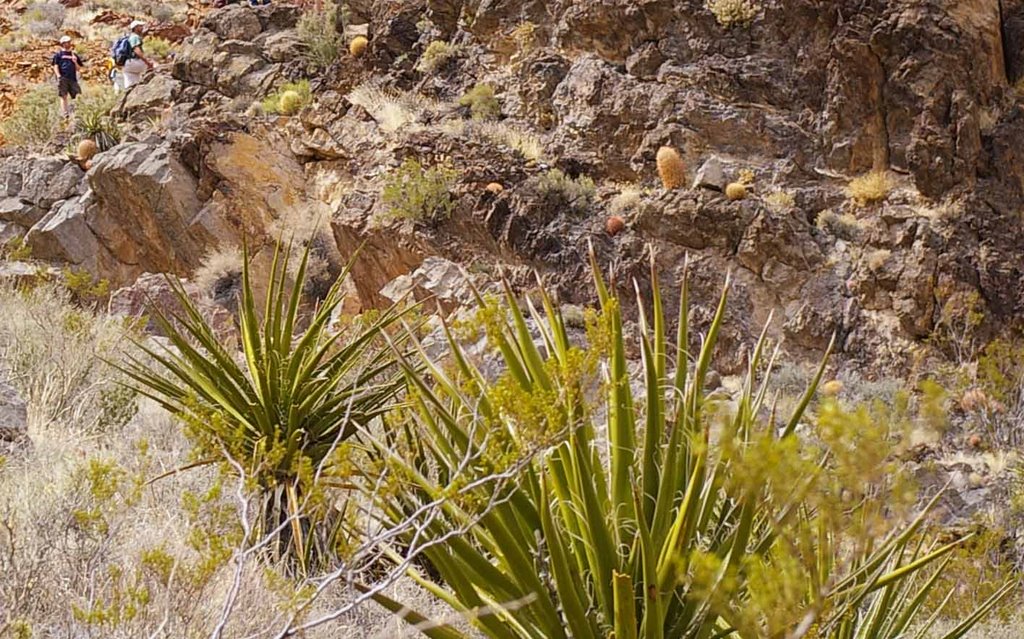
These are your pants after you fall into some.

Any questions?
30 March 2006
Prayer and the Military
Some of our more self-righteous congresscritters have been making to have the president sign an executive order guaranteeing evangelical Christian military chaplains the right to pray in Jesus' name. To their credit, the organization that represents the majority of military chaplains has come out against this move.
Here's the bottom line:
Military chaplains pray in two different types of circumstance. They pray when they are conducting religious services for people who share their beliefs, and they pray in circumstances when people who do not share their beliefs are required to be present. Nobody is questioning the right of chaplains to pray as they wish when they are conducting the services appropriate to their own denomination. However, when praying in a situation when people from other religious traditions are present, it is entirely inappropriate for a chaplain to deliver anything but a non-denominational prayer.
The executive director of an organization that represents some evangelical chaplains and is pushing for the executive order is quoted in the Washington Post article linked above:
Any chaplain that cannot be sensitive to the differing beliefs of others in their unit is simply unfit for the needs of the military, and should be discharged.
Here's the bottom line:
Military chaplains pray in two different types of circumstance. They pray when they are conducting religious services for people who share their beliefs, and they pray in circumstances when people who do not share their beliefs are required to be present. Nobody is questioning the right of chaplains to pray as they wish when they are conducting the services appropriate to their own denomination. However, when praying in a situation when people from other religious traditions are present, it is entirely inappropriate for a chaplain to deliver anything but a non-denominational prayer.
The executive director of an organization that represents some evangelical chaplains and is pushing for the executive order is quoted in the Washington Post article linked above:
But Baugham said evangelical chaplains must represent the church that endorses them for military duty, and "they are not authorized to give nonsectarian prayers."That position is extrordinarily odd, particularly coming from a group that endorses chaplains for military duty. According to this army website, a chaplain's endorsement from their faith group should certify that the candidate is, among other things, "Sensitive to religious pluralism and able to provide for the free exercise of religion by all military personnel, their family members and civilians who work for the Army."
Any chaplain that cannot be sensitive to the differing beliefs of others in their unit is simply unfit for the needs of the military, and should be discharged.
25 March 2006
Fieldwork 1: Packing
Preparation is absolutely essential to doing good fieldwork. Some of the preparation includes obvious tasks like figuring out where you are going to go, why you are going there, and how you are going to spend your time when you get there. Figuring out how you are getting there is usually a good idea, too, as is making sure that you have any and all paperwork that you will need. That's often a bit harder for scientists, becuase there are frequently extra permits and permissions to be obtained. There's also the matter of setting up your schedule once you get on site. Time is precious, and it's common to have to budget time tightly to make sure everything gets done.
Let's put it this way: fieldwork doesn't often happen on a moment's notice. When it does, it's usually because something extrordinary has happened somewhere in the world, creating a research opportunity that might not be available for long. (Most people refer to these as 'natural disasters'.)
It's also important to make sure that the logistics for the trip are lined up ahead of time. Food and shelter come under this category, of course, but I'm mostly talking about gear. You need stuff to do science, and there's nothing worse than finding out that you aren't going to be able to get all the data you need because you forgot to bring something important. That's why you'll find scientists (like me) who would ordinarily pack for a two-week vacation without using a list putting together detailed packing checklists for fieldwork. Putting together the checklist is usually followed by staring at it for a while to make sure you haven't forgotten anything, packing it all, unpacking it to make sure you haven't forgotten something, re-packing it, and wondering what you've forgotten.
Anyone want to take bets on what I'll forget?
Let's put it this way: fieldwork doesn't often happen on a moment's notice. When it does, it's usually because something extrordinary has happened somewhere in the world, creating a research opportunity that might not be available for long. (Most people refer to these as 'natural disasters'.)
It's also important to make sure that the logistics for the trip are lined up ahead of time. Food and shelter come under this category, of course, but I'm mostly talking about gear. You need stuff to do science, and there's nothing worse than finding out that you aren't going to be able to get all the data you need because you forgot to bring something important. That's why you'll find scientists (like me) who would ordinarily pack for a two-week vacation without using a list putting together detailed packing checklists for fieldwork. Putting together the checklist is usually followed by staring at it for a while to make sure you haven't forgotten anything, packing it all, unpacking it to make sure you haven't forgotten something, re-packing it, and wondering what you've forgotten.
Anyone want to take bets on what I'll forget?
Into the field
I've been trapped in the lab for the last few months, but that's about to change. I'm heading out into the field tomorrow morning, on a short trip to the Death Valley, California area.
The fieldwork I'm going to be doing isn't really related to my own research, but I'll take what I can get. Actually, it will be nice, because I'm going to be getting back to my roots. Back when I was first getting into science, I started out intending to be a paleontologist. Evolution interested me, and I was very interested in broad-scale, macroevolutionary events. But somewhere along the way I was seduced by the Dark Side, and was overcome by the lure of molecular techniques.
This week, I get to be a paleontologist again. A group of six grad students and two professors at UH, including myself, are working on a review paper. The topic of the review is the origins of animal life, and we thought it would be a good idea to get to get more familiar with the field. We're heading to Death Valley because it's a site that has some nice places to see the evidence for Precambrian animal life.
We'll be staying just south of the National Park, in a little town with a population of about 80. I've got a hunch that internet access will be a little hard to come by, so I probably won't be able to post too much before I get back on Thursday.
The fieldwork I'm going to be doing isn't really related to my own research, but I'll take what I can get. Actually, it will be nice, because I'm going to be getting back to my roots. Back when I was first getting into science, I started out intending to be a paleontologist. Evolution interested me, and I was very interested in broad-scale, macroevolutionary events. But somewhere along the way I was seduced by the Dark Side, and was overcome by the lure of molecular techniques.
This week, I get to be a paleontologist again. A group of six grad students and two professors at UH, including myself, are working on a review paper. The topic of the review is the origins of animal life, and we thought it would be a good idea to get to get more familiar with the field. We're heading to Death Valley because it's a site that has some nice places to see the evidence for Precambrian animal life.
We'll be staying just south of the National Park, in a little town with a population of about 80. I've got a hunch that internet access will be a little hard to come by, so I probably won't be able to post too much before I get back on Thursday.
24 March 2006
Friday Random Ten
The Friday Random Ten is a blog meme of uncertain origins that's been around for years. I keep meaning to do one, and every week (until now) I forget.
Directions: Fire up the iPod, set to shuffle songs, hit play. List the first ten songs that come up. Don't cheat.
This week, my iPod seems to be a bit more random than usual.
1: Louis Armstrong and Duke Ellington
It Don't Mean A Thing if it Ain't Got that Swing
2: The Clash
Should I Stay or Should I Go Now
3: Pearl Jam and Neil Young
Rockin' In the Free World
4: Pete Seeger
The Erie Canal
5: Sean Na'auao
Fish and Poi
6: U2
Pride (In the Name of Love)
7: The Who
Baba O'Riley
8: Black 47
Living in America
9: Buffalo Springfield
For What It's Worth
10: The Muppets
The Muppet Show Theme
Directions: Fire up the iPod, set to shuffle songs, hit play. List the first ten songs that come up. Don't cheat.
This week, my iPod seems to be a bit more random than usual.
1: Louis Armstrong and Duke Ellington
It Don't Mean A Thing if it Ain't Got that Swing
2: The Clash
Should I Stay or Should I Go Now
3: Pearl Jam and Neil Young
Rockin' In the Free World
4: Pete Seeger
The Erie Canal
5: Sean Na'auao
Fish and Poi
6: U2
Pride (In the Name of Love)
7: The Who
Baba O'Riley
8: Black 47
Living in America
9: Buffalo Springfield
For What It's Worth
10: The Muppets
The Muppet Show Theme
22 March 2006
Last Night
Somewhere around two this morning, I had to get up to take care of one of a father's most important duties: monster patrol.
I've done it before, but this time was different. For starters, it was both kids who woke me up. Usually it's just one. Second, the monster was hiding somewhere different. Usually, it's under the bed or in one of the bedroom closets. This time, for some strange reason, it seemed to be in the bathroom. That's what I could gather from the kids, anyway. When they're under the blankets, it can be hard to understand everything.
I wasn't really that surprised. We were having a hell of a thunderstorm last night, and I figured that was probably the cause. In the probably futile hope of reclaiming my bed from the kids, I dragged myself out of bed and staggered out to take a look at the bathroom.
Damn near pissed myself when I got there. There was this really freaky sound coming out of the bedroom. It's almost impossible to describe - it was sort of like a whimper, but with this strange echo effect, and something that sounded sort of like heavy breathing going on, too. I wasn't sure what it was, but it probably wasn't the pipes.
After taking a minute to recover, I mustered up my courage, turned on the lights, and lunged into the bathroom. And found the dog.
It turns out that the thunderphobic canine, banished from the master bedroom, had taken refuge, whimpering and panting, in the bathtub.
I've done it before, but this time was different. For starters, it was both kids who woke me up. Usually it's just one. Second, the monster was hiding somewhere different. Usually, it's under the bed or in one of the bedroom closets. This time, for some strange reason, it seemed to be in the bathroom. That's what I could gather from the kids, anyway. When they're under the blankets, it can be hard to understand everything.
I wasn't really that surprised. We were having a hell of a thunderstorm last night, and I figured that was probably the cause. In the probably futile hope of reclaiming my bed from the kids, I dragged myself out of bed and staggered out to take a look at the bathroom.
Damn near pissed myself when I got there. There was this really freaky sound coming out of the bedroom. It's almost impossible to describe - it was sort of like a whimper, but with this strange echo effect, and something that sounded sort of like heavy breathing going on, too. I wasn't sure what it was, but it probably wasn't the pipes.
After taking a minute to recover, I mustered up my courage, turned on the lights, and lunged into the bathroom. And found the dog.
It turns out that the thunderphobic canine, banished from the master bedroom, had taken refuge, whimpering and panting, in the bathtub.
21 March 2006
If we can keep it.
As Ben Franklin left Independence Hall during the final day of deliberations during the Constitutional Convention, a woman is reported to have stopped him and asked:
The problem here, as in way too many other areas of American life, probably rests with the godawful state of our educational system. Far too many Americans seem to hold the mistaken view that we live in a democracy, and that the majority should be able to impose its will on the minority.
For example:
We don't live in a democracy. We live in a republic. We live in a republic because many of the drafters of the Constitution were at least as afraid of democracy as they were of monarchy:
I'm sorry to rant for so long on this, but it's important. The narrow-minded bigots who advocate for those kinds of "Christian Nation" and "if you don't like it, move" positions are attacking our fundamental values. They are trying to remake the country in their own twisted image, and they are trying to remake it as something far different from the Republic that the signers of the Constitution worked so hard and risked so much to establish.
Unfortunately, it really seems like those ignorant, jingoistic fools are becoming more common. At a minimum, they're becoming more vocal, and in our modern media world that can sometimes amount to the same thing. Franklin was right - we have a republic only as long as we can keep it.
We're going to need to work at that, I'm afraid. That's why groups, like the ACLU, that are willing to stand up for the rights of the minority are so critical right now. They provide a voice to people who are willing to fight the majority to protect their rights. Without them, it would be much, much easier for the majority to act like a tyrant.
“Well, Doctor, what have we got—a Republic or a Monarchy?”Franklin responded:
"A Republic, if you can keep it."If we can keep it. There's the rub. Somehow, it seems like that just keeps getting harder to do.
The problem here, as in way too many other areas of American life, probably rests with the godawful state of our educational system. Far too many Americans seem to hold the mistaken view that we live in a democracy, and that the majority should be able to impose its will on the minority.
For example:
Who cares if there’s a “sizeable Mormon community”. They don’t have to sing Christmas songs if they don’t want to or they can ask that traditional Mormon pieces be added. This is America and Christmas along with Christmas carols are a longstanding tradition of a vast majority. Christmas is a national holiday and tragic as it is for the loony left it hasn’t been renamed Winter Solstice Celebration yet. Anyone that doesn’t like that is welcome to move to a country where they don’t celebrate Christmas. I’ll help them pack and pay for a one-way ticket on a banana boat out of here.Here's another example, from a resolution currently on the floor in the Missouri State Legislature:
Now, therefore, be it resolved by the members of the House of Representatives of the Ninety-third General Assembly, Second Regular Session, the Senate concurring therein, that we stand with the majority of our constituents and exercise the common sense that voluntary prayer in public schools and religious displays on public property are not a coalition of church and state, but rather the justified recognition of the positive role that Christianity has played in this great nation of ours, the United States of America.Way, way too many people, apparently including some legislators, just don't seem to understand why we have the system of government that we do.
We don't live in a democracy. We live in a republic. We live in a republic because many of the drafters of the Constitution were at least as afraid of democracy as they were of monarchy:
From this view of the subject it may be concluded that a pure democracy, by which I mean a society consisting of a small number of citizens, who assemble and administer the government in person, can admit of no cure for the mischiefs of faction. A common passion or interest will, in almost every case, be felt by a majority of the whole; a communication and concert result from the form of government itself; and there is nothing to check the inducements to sacrifice the weaker party or an obnoxious individual. Hence it is that such democracies have ever been spectacles of turbulence and contention; have ever been found incompatible with personal security or the rights of property; and have in general been as short in their lives as they have been violent in their deaths.The Constitution was very intelligently designed to set up a system of government that protects the rights of the minority from the tyrany of the majority. That's why changing the Constitution is such a difficult process. It's not supposed to be something that the majority can do anytime they want. If it was otherwise, we would live in a very, very scary place - a place where the rights of the minority could be revoked by the majority at any time, for any reason.
James Madison, Federalist #10.
I'm sorry to rant for so long on this, but it's important. The narrow-minded bigots who advocate for those kinds of "Christian Nation" and "if you don't like it, move" positions are attacking our fundamental values. They are trying to remake the country in their own twisted image, and they are trying to remake it as something far different from the Republic that the signers of the Constitution worked so hard and risked so much to establish.
Unfortunately, it really seems like those ignorant, jingoistic fools are becoming more common. At a minimum, they're becoming more vocal, and in our modern media world that can sometimes amount to the same thing. Franklin was right - we have a republic only as long as we can keep it.
We're going to need to work at that, I'm afraid. That's why groups, like the ACLU, that are willing to stand up for the rights of the minority are so critical right now. They provide a voice to people who are willing to fight the majority to protect their rights. Without them, it would be much, much easier for the majority to act like a tyrant.
Last Throws
It would seem that our vice-president's grasp on reality is about as good as his marksmanship. On Sunday, he did Face the Nation. During the interview, the following exchange took place:
I caught that on the air when it happened. One of my neighbors was there, too. I think he probably put it best when he said, "if you believe everything they say in Washington, the insurgents have had more last throes than a nymphomaniac in a frat house."
SCHIEFFER: Mr. Vice President, all along the government has been very optimistic. You remain optimistic. But I remember when you were saying we'd be greeted as liberators, you played down the insurgency 10 months ago. You said it was in its last throes. Do you believe that these optimistic statements may be one of the reasons that people seem to be more skeptical in this country about whether we ought to be in Iraq?That's right, he really said that his ten-month old claim that the insurgency is in its "last throes", and other similar claims, were "basically accurate and reflect reality".
CHENEY: No. I think it has less to do with the statements we've made, which I think were basically accurate and reflect reality, than it does with the fact that there's a constant sort of perception, if you will, that's created because what's newsworthy is the car bomb in Baghdad. It's not all the work that went on that day in 15 other provinces in terms of making progress towards rebuilding Iraq
I caught that on the air when it happened. One of my neighbors was there, too. I think he probably put it best when he said, "if you believe everything they say in Washington, the insurgents have had more last throes than a nymphomaniac in a frat house."
15 March 2006
Plantinga, Intelligent Design, and Uninformed Opinions
One of the better posts mentioned in yesterday's Tangled Bank can be found over at Adventures in Science and Ethics. In that article, Janet provides a clear and detailed explanation of the limits of scientific expertise. As she reminds us, scientists are not near-omniscient beings, endowed with some sort of infailable ability to assess ideas across all the fields of scientific research. Scientists are primarily qualified to comment on matters within their own field. If a scientist is not an expert in an area of science, he or she should give the scientists within the other field the benefit of the doubt, and assume that they have a better understanding of their own area. As Janet points out, scientists (and other adademics) should be responsible enough to know their own limitations.
This sense of responsibility seems to be somewhat lacking among some of the more prominant proponents of Intelligent Design. It's shown up in any number of places, including a recent article by well-known philosopher Alvin Plantinga.
Plantinga pontificates at length on Judge Jones' ruling in the recent Kitzmiller v. Dover Intelligent Design lawsuit, but his rant seems to be entirely disconnected from the actual facts of the case - or, for that matter, any real understanding of what the ID proponents actually advocate.
The monumental depth of Plantinga's ignorance becomes clear fairly early on in the paper, when he discusses the Intelligent Design view of evolution:
The problem for Plantinga's argument comes when one moves from the undefined principles of an idealized "Intelligent Design as such" to those of Intelligent Design, as outlined in the various "resources" provided to the Dover High School students. A quick look at the "textbook" at the center of the case is all it takes to see that Plantinga's position does not hold up well when evaluated using reality-based criteria:
It seems clear to me that Plantinga is talking about some form of Intelligent Design that exists only in the realm of the ideal. Here, on Earth, we are dealing with a different form of Intelligent Design. The form of Intelligent Design that we are coping with doesn't have much to do with working on developing new scientific knowledge in the future. Instead, it is about what some people want to teach in the secondary school classroom right now.
Plantinga might have been able to see this if he had taken the time to look at what ID proponents do, rather than just what they say.
This sense of responsibility seems to be somewhat lacking among some of the more prominant proponents of Intelligent Design. It's shown up in any number of places, including a recent article by well-known philosopher Alvin Plantinga.
Plantinga pontificates at length on Judge Jones' ruling in the recent Kitzmiller v. Dover Intelligent Design lawsuit, but his rant seems to be entirely disconnected from the actual facts of the case - or, for that matter, any real understanding of what the ID proponents actually advocate.
The monumental depth of Plantinga's ignorance becomes clear fairly early on in the paper, when he discusses the Intelligent Design view of evolution:
Consider, for example, the claim that ID is just creation science in drag, as it were. That ruling is relevant in that previous court decisions have gone against creation science. But the kind of creation science those decisions had gone against is characterized by the claim that the world is a mere 6,000 to 100,000 years old, rather than the currently favored age of 4 billion or so years old.It is possible that Plantinga is correct here, since it is notoriously difficult to determine what ID, "as such," actually involves for any particular aspect of science. (That's the inevitable side effect of having a "theory" that entails no positively testable hypotheses.)
Second, those creationists reject evolution in favor of the idea that the major kinds of plants and animals were created in pretty much their present form. ID, as such, doesn’t involve either of these two things
The problem for Plantinga's argument comes when one moves from the undefined principles of an idealized "Intelligent Design as such" to those of Intelligent Design, as outlined in the various "resources" provided to the Dover High School students. A quick look at the "textbook" at the center of the case is all it takes to see that Plantinga's position does not hold up well when evaluated using reality-based criteria:
"Intelligent design means that various forms of life began abruptly through an intelligent agency with their distinctive features already intact. Fish with fins and scales, birds with feathers, beaks, and wings..."That may not reflect Plantinga's view of Intelligent Design, but it clearly involves the idea that the major kinds of animal were created in more or less their current forms, and it clearly links that concept with the definition of Intelligent Design. It's also a view that the Discovery Institute doesn't seem to have too much of a problem with - they've called the book that it appears in "an excellent educational resource."
(Of Pandas and People, quoted in Forrest trial testimony)
It seems clear to me that Plantinga is talking about some form of Intelligent Design that exists only in the realm of the ideal. Here, on Earth, we are dealing with a different form of Intelligent Design. The form of Intelligent Design that we are coping with doesn't have much to do with working on developing new scientific knowledge in the future. Instead, it is about what some people want to teach in the secondary school classroom right now.
Plantinga might have been able to see this if he had taken the time to look at what ID proponents do, rather than just what they say.
Tangled Bank #49
Tangled Bank #49 is now available over at Living the Scientific Life. Tangled Bank is almost always very good, and this one is better than most. It's laid out better than most, and there are a number of extrordinarily good submissions.
14 March 2006
For the love of God, stand up for something
Yet again, the Democrats in congress are doing their best to dodge an issue. What a bloody shock. This time, the issue is Senator Russell Feingold's recent motion to censure the president for operating an illegal wiretapping program.
The Republicans, secure in their knowledge that their majority is sufficient (at the moment) to defeat any such motion, called for an immediate vote on the motion. The Democratic Leadership, proving yet again that they are incapable of demonstrating the leadership or moral courage needed to do light a match in a dark cave without first conducting extensive polling on the issue, are acting to postpone any vote for the moment. Essentially, they're filabustering Feingold's motion. The excuse for this inaction, as provided by Harry Reid, is that the motion deserves more thought and consideration.
Yeah, right. There are lots of things out there that deserve more thought and consideration. This really isn't one of them. What the president did is somewhat, but not entirely, known. Congress has attempted, somewhat pathetically, to extract more information. The administration semi-politely told them where they could stick their request. No further action has been taken, and no further action appears to be forthcoming.
Legal scholars have weighed in all over the place on the president's justification ("I'm a wartime leader.") for the program. Either you buy his argument or you don't. If you do, you don't think he did anything illegal. If you don't, you think he did soemthing illegal. If he did something illegal, he should be censured. If he didn't, he shouldn't. If you haven't figured out where you stand on this one by now, you haven't been paying attention.
What the Democratic delay tactics are all about is not taking a stand. They don't want to risk pissing off their base by going on record against censure, and they don't want to risk pissing anyone else off by (heaven forbid) going on record for censure. So, yet again, we find the Democratic leadership standing around trying to figure out which way the train's going - presumably so that they can jump in front and get run over again.
For crying out loud, why can't they take a stand. At this point, I'd settle for almost any kind of stand. OK, it's nice that they aren't the Republicans, but it would be even nicer if they were something more than the "not-Republican Party". The country is in deaparate need for leadership, and right now it doesn't look like anyone's willing to step up.
The Republicans, secure in their knowledge that their majority is sufficient (at the moment) to defeat any such motion, called for an immediate vote on the motion. The Democratic Leadership, proving yet again that they are incapable of demonstrating the leadership or moral courage needed to do light a match in a dark cave without first conducting extensive polling on the issue, are acting to postpone any vote for the moment. Essentially, they're filabustering Feingold's motion. The excuse for this inaction, as provided by Harry Reid, is that the motion deserves more thought and consideration.
Yeah, right. There are lots of things out there that deserve more thought and consideration. This really isn't one of them. What the president did is somewhat, but not entirely, known. Congress has attempted, somewhat pathetically, to extract more information. The administration semi-politely told them where they could stick their request. No further action has been taken, and no further action appears to be forthcoming.
Legal scholars have weighed in all over the place on the president's justification ("I'm a wartime leader.") for the program. Either you buy his argument or you don't. If you do, you don't think he did anything illegal. If you don't, you think he did soemthing illegal. If he did something illegal, he should be censured. If he didn't, he shouldn't. If you haven't figured out where you stand on this one by now, you haven't been paying attention.
What the Democratic delay tactics are all about is not taking a stand. They don't want to risk pissing off their base by going on record against censure, and they don't want to risk pissing anyone else off by (heaven forbid) going on record for censure. So, yet again, we find the Democratic leadership standing around trying to figure out which way the train's going - presumably so that they can jump in front and get run over again.
For crying out loud, why can't they take a stand. At this point, I'd settle for almost any kind of stand. OK, it's nice that they aren't the Republicans, but it would be even nicer if they were something more than the "not-Republican Party". The country is in deaparate need for leadership, and right now it doesn't look like anyone's willing to step up.
10 March 2006
Yes, I'm slacking off on blogging again.
There's nothing like two or three nights of checking the base calls from the sequencer by eye for sucking the will to live (and all other motivation) clean out of your system. I'll be done in another day or two - for these two loci.
In the mean time, I'd like to wish a belated happy birthday to PZ. (Your dried squid is in the mail.)
If you're looking for something else to read right now, go take a look at a nice rant over on Evil Monkey's blog - it does a fantastic job at capturing modern science.
In the mean time, I'd like to wish a belated happy birthday to PZ. (Your dried squid is in the mail.)
If you're looking for something else to read right now, go take a look at a nice rant over on Evil Monkey's blog - it does a fantastic job at capturing modern science.
06 March 2006
Applications of Evolution - More on the gall wasp
A while back I put up a couple of posts about an invasive gall wasp that's threatening a species of tree unique to Hawaii.
In the first of those posts, I made a few predictions, based on my understanding of ecology and evolution, on how researchers might be able to control the gall wasp infestation:
They found it in Tanzania.
An update in today's Honolulu Advertiser reports that a state entomologist spent two months in Tanzania earlier this year, and discovered a species of wasp that feeds on the larvae of the species of wasp that's killing the trees. He went to Tanzania, it appears, because he was a good bit more careful with his preliminary research than I was when I wrote the initial article:
The wasp has been tested against the invasive, and appears to be effective. They are now testing it for side effects (they want to make sure it won't kill things that it shouldn't). Those tests will probably take at least a year, but it looks like there may still be some hope for the Wiliwili.
In the first of those posts, I made a few predictions, based on my understanding of ecology and evolution, on how researchers might be able to control the gall wasp infestation:
Ultimately, however, it may be impossible to save the Wiliwili without some sort of biological control. So let's assume that a decision is made to look for one. Normally, we would look to the species' native habitat to find a parasite or predator. Unfortunately, we don't actually know what the native range of this species actually is. It was only described for the first time last year, and it seems to be an invasive in all of the places that it has been found. The world is a really big place, and we have a limited amount of time until the Wiliwili follows countless other Hawaiian species into extinction. So where do we start to look?I'm a big believer in scientific integrity, and I believe that scientific integrity includes reporting negative results and incorrect or falsified hypotheses. With that in mind, I find that I must take this opportunity to admit that part of my hypothesis was not, in fact, entirely accurate. Researchers have not found a parisite or predator that targets these wasps in South Africa.
Africa. Since this species hasn't been described from there at all yet, what makes us think that we should look there?
Evolution.
There are a number of related species of gall wasp in South Africa, including some that utilize Erythrina trees. There are also Erythrina trees that are native to this area. As I understand it from conversations with other grad students here, these trees do not appear to be experiencing the same sort of massive infestation that is being seen here in Hawaii. This indicates that one of two things is happening there. Either the South African Erythrina have an innate defence mechanism protecting them from the gall wasps (this is unlikely, as the gall wasps can and do breed using these trees) or there is something else, most likely a predator or parasite, keeping their population in check. This is the type of more stable ecological relationship that we expect to see in areas where the species evolved.
I don't know whether or not sufficient funding will be found to do this, but I predict that a thorough study of the gall wasps in South Africa will turn up a predator and/or parasite capable of controlling the gall wasp population. (Or that the Erythrina trees have a defence mechanism protecting them from gall wasps.) I also predict that, again pending sufficient funding, that molecular studies will show that the wasps invading Hawaii are relatively closely related to species from South Africa.
They found it in Tanzania.
An update in today's Honolulu Advertiser reports that a state entomologist spent two months in Tanzania earlier this year, and discovered a species of wasp that feeds on the larvae of the species of wasp that's killing the trees. He went to Tanzania, it appears, because he was a good bit more careful with his preliminary research than I was when I wrote the initial article:
Ramadan, a 54-year-old native of Egypt who has been working for the state agriculture department since 1997, studied the situation and recommended searching for a natural enemy in Tanzania because the country, which borders the Indian Ocean, has more than 15 Erythrina species.Aside from that, the reasoning behind the approach was essentially what I outlined above. He went to look for wasps in an area where the wasps and trees were believed to co-exist. What he found was encouraging. He brought back a species of wasp that seems to successfully eliminate about 95% of the larvae of the tree-killing wasps.
The wasp has been tested against the invasive, and appears to be effective. They are now testing it for side effects (they want to make sure it won't kill things that it shouldn't). Those tests will probably take at least a year, but it looks like there may still be some hope for the Wiliwili.
01 March 2006
Blonde Equilibrium
I was originally planning to hold off on starting a series of posts on the genetics of evolution until next week, but John Wilkins recently found a myth that's just too good to ignore.
According to this legend, a World Health Organization study conducted a few years ago revealed that the natural blonde is scheduled to become extinct by the year 2202. The reason given for the imminent demise of the unperoxided flaxen haired is that blonde hair is caused by a recessive gene, and too few people now carry that gene. Since two people who carry the gene must meet (and do certain other things) in order to produce a blonde, the number of blondes is decreasing.
The myth is in fact just that - a myth. It was a wildly successful hoax carried out by someone pretending to be on the WHO staff. They were able to get a large number of media outlets to bite, and the story received international attention when it was first released. Despite a World Health Organization 'clarification', it would appear that some media outlets still haven't quite figured out what's going on.
Still...
The looming extinction of the natural blonde is a legend that's probably going to stick around for a while, for a couple of reasons. For starters, there's a certain ironic appeal to having the blonde meet the fate of the dodo. More importantly, though, the scenario sounds plausible enough. There do seem to be more dark haired people around than there used to, and if natural blonde's aren't meeting and mating as much as they used to, then why shouldn't we expect the blonde to go extinct?
That's a classic population genetics question if there ever was one, and it's one that I'll be looking at in this post (and, hopefully, in a few follow-ups). There are a few different ways to look at the question. We'll start with the easiest, but there is a little bit of vocabulary to get out of the way first.
It's just two terms, but they are important words in genetics. The first is "locus" (plural: "loci"). You can think of a locus as a single gene. (To be a little more specific, a locus is a specific location at a chromosome.) The second is "allele". An allele is one possible version of a gene. Since humans have two copies of each chromosome (one from each parent), we can have either two identical alleles or two different alleles at any locus.
Now back to the blondes.
The question of whether or not the blonde hair allele will disappear from the human species can actually be treated as the simplest situation in all of genetics: it's called a one-locus, two-allele model. This means that the trait (in this case, hair color) is controlled by a single gene, and there are only two variations of the gene in the population. In the case of human hair color, it's not really that simple, but because blonde hair is a recessive trait, we can get away with pretending that it is. We'll just call the dominant allele "not blonde" (and we'll represent it with 'B') and the recessive allele "blonde" ('b'). It's simpler to do it that way, and the math comes out the same.
Let's assume that 1% of humans are natural blondes. That means that they carry two copies of the 'b' allele. If we assume that people don't choose who they marry based on natural hair color, we can use this to figure out how common the 'b' allele is in the population. The equation for that is easy. If 'b' is the probability of picking a random allele from the populaiton and finding that it is a 'b', then the percentage of people with two 'b' alleles will equal b*b. We know that b*b = .01 (or 1%), so b must equal 0.1.
To put it another way, if one percent of the people are blonde, then ten percent of the alleles are the blonde allele. (Which means that 90%, or 0.9) of the alleles are the 'B' allele.
That's the case in the first generation, but what happens in the next one? That's the key question. If the next generation has a smaller percentage of blonde alleles, then blondes may be on the way out. So how do we find out what's going to happen next?
It turns out that there is a famous genetic principle that provides the answer to that pressing question. It's called Hardy-Weinberg equilibrium, and it says that, given certain assumptions (which we will discuss later), then the allele frequencies won't change. 10% of the alleles in the next generation will still be 'b' alleles. There's a famous equation that goes with that, but it's got exponents and other annoying mathy things, so I'll skip it for now. If you don't want to trust me, you can always google it.
The assumptions are where things get a little tricky. For Hardy-Weinberg to work, a number of conditions must be met. The population must be very large, there can't be migration into or out of the population, there can't be mutation, and there can't be any form of selection going on. It's clear that there will be few cases where this is true, but there are lots of cases where it comes close.
The blonde gene, if we consider the entire human race, is one of them. The mutation rate for the gene is going to be so low we can ignore it, the population is very large, and if we are talking about the whole planet, there's not a lot of migration to worry about. Selection is a possibility, of course, but peroxide's taken that one out of the equation.
Since the Hardy-Weinberg conditions are met on a global level, we can safely say that the frequency of the "blonde allele" isn't going to change in the species as a whole. That means that blondes won't ever go entirely extinct.
That takes care of the gene that causes blondeness. But what about the number of blondes? Will that change? Actually, it might - in fact, it's likely to drop. That's becuase of ethnic differences and our increasingly international society, and it's what I'll talk about when I write the next post in the series.
According to this legend, a World Health Organization study conducted a few years ago revealed that the natural blonde is scheduled to become extinct by the year 2202. The reason given for the imminent demise of the unperoxided flaxen haired is that blonde hair is caused by a recessive gene, and too few people now carry that gene. Since two people who carry the gene must meet (and do certain other things) in order to produce a blonde, the number of blondes is decreasing.
The myth is in fact just that - a myth. It was a wildly successful hoax carried out by someone pretending to be on the WHO staff. They were able to get a large number of media outlets to bite, and the story received international attention when it was first released. Despite a World Health Organization 'clarification', it would appear that some media outlets still haven't quite figured out what's going on.
Still...
The looming extinction of the natural blonde is a legend that's probably going to stick around for a while, for a couple of reasons. For starters, there's a certain ironic appeal to having the blonde meet the fate of the dodo. More importantly, though, the scenario sounds plausible enough. There do seem to be more dark haired people around than there used to, and if natural blonde's aren't meeting and mating as much as they used to, then why shouldn't we expect the blonde to go extinct?
That's a classic population genetics question if there ever was one, and it's one that I'll be looking at in this post (and, hopefully, in a few follow-ups). There are a few different ways to look at the question. We'll start with the easiest, but there is a little bit of vocabulary to get out of the way first.
It's just two terms, but they are important words in genetics. The first is "locus" (plural: "loci"). You can think of a locus as a single gene. (To be a little more specific, a locus is a specific location at a chromosome.) The second is "allele". An allele is one possible version of a gene. Since humans have two copies of each chromosome (one from each parent), we can have either two identical alleles or two different alleles at any locus.
Now back to the blondes.
The question of whether or not the blonde hair allele will disappear from the human species can actually be treated as the simplest situation in all of genetics: it's called a one-locus, two-allele model. This means that the trait (in this case, hair color) is controlled by a single gene, and there are only two variations of the gene in the population. In the case of human hair color, it's not really that simple, but because blonde hair is a recessive trait, we can get away with pretending that it is. We'll just call the dominant allele "not blonde" (and we'll represent it with 'B') and the recessive allele "blonde" ('b'). It's simpler to do it that way, and the math comes out the same.
Let's assume that 1% of humans are natural blondes. That means that they carry two copies of the 'b' allele. If we assume that people don't choose who they marry based on natural hair color, we can use this to figure out how common the 'b' allele is in the population. The equation for that is easy. If 'b' is the probability of picking a random allele from the populaiton and finding that it is a 'b', then the percentage of people with two 'b' alleles will equal b*b. We know that b*b = .01 (or 1%), so b must equal 0.1.
To put it another way, if one percent of the people are blonde, then ten percent of the alleles are the blonde allele. (Which means that 90%, or 0.9) of the alleles are the 'B' allele.
That's the case in the first generation, but what happens in the next one? That's the key question. If the next generation has a smaller percentage of blonde alleles, then blondes may be on the way out. So how do we find out what's going to happen next?
It turns out that there is a famous genetic principle that provides the answer to that pressing question. It's called Hardy-Weinberg equilibrium, and it says that, given certain assumptions (which we will discuss later), then the allele frequencies won't change. 10% of the alleles in the next generation will still be 'b' alleles. There's a famous equation that goes with that, but it's got exponents and other annoying mathy things, so I'll skip it for now. If you don't want to trust me, you can always google it.
The assumptions are where things get a little tricky. For Hardy-Weinberg to work, a number of conditions must be met. The population must be very large, there can't be migration into or out of the population, there can't be mutation, and there can't be any form of selection going on. It's clear that there will be few cases where this is true, but there are lots of cases where it comes close.
The blonde gene, if we consider the entire human race, is one of them. The mutation rate for the gene is going to be so low we can ignore it, the population is very large, and if we are talking about the whole planet, there's not a lot of migration to worry about. Selection is a possibility, of course, but peroxide's taken that one out of the equation.
Since the Hardy-Weinberg conditions are met on a global level, we can safely say that the frequency of the "blonde allele" isn't going to change in the species as a whole. That means that blondes won't ever go entirely extinct.
That takes care of the gene that causes blondeness. But what about the number of blondes? Will that change? Actually, it might - in fact, it's likely to drop. That's becuase of ethnic differences and our increasingly international society, and it's what I'll talk about when I write the next post in the series.
28 February 2006
Grading papers
"Don't worry, they're going into medicine."
-Grad student in my lab, looking at the lab reports I was grading.
I just finished grading this week's batch of lab reports for the 400-level animal physiology class I'm TAing. I'd like to share a few of the better little oopsies committed by the students this time:
"the heart recovery rat"
"has been use din the past"
"as needed overtime"
"The student with the least amount of excercise a week was tide with"
"two data were collected during this experiment"
"fitness is an important indicator of mortality"
"Fourteen individuals (six males, nine females)"
27 February 2006
Evolutionary Genetics - Introduction
[A] curious aspect of the theory of evolution is that everybody thinks he understands it.
-Jacques Monod
I enjoy my job. I love getting out into the field to do research. I love studying populations of organisms. I think that the questions that I look at are interesting, and that a lot of the answers are pretty cool.
The problem is that it's hard to explain to people exactly what it is that I do. In part, that's because evolution is really a lot more complicated a field than most people realize. The popular view of evolution is more or less that Darwin figured out that species evolve through natural selection, and that's that. People with more background than average in evolution understand that there are other things that come into play, too, like genetic drift.
It is accurate to say that evolution and drift cause species to diverge. In the same sense, it's accurate to say that World War I started because some lunatic Serb blew an Archduke away. In both cases, the explanation only just begins to touch on what is really going on.
I'm still just getting started as far as blogging is concerned, and I'm just getting started in my career as a scientist. I'm probably going to want to talk about my work a lot over the coming years. To make things easier to follow, I'm going to start a series of posts that will outline in as simple terms as I can manage the basics of evolutionary genetics. I'm hoping to make those posts a weekly feature on this blog. The first real post in the series will appear next Monday.
I've got some ideas for topics, but I'm also willing to take suggestions. Feel free to add them to the comments of this post.
24 February 2006
Not a lot this weekend
I've been handed a heavy schedule of spring cleaning for this weekend, so I probably won't have a lot of time available to update this between now and Monday. On Monday, I'll be kicking off a new series of posts on how scientists study evolution.
22 February 2006
Informed Dissent
As many of you have already heard, the Discovery Institute has released its list of scientists who "Dissent from Darwinism." The New York Times decided to look a bit beyond the DI press release, and actually took a look at some of the signers and their motives. Other bloggers, including PZ Myers and Josh Rosenau, have already looked at the NYT article and the list itself. I'm not going to attempt to redo their work. Instead, I'm going to take a look at the DI's response to the New York Times piece.
Predictably, the Discovery Institute's Media Complaints Division is a bit upset about the tone of the article. They tried to make sure that the author of the Times piece received the proper spin before the article came out, but despite their best efforts the article still took a fair look at their list.
One of the things that upset the DI was the article's focus on the signers' disciplines. The Times article pointed out that biologists and biochemists make up a minority of the names on the list (30%, according to the Discovery Institute). The Discovery Institute doesn't think that this is worth considering. From the preemptive strike:
In this case, it comes down to the basis for the opinion. A scientist who is relatively unfamiliar with evolution but who supports it anyway is basically expressing his or her confidence in the scientific process and the scientific community. In the same way, I know little about relativity, but I recognize that the theory of relativity is considered by physicists to be well-supported. I understand the scientific process, and I trust physicists to do their jobs correctly. I do not presume to understand physics better than they do. In cases such as this, the background of the scientists is not all that relevant. What matters is the scientist's understanding of the nature of science and the role of the scientific community, because that is the foundation for the opinion.
A scientists who is dissenting from something in another field is making an entirely different - and much more radical - statement. What that scientist is saying is that he or she does not trust the scientists in the other discipline. Instead, that scientist is directly judging the work done in another field, based on some factor other than trust in the scientific process.
In those cases, the background of the "dissenting scientist" becomes much, much more relevant. We need to know something about the scientist's background in order to figure out how seriously to take that dissent. In particular, we need to know if their position is an informed dissent. We need to know if that scientist has the background needed to be able to independently, fairly, and above all competently assess the science involved.
Predictably, the Discovery Institute's Media Complaints Division is a bit upset about the tone of the article. They tried to make sure that the author of the Times piece received the proper spin before the article came out, but despite their best efforts the article still took a fair look at their list.
One of the things that upset the DI was the article's focus on the signers' disciplines. The Times article pointed out that biologists and biochemists make up a minority of the names on the list (30%, according to the Discovery Institute). The Discovery Institute doesn't think that this is worth considering. From the preemptive strike:
Of course, the list also includes many scientists specializing in chemistry, physics, engineering, mathematics/statistics, and related disciplines. But since Darwinists continually assert that their theory has implications for many other scientific fields, why shouldn't scientists from these other fields have the right to speak out? Moreover, it's remarkably cheeky for Darwinists to claim that only biologists have the right to express views about evolution when many of Darwinism's leading public defenders in America aren't biologists. For example, Lawrence Krauss of Ohio (who the New York Times deems qualified to defend evolution on its op-ed page) is a physicist, not a biologist. And Eugenie Scott, the director of the National Center for Science Education, has a degree in anthropology, not biology. If Chang raises this bogus argument in his article, I hope he also quotes my response.At first glance, that seems to be a reasonable point. Why should it matter if scientists who "dissent" have experience in a relevant field, especially if the discipline of a scientist supporting evolution is irrelevant?
In this case, it comes down to the basis for the opinion. A scientist who is relatively unfamiliar with evolution but who supports it anyway is basically expressing his or her confidence in the scientific process and the scientific community. In the same way, I know little about relativity, but I recognize that the theory of relativity is considered by physicists to be well-supported. I understand the scientific process, and I trust physicists to do their jobs correctly. I do not presume to understand physics better than they do. In cases such as this, the background of the scientists is not all that relevant. What matters is the scientist's understanding of the nature of science and the role of the scientific community, because that is the foundation for the opinion.
A scientists who is dissenting from something in another field is making an entirely different - and much more radical - statement. What that scientist is saying is that he or she does not trust the scientists in the other discipline. Instead, that scientist is directly judging the work done in another field, based on some factor other than trust in the scientific process.
In those cases, the background of the "dissenting scientist" becomes much, much more relevant. We need to know something about the scientist's background in order to figure out how seriously to take that dissent. In particular, we need to know if their position is an informed dissent. We need to know if that scientist has the background needed to be able to independently, fairly, and above all competently assess the science involved.
Long time again
It's been a long weekend for me, and I haven't had much of a chance to blog - as both the people who look at this regularly know. Things have calmed down a bit now, so I should be getting back into the swing of things real soon now.
17 February 2006
Rejoicing in Ignorance
PZ Myers already trashed this incredibly, painfully, dangerously, arrogantly stupid op-ed that appeared in the usually intelligent WaPo. PZ, as always, does a good job of informing this idiot that he is a stinky brown object floating around in the gene pool. Ordinarily, I wouldn't waste much time trying to add to what Myers wrote, but in this case I think there's something that he missed - and Cohen is just too damn stupid for me to resist commenting.
Richard Cohen wrote his article in response to an LA Times report about children dropping out of high school after repeatedly failing algebra. That is a legitimate problem, and it is one that we desparately, desparately need to address as a nation. We need to educate our children. All of them. Not just the ones who can afford to go to a private school, or the ones who are lucky enough to live in a good school district. Schools may be a local responsibility, but this has become a national problem, a national crisis, and it really is in need of a national solution.
Cohen, in his article, proposes a solution that is the intellectual equivalent of fixing an ingrown toenail by amputating the foot. His idea: if people can't pass algebra, don't make them take it.
Arithmatic - the part of math that Cohen claims to be competant at - teaches you how to answer a problem. Algebra teaches you how to set the problem up. It does, Cohen's pathetic assertions notwithstanding, teach you how to reason. In fact, it teaches you how to reason in ways that you really do use in everyday life.
Word problems suck, but you rarely run into anything else in the real world. Some people may be lucky enough that it doesn't matter too much if they miss the answer by a little bit. Cohen may have enough money to pay the landscapers no matter how many are working. Others aren't so lucky. Gabriella may need to figure out how far she can stretch that last 15 bucks.
In fact, the educational disparities in this country make it much more likely that Gabriella will find herself in just that situation. I grew up in the Bronx. We weren't as poor as others in the neighborhood, but we weren't exactly rich - we sat right on that border between working-class and middle-class. When you are coming from that kind of inner-city background, there aren't a lot of ways to do better. A fortunate few might have the athletic or musical skills that can lead to fame and fortune. The military is an option for some, but you need to get through high school before they'll take you - especially if you want training in something high-tech. You might win a lottery jackpot. Or you can get educated.
For most people, education is the only way out of poverty. Education is the only way to get a job that will pay something more than minimum wages. Education is the only viable path to a better life.
That's simple reasoning, but it apparently escapes Cohen. Of course, that's not much of a surprise. After all, he has this to say about reasoning:
I'm not trying to argue that the humanities and social sciences are unimportant, or even that they are less important than math and science. They're all important. They're all part of a good education. They're all things that you need to know if you are going to succeed in our modern society.
Especially if you're not lucky enough to start out ahead.
Richard Cohen wrote his article in response to an LA Times report about children dropping out of high school after repeatedly failing algebra. That is a legitimate problem, and it is one that we desparately, desparately need to address as a nation. We need to educate our children. All of them. Not just the ones who can afford to go to a private school, or the ones who are lucky enough to live in a good school district. Schools may be a local responsibility, but this has become a national problem, a national crisis, and it really is in need of a national solution.
Cohen, in his article, proposes a solution that is the intellectual equivalent of fixing an ingrown toenail by amputating the foot. His idea: if people can't pass algebra, don't make them take it.
Arithmatic - the part of math that Cohen claims to be competant at - teaches you how to answer a problem. Algebra teaches you how to set the problem up. It does, Cohen's pathetic assertions notwithstanding, teach you how to reason. In fact, it teaches you how to reason in ways that you really do use in everyday life.
Here's the thing, Gabriela: You will never need to know algebra. I have never once used it and never once even rued that I could not use it. You will never need to know -- never mind want to know -- how many boys it will take to mow a lawn if one of them quits halfway and two more show up later -- or something like that.That's a word problem, and it is the kind of thing that algebra teaches you to solve. Here's another example: You're at the gas station on your way home from work. You don't have a credit card, it's three days until payday, and you know that you are going to need to put five gallons into the tank to keep the car running until then. Gas is at 2.50, and you have 15 dollars left. You also need milk. If you buy a gallon of milk, will you have enough money left for the gas you need?
Word problems suck, but you rarely run into anything else in the real world. Some people may be lucky enough that it doesn't matter too much if they miss the answer by a little bit. Cohen may have enough money to pay the landscapers no matter how many are working. Others aren't so lucky. Gabriella may need to figure out how far she can stretch that last 15 bucks.
In fact, the educational disparities in this country make it much more likely that Gabriella will find herself in just that situation. I grew up in the Bronx. We weren't as poor as others in the neighborhood, but we weren't exactly rich - we sat right on that border between working-class and middle-class. When you are coming from that kind of inner-city background, there aren't a lot of ways to do better. A fortunate few might have the athletic or musical skills that can lead to fame and fortune. The military is an option for some, but you need to get through high school before they'll take you - especially if you want training in something high-tech. You might win a lottery jackpot. Or you can get educated.
For most people, education is the only way out of poverty. Education is the only way to get a job that will pay something more than minimum wages. Education is the only viable path to a better life.
That's simple reasoning, but it apparently escapes Cohen. Of course, that's not much of a surprise. After all, he has this to say about reasoning:
Gabriela, sooner or later someone's going to tell you that algebra teaches reasoning. This is a lie propagated by, among others, algebra teachers. Writing is the highest form of reasoning. This is a fact. Algebra is not. The proof of this, Gabriela, is all the people in my high school who were whizzes at math but did not know a thing about history and could not write a readable English sentence. I can cite Shelly, whose last name will not be mentioned, who aced algebra but when called to the board in geography class, located the Sahara Desert right where the Gobi usually is. She was off by a whole continent.Let me see if I've got that right: Writing teaches reasoning better than math. We know this because people who are good at math are bad at writing. An example of this is someone who is good at math, but doesn't know where the Sahara is. Yeah, writing has definitely taught this guy how to reason.
I'm not trying to argue that the humanities and social sciences are unimportant, or even that they are less important than math and science. They're all important. They're all part of a good education. They're all things that you need to know if you are going to succeed in our modern society.
Especially if you're not lucky enough to start out ahead.
15 February 2006
Molecules and Evolution.
I spend a lot of time on this blog writing about evolution, and about Intelligent Design, and about why one is bad and the other good. This time, I'm going to try to do something a little different, and discuss one of the many lines of evidence for evolution: the similarities that we see when we compare DNA sequences from different animals.
The example that I'm going to use is hemoglobin from humans and chimps. Hemoglobin is a protein that is found in red blood cells. The hemoglobin picks up oxygen in the lungs and carries it to the different tissues. Hemoglobin is not a single molecule. It is a complex protein that is made of several smaller proteins. Each of those proteins is produced by a gene. We're going to look at one of those genes: alpha-globin.
The National Institutes of Health maintains a database known as GenBank. GenBank's basically Google for hard-core biology geeks. It's an international database where scientists store DNA and protein sequences. I rummaged around there, and came up with a alpha-globin DNA sequences from a human and a chimp. I'll put these sequences in pairs of lines, with the human sequence on top and the chimp sequence on the bottom.
I've shown you that humans and chimps have very similar alpha-globin gene sequences, but so far that's all I've shown you. I haven't explained why I think that this similarity indicates evolution instead of something else. After all, it might just be that the gene does the same things, and that explains the similarity.
The gene does, in fact, do exactly the same thing in chimps that it does in humans. The gene makes a protein that is part of hemoglobin in both species. In fact, even though the genes are slightly different, the portion of the gene that I showed the sequence for makes exactly the same protein in both species. There is a difference in the DNA sequence, but not in the protein sequence.
Our proteins are strings of amino acids joined together in a line. There are twenty amino acids that we use in our proteins. The "genetic code" that tells our body the order that the amino acids should go in uses three letter DNA "words" to indicate each amino acid. There are four DNA letters, so there are 64 possible words. That's a lot more words than we need, so most of the amino acids have more than one "word" assigned in the code.
This means that there are literally hundreds of possible DNA sequences that could make exactly the same protein sequence that we see in human and chimp alpha-globin. The sequences that humans and chimps use are almost identical. They aren't exactly the same, but they are really close. The sequence for an orang-utan is a bit more different.
These slight differences, more than the similarities, are what makes us view this as evidence for evolution.
The example that I'm going to use is hemoglobin from humans and chimps. Hemoglobin is a protein that is found in red blood cells. The hemoglobin picks up oxygen in the lungs and carries it to the different tissues. Hemoglobin is not a single molecule. It is a complex protein that is made of several smaller proteins. Each of those proteins is produced by a gene. We're going to look at one of those genes: alpha-globin.
The National Institutes of Health maintains a database known as GenBank. GenBank's basically Google for hard-core biology geeks. It's an international database where scientists store DNA and protein sequences. I rummaged around there, and came up with a alpha-globin DNA sequences from a human and a chimp. I'll put these sequences in pairs of lines, with the human sequence on top and the chimp sequence on the bottom.
Human: ACT CTT CTG GTC CCC ACA GAC TCA GAg AGAThat's only part of the sequence, but it's pretty representative. I showed the first 150 "letters" of the DNA sequence. There's one difference in these 150 bases, and the full sequence shows 99% similarity.
Chimp: ACT CTT CTG GTC CCC ACA GAC TCA GAa AGA
Human: ACC CAC CAT GGT GCT GTC TCC TGC CGA CAA
Chimp: ACC CAC CAT GGT GCT GTC TCC TGC CGA CAA
Human: GAC CAA CGT AAG GCC GCC TGG GGT AAG GTC
Chimp: GAC CAA CGT AAG GCC GCC TGG GGT AAG GTC
Human: GGC GCG CAC GCT GGC GAG TAT GGT GCG GAG
Chimp: GGC GCG CAC GCT GGC GAG TAT GGT GCG GAG
Human: GCC CTG GAG AGG ATG TTC CTG TCC TTC CCC
Chimp: GCC CTG GAG AGG ATG TTC CTG TCC TTC CCC
I've shown you that humans and chimps have very similar alpha-globin gene sequences, but so far that's all I've shown you. I haven't explained why I think that this similarity indicates evolution instead of something else. After all, it might just be that the gene does the same things, and that explains the similarity.
The gene does, in fact, do exactly the same thing in chimps that it does in humans. The gene makes a protein that is part of hemoglobin in both species. In fact, even though the genes are slightly different, the portion of the gene that I showed the sequence for makes exactly the same protein in both species. There is a difference in the DNA sequence, but not in the protein sequence.
Our proteins are strings of amino acids joined together in a line. There are twenty amino acids that we use in our proteins. The "genetic code" that tells our body the order that the amino acids should go in uses three letter DNA "words" to indicate each amino acid. There are four DNA letters, so there are 64 possible words. That's a lot more words than we need, so most of the amino acids have more than one "word" assigned in the code.
This means that there are literally hundreds of possible DNA sequences that could make exactly the same protein sequence that we see in human and chimp alpha-globin. The sequences that humans and chimps use are almost identical. They aren't exactly the same, but they are really close. The sequence for an orang-utan is a bit more different.
These slight differences, more than the similarities, are what makes us view this as evidence for evolution.
13 February 2006
Bloody stupid media
It looks like the media got a bit pissed at Scott McClellan during the press briefing today. Why? Because they weren't promptly informed that the Vice President accidentally shot his hunting partner.
Useless whining schmucks.
They have been routinely mushroomed by this administration over the past five years on a virtually limitless range of subjects. They have very rarely demonstrated anger about any of this. (Of course, it's possible that they still haven't noticed.) They could have gotten angry about being lied to on a policy story - it's not like that hasn't happened - but, no. Instead, they pitch a fit because they weren't told about a story that looks to be more fodder for the Daily Show than serious news.
Useless whining schmucks.
They have been routinely mushroomed by this administration over the past five years on a virtually limitless range of subjects. They have very rarely demonstrated anger about any of this. (Of course, it's possible that they still haven't noticed.) They could have gotten angry about being lied to on a policy story - it's not like that hasn't happened - but, no. Instead, they pitch a fit because they weren't told about a story that looks to be more fodder for the Daily Show than serious news.
12 February 2006


Darwin Day
Today is the 197th anniversary of the birth of Charles Darwin. In honor of this, I've tried to pull together a mini-blog carnival of posts related to Darwin and evolution.
The Darwin Day website has a list of events from around the world that were (or are being) held today in celebration of Darwin's birthday. Scanning the list, it looks like most of these are scientific lectures about evolution and evolutionary biology.
Scientists aren't the only ones who are giving talks and making presentations today. Today is being marked as Evolution Sunday in hundreds of churches across the United States. This event was put together by a the same person who started the Clergy Letter Project, which has collected over 10,000 signatures of clergy who support teaching real science in the science classroom. For those interested, their website has a list of links to some of the sermons.
Darwin's birthday and evolution have gotten some attention from bloggers recently, too. PZ has a picture and an excerpt from a biography of Darwin. Actually, pictures seem to be a real theme for today. There are a couple of other photographs on blogs, Olduvai George has a nice portrait of a young Darwin, and Jennifer Forman Orth gives us an iconic image of Darwin in an unlikely place.
There are also several blog posts that have gone up in recent days that fit this occasion well. Tara Smith, over at Aetiology, was kind enough to write a post about how evolution relates to her own research. 10,000 Birds wrote a post earlier this week that presents a nice discussion of evolution and birds. Over at Daily Kos, there's a brief history of the evolution of humans since the big bang. Alun touches on the evolution of religion in a post, and there's an article on evolution written by Niles Eldredge over at The Virginia Quarterly Review. Finally, I wrote a small piece about how we get new species the other day that seems to fit the occasion.
Happy Birthday, Charles.
The Darwin Day website has a list of events from around the world that were (or are being) held today in celebration of Darwin's birthday. Scanning the list, it looks like most of these are scientific lectures about evolution and evolutionary biology.
Scientists aren't the only ones who are giving talks and making presentations today. Today is being marked as Evolution Sunday in hundreds of churches across the United States. This event was put together by a the same person who started the Clergy Letter Project, which has collected over 10,000 signatures of clergy who support teaching real science in the science classroom. For those interested, their website has a list of links to some of the sermons.
Darwin's birthday and evolution have gotten some attention from bloggers recently, too. PZ has a picture and an excerpt from a biography of Darwin. Actually, pictures seem to be a real theme for today. There are a couple of other photographs on blogs, Olduvai George has a nice portrait of a young Darwin, and Jennifer Forman Orth gives us an iconic image of Darwin in an unlikely place.
There are also several blog posts that have gone up in recent days that fit this occasion well. Tara Smith, over at Aetiology, was kind enough to write a post about how evolution relates to her own research. 10,000 Birds wrote a post earlier this week that presents a nice discussion of evolution and birds. Over at Daily Kos, there's a brief history of the evolution of humans since the big bang. Alun touches on the evolution of religion in a post, and there's an article on evolution written by Niles Eldredge over at The Virginia Quarterly Review. Finally, I wrote a small piece about how we get new species the other day that seems to fit the occasion.
Happy Birthday, Charles.
09 February 2006
A reality-impaired perspective on current events
As I mentioned a couple of days ago, NASA finally got around to firing the two-bit political hack that had been trying to make sure that their scientists published only those results that fit his restricted worldview. Today, the New York Times has his side of the story.
It's an interesting read. Apparently, he left because he was tired of being smeared by the media. The whole didn't actually graduate thing had nothing to do with it. Really. Trust him.
It's an interesting read. Apparently, he left because he was tired of being smeared by the media. The whole didn't actually graduate thing had nothing to do with it. Really. Trust him.
Subscribe to:
Posts (Atom)