10 September 2005

Political philosophy and Katrina

There's an interesting Katrina op-ed in today's New York Times. David Brooks argues that...
Katrina was the most anticipated natural disaster in American history, and still government managed to fail at every level.

For the brutal fact is, government tends toward bureaucracy, which means elaborate paper flow but ineffective action. Government depends on planning, but planners can never really anticipate the inevitable complexity of events. And American government is inevitably divided and power is inevitably devolved.

For example, the Army Corps of Engineers had plenty of money (Louisiana received more than any other state), but that spending was carved up into little pork barrel projects. There were ample troops nearby to maintain order, but they were divided between federal and state authorities and constrained by regulations.

This preparedness plan is government as it really is. It reminds us that canning Michael Brown or appointing some tough response czar will not change the endemic failures at the heart of this institutional collapse.

So of course we need limited but energetic government. But liberals who think this disaster is going to set off a progressive revival need to explain how a comprehensive governmental failure is going to restore America's faith in big government.


I disagree wholeheartedly with the opinion expressed here, but it does clearly illustrate an important point that will need to be considered carefully over the coming months: solving the problems in our disaster response system that Katrina has shown us is a question that has some real political implications. I'm not talking about the kind of narrow-minded partisan garbage that has characterized far too much of recent politics. What I'm talking about is a real difference of opinion between differing political philosophies.

One perspective is shown by people like Brooks, who are strong believers in the traditional conservative philosophy of small government. These people believe that the primary responsibility for dealing with disasters rests at the local level, and that the federal role should be to support the locals in situations where the need is great enough. If I have misrepresented this view, I apologize - it is not one I share, and I may have misinterpreted it somewhat.

Another perspective, which I favor, is that Katrina illustrates a need for larger, not smaller, federal responsibility in disaster incidents. The situation in New Orleans seems to me to demonstrate that disasters above a certain size rapidly overwhelm the resources of local officials. This is entirely reasonable. City governments are designed to have the resources to run a city. Evacuation of an entire city, particularly in a short period of time, will require an enormous amount of effort, preparation, and planning, and enormous numbers of law enforcement and other emergency responders to carry out. Expecting every city to be able to do that alone is not reasonable. Early and extensive federal assistance will be the simplest way to accomplish that.

Over the months to come, we will need to decide, as a nation, what path to take. It is far from certain which will be chosen, although it is certain that we cannot continue along the aimless path we have been following. It is also certain that this question will be best resolved by honest and open discussion, not the all-too-common mudslinging.

09 September 2005

So that's what it takes...

Apparently, the Bush administration did not consider the mere fact that Michael Brown, according to his own CV and online bio, had virtually no emergency services experience prior to joining FEMA to be a reason for concern. However, reports that he may have inflated his credentials slightly when he wrote that CV is.

Yet again, I can't figure out what about this whole thing scares me the most - the fact that anyone might actually seriously consider the question of whether or not he had "emergency services oversight" when serving as "assistant city manager" (or possibly "assistant to the city manager" of an Oklahoma city with a population of 70,000 has any substantial relevance to his qualifications to run FEMA, or the fact that nobody appears to have caught any of a substantial number of potential CV discrepencies mentioned in a time magazine online feature.

This whole situation that has erupted since Katrina struck is unreal. It is difficult to pinpoint what the most unreal part of it is. The most disturbing part is easier to figure out - it's the large number of different things that all seem to indicate that the president just plain didn't give a damn about the federal role in disasters.

Applications of Evolution 2 - Bayer Withdraws Cipro

From a story in today's WaPo, I learned that Bayer has withdrawn it's poultry anitbiotic Baytril from the market. This marks the end of a five-year battle with the FDA over the drug.

The FDA first proposed withdrawing Baytril in October of 2000, due to concerns regarding the development of antibiotic resistance. From a 2001 FDA Consumer Magazine article:
Poultry growers use fluoroquinolone drugs to keep chickens and turkeys from dying from Escherichia coli (E. coli) infection, a disease that they could pick up from their own droppings. But the size of flocks precludes testing and treating individual chickens--so when a veterinarian diagnoses an infected bird, the farmers treat the whole flock by adding the drug to its drinking water. While the drug may cure the E. coli bacteria in the poultry, another kind of bacteria--Campylobacter--may build up resistance to these drugs. And that's the root of the problem.

People who consume chicken or turkey contaminated with fluoroquinolone-resistant Campylobacter are at risk of becoming infected with a bacteria that current drugs can't easily kill. Campylobacter is the most common bacterial cause of diarrheal illness in the United States, according to the Centers for Disease Control and Prevention. It's estimated to affect over 2 million persons every year, or 1 percent of the population.

Commonly found in chickens, Campylobacter doesn't make the birds sick. But humans who eat the bacteria-contaminated birds may develop fever, diarrhea, and abdominal cramps. In people with weakened immune systems, Campylobacter can be life-threatening. Eating undercooked chicken or turkey, or other food that has been contaminated from contact with raw poultry, is a frequent source of Campylobacter infection. Not washing utensils, countertops, cutting boards, sponges, or hands after coming into contact with raw poultry can also spread the bacteria and cause infection. People infected with Campylobacter may be prescribed a fluoroquinolone--which may or may not work.

But the damage doesn't stop there. "Cross-resistance occurs throughout this class of drugs," says Stephen F. Sundlof, DVM, PhD, director of CVM. "So resistance to one fluoroquinolone can compromise the effectiveness of all fluoroquinolone drugs."


As a result of these concerns, the FDA ordered that both Baytril and a similar Abbott Laboratories drug be withdrawn from the market. Abbott complied with the ruling, and Bayer appealed. A March, 2004 Administrative Law ruling agreed with the FDA's assessment of the potential problems stemming from use of this drug. Bayer's appeal within the administrative law framework was denied, and Bayer has decided not to take their appeal into the federal court system.

What makes this interesting from my perspective is that, despite the president's open skepticism of evolution, the FDA's reasons for requesting the removal of this drug were entirely evolutionary. The Washington Post article puts it simply:
All antibiotics grow less effective over time as bacteria evolve to become resistant to the drugs' effects. Experts say wider use of an antibiotic -- by either animals or people -- leads to a speedier development of resistance.


The FDA Administrative Judge's ruling gives an explanation that is slightly more complex:
Use of Baytril in poultry acts as a selection pressure, resulting in the emergence and dissemination of fluoroquinolone-resistant Campylobacter


Baytril acts as a selection pressure. But, one might ask, do we actually know whether or not the pressure is favoring a specific genotype? Is there a "resistance gene" in this bacteria? If so, do we know the sequence of mutations that lead to this? In this case, we do.

Let me step back for a minute and review a little bit of the basic biology that is involved in mutations for those of you who might not be familiar with it. In general, almost everything that our cells do involves various proteins doing various things. Our cells make the proteins based on the instructions found in our DNA. Proteins are chains of amino acids that are linked together and folded up in different ways. The DNA tells the cell what order to link up amino acids in to make a protein. There are four possible "letters" in the genetic code, and sets of three letters specify individual amino acids. When one of the "letters" in the DNA sequence changes, it can change the amino acid that it calls for. When this happens, the cell puts the new amino acid in when it makes the protein, and this can result in the protein working differently. (For more information on this, follow the links in the paragraph.)

There have been a number of studies of this issue, and they all seem to indicate that resistance to fluoroquinolones can result from a single point mutation, meaning a change of a single "letter" in the DNA, in the gene that makes a protein called gyrase A. Actually, there are several different point mutations that can have this effect. Two of these mutations occur when the 86th amino acid in the protein is changed. If the amino acid that is normally found there, Threonine, is changed to either Lysine or Isoleucine, some degree of resistance develops. Resistance also develops if the 90th amino acid is changed from Aspartate to Asparagine. Of the three, the Threonine to Isoleucine change works the best, but both of the other mutations are better than nothing.

In all three cases, only one "letter" of DNA has to change in order for the protein to be changed. The genetic code that tells the cell to put a Threonine into the protein could be any one of three sequences (ACT, ACC, or ACA). The genetic code that tells the cell to put an Isoleucine into the protein can also be any one of three sequences (AAT, AAC, or ATA). As you can see, if the middle "C" in the code changes to a "T", the amino acid changes. If "ACA" is changed to "AAA", the Threonine is replaced with Lysine. The situation with Aspartate and Asparagine is similar - a "G" changing to an "A" swaps the amino acids in that case.

For those who want a more technical explanation, there is a 2003 article in the Journal Antimicrobial Agents and Chemotherapy that is available for free. The full reference can be found at the bottom of this post. Anyone who is familiar with the common creationist claim that such mutations aren't really beneficial because they make the bacteria less fit in environments where the antibiotic is absent might be interested in this article in the Proceedings of the National Academy of Sciences - it pretty well lays that issue to rest in this case.

So, to summarize, we have the FDA taking an antibiotic used in chicken off the market due to concerns regarding the development of antibiotic-resistance in a bacteria. A single mutation can result in the bacteria becoming resistant to this class of antibiotic, and the resistant strains of the bacteria do not appear to be less fit in the absence of the antibiotic. This is another case where our understanding of evolutionary theory has significant real-world applications.

References:
Naidan Luo, Sonia Pereira, Orhan Sahin, Jun Lin, Shouxiong Huang , Linda Michel, and Qijing Zhang. 2005. Enhanced in vivo fitness of fluoroquinolone-resistant Campylobacter jejuni in the absence of antibiotic selection pressure. PNAS. Vol 102 p. 541

Naidan Luo, Orhan Sahin, Jun Lin, Linda O. Michel, and Qijing Zhang. 2003. In Vivo Selection of Campylobacter Isolates with High Levels of Fluoroquinolone Resistance Associated with gyrA Mutations and the Function of the CmeABC Efflux Pump. Antimicrobial Agents and Chemotherapy. Vol 47, p. 390

08 September 2005

Disastrous Incompetence


I don't believe it. I totally don't believe it. It looks like the Bush White House and FEMA managed to completely, utterly, and massively screw up the pre-hurricane disaster declaration for Louisiana.

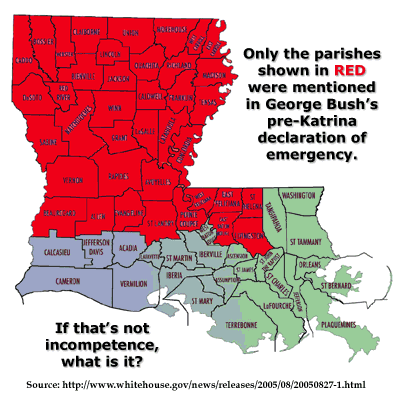
A post over on BobHarris.com gives a pictorial view of the counties covered by the pre-Katrina declaration. I'm linking the picture here. The counties in RED are the ones covered by the pre-Katrina declaration. If that map doesn't make sense to you, join the crowd. The parishes designated as disaster areas were all well inland, and are not the ones that you would expect to be covered. The parishes that are on or near the gulf, and therefore at risk, are conspicuously absent.

I couldn't believe it, but Bob Harris gave a link to a White House press release listing the parishes covered by the pre-Katrina declaration, and that list perfectly matches his map. I still couldn't believe it, so I went over to FEMA's site,
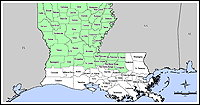
went through their archive, and found their site for that presidential declaration. The map to the left is taken from their site for that declaration. This list is exactly the same as the list on the White House website. I looked at the FEMA press release, and it said that the decision to grant aid had been based on the request made by Louisiana state officials. Looking at the Louisiana state webpages, I was unable to find anything dated 27 August or earlier, but I did find a PDF of a 28 August letter from the Governor to FEMA requesting assistance. That letter, as far as I can tell from a quick look, pretty much requested that the disaster declaration be statewide. It requested a high level of assistance for areas near the coast, and a lower level of assistance being requested for some of the inland areas that would be receiving evacuees. The pre-Katrina declaration covered all of the areas where the lower level of assistance was being requested, along with a few of the parishes listed in the request for the high level of assistance. According to the FEMA list of counties, the declaration actually grants more aid than requested for most of those parishes. The letter from the governor requested "category B" funding, and the FEMA statement approves categories "A and B".


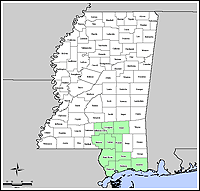
It occurred to me that the FEMA declaration might have been a matter of policy. Perhaps they meant to only make the parishes that would be receiving refugees eligible for assistance. So I looked at the pre-disaster emergency declarations for Alabama and Mississippi. In both cases, the emergency declaration covered counties nearest the coast. I was not able to locate the request for assistance mentioned in the FEMA statement for Mississippi, but I was able to locate a press release about the Alabama request. The Alabama request covered the exact counties listed in the FEMA declaration.

Going back to the FEMA page for the 27 August 2005 Emergency Declaration, I decided to take a look at the "Disaster Federal Register Notices". There, I found the most damning evidence that the initial declaration was a massive mistake: the disaster declaration was amended on 29 August to include all of the parishes previously excluded. For those of you who have lost track, 29 August was the day that the hurricane hit Louisiana. Oops.

My best guess of what happened is this: FEMA decided that Gov. Blanco's request, which covered all of Louisiana to some degree, was excessive, and they decided not to give her all of the aid that she had requested. They drew up a list of the counties to include and the counties to exclude and, possibly in a rush to get done for the presidential press event covering the declaration, got the lists crossed. And then nobody noticed the mistake until the storm hit. I'd love - totally love - to be wrong about this. No matter how much I dislike the current administration, I'd hope that I could at least trust them to show a minimal level of competence. Unfortunately, that does not appear to be the case.

The worst part of all of this is that the only way for something like this to happen is if a lot of people didn't care enough about the situation to double check their decisions. Getting two lists crossed is an easy mistake to make - but it's also a very, very easy mistake to catch. It should have been caught. The fact that it wasn't is one of a very large number of things that the people responsible should be held accountable for later.

Hat Tip: Amygdala

Communications and Science,

A little more than a week ago, Mike Syvanen posted an article on Panda's Thumb that discussed a real controversy within the field of evolutionary biology: the role of horizontal gene transfer in early evolution. Today, Paul Nelson misinterpreted that article in a post over on ID: The Future. The specifics of this incident have been covered in more detail both by at Evolving Thoughts, and at Evolutionblog. I'm going to look at this incident from a slightly different perspective: how it illustrates some of the communications issues that scientists are forced to face when dealing with creationists.

I read Mike Syvannen's article, and found it both enjoyable and thought-provoking. I certainly found it to be quite understandable. That is to be expected, of course. I am a grad student in zoology. I read scientific papers on a daily basis and I am familiar with the terms and concepts that appear in scientific papers. I suspect that reading Mike's article would be a very different experience for someone who did not have a strong foundation in biology. Such a person would have been confronted with unfamiliar terms and concepts - lots of them, tightly packed, and with very little familiar ground in between.

That is not meant in any way as a criticism of the paper. The concept of horizontal gene transfer is complex. Understanding how horizontal gene transfer might affect evolution is even more complex. Learning how to read an unrooted phylogenetic tree is complex. Understanding what a phylogenetic tree is is complex. Understanding the mathematics involved in finding the best phylogenetic tree for a set of data is extremely complex. Evolution is a complex science, and complex things can be very difficult to explain in simple terms.

Intelligent design has been accused of being a number of things. Complex isn't one of them. Anyone can follow the basic ID argument: Evolution can't explain it, so God must be the explanation. Some of the IDers might try to wrap that up in some more complex-looking outfit, but the basic argument remains unchanged. In fact, they can't really change it much, since the sheer simplicity is a large part of their argument's appeal.

That's a difficult enough situation, but unfortunately it's just the beginning. Many of the IDers are not above taking advantage of the complexities of real science. It is very easy to misrepresent a complex concept, and it can be very difficult to correct the misrepresentation. This is exactly what is happening with Nelson's misrepresentation of Mike Syvannen's article.

Nelson wrote:
Turns out Mike Syvanen is explaining why Darwin's tree of life -- Mooney and Nisbet's orthodox "common ancestry of all organisms on earth" -- may not be the case, because life may have arisen from multiple independent starting points.


That's a single, long sentence containing 37 words. I'm now going to try to explain, in as simple terms as I possibly can, why this misrepresents what Syvanen was actually arguing.

The conventional way that people have thought about evolutionary descent is as a tree, with all living things branching off from a single starting point - like the family trees that show all of the descendents of one couple. The reason that people have thought about evolution as having happened this way is because parent-to-child was the only way that anyone knew of for genes to be passed on. Over the last thirty to forty years, we have discovered that there are actually some other ways for genes to be passed on to someone else. It's been found that bacteria can transmit small pieces of DNA to other bacteria, that they can do this even between bacteria that are not part of the same species, and that the DNA can contain usable genes. People have seen this happen, and it looks like this kind of gene transmission has helped some kinds of bacteria to get resistance to antibiotics. It also looks like there are some species of virus that can move chunks of DNA from one species to another.

These kinds of non-traditional genetics seem to be more important in things like bacteria than they are in big, multicellular organisms. But way, way back in time everything that was alive was something like bacteria. If that kind of "sideways" movement of genes was important then, we might need to change the way we think about the evolution that was happening then. When we thought that traditional, parent to child genetics was all that went on, we could draw the lines of descent as all running straight from parents to children. But we can't draw those kind of lines if the "child" is also getting some genes from a somewhere else. Instead, we have to draw at least two lines leading to that child - one from the "parent", and one from any other bacteria that contributed genes. If we do that, we don't have a drawing that looks like a tree. We have a drawing that looks like a net.

What Mike Syvanen suggested is that life could have started several times in that "net" of parents, instead of just once. If he is right, then what it would mean is that not everything alive today is descended from a single species. Instead, it would mean that everything that is alive today is descended from a pool of species that were able to (and did) swap some genes back and forth. It doesn't mean that things alive today don't have common ancestry. It just means that the ancestry worked a little different, and a little bit messier, than we used to think about it.

That took 444 words, arranged in seventeen sentences over three paragraphs. It took about half an hour to write. It wasn't as clear as I hoped it would be, and there's a good chance that it would bore the hell out of anyone who isn't really interested in evolution (and maybe some who are). Paul Nelson's comment, on the other hand, was a complete misrepresentation of what was actually written, but it was short, clear, and to the point.

This is a problem. Evolution, like most of the natural world, is very complex. It is simply not possible to explain why Nelson was lying about what Syvannen said in anywhere near the number of words that it took him to do it. I suspect that Nelson and other ID proponents know this, and that is why they do it. I wish I could say that I know how we can counter that strategy, but I do not. A short and simple lie can sound a lot more compelling than a messy and complicated truth. That's just a fact, and it's something that we're going to have to continue to work around.

07 September 2005

Environment and Katrina

The Society of Environmental Journalists has compiled a couple of nice resources for anyone interested in the (massive) environmental impacts caused by Hurricane Katrina. One page gives a list of primary resources (mostly links to government sites, but some NGOs and other resources). The other is a collection of news articles on the environmental aspects of the disaster. Both are excellent sources of information on this part of the crisis.

Hat Tip: Bootstrap Analysis

06 September 2005

Tangled Bank

The 36th edition of Tangled Bank is now available at B & B. As always, it looks like there's a lot of good science blogging there Enjoy.

Boy, was that stupid.

Just when I had begun to think that we had pretty much scraped the bottom of the barrel of stupidity as far as Katrina goes, former First Lady and current First Mommy Barbara Bush proved once again that there is no bottom to that barrel. From the Independent Online:
Barbara: 'Victims poor anyway'

Barbara Bush, the former first lady, courted controversy by pointing out that many of the people forced out of their homes by Hurricane Katrina "were underprivileged anyway". Mrs Bush, who joined her husband, George, on a tour of the Houston Astrodome, said: "And so many of the people in the arena here were underprivileged anyway, so this is working very well for them. What I'm hearing, which is sort of scary, is they all want to stay in Texas. Everyone is so overwhelmed by the hospitality."


Wow. I mean, really. Wow. For a minute there, I thought I'd actually never seen that level of painfully stupid ignorance. But after a minute, it picked the scab off of some old memories. Once, a long time ago, I actually ran into that level of cluelessness.

It was back in the early nineties. David Dinkins was the major in New York, and I had a summer internship at the Mayor's Action Center, where I worked on a consituent complaints hotline. It was kind of fun. We had a primitive call-routing voicemail system - "Push one for welfare issues, push two for parking violations" type thing. I was usually on button six - "For all other complaints". Some of the issues were legitimate. Others involved reassuring people that we had nothing to do with the CIA and their mind rays.

About this time, someone on the mayor's staff came up with the idea of having "City Hall in the Boroughs" weeks. The principle was that the city was big, and it would look good if the mayor went out and worked in the parts of the city that weren't Manhattan. For "Mayor in Staten Island Week", things got interesting. The Staten Island Borough President and the Mayor were not on good terms, so when we went to Borough Hall, we didn't get good quarters. My unit - me, another guy, our boss, and sometimes his boss were all quartered in a large janitorial closet. I'm serious. There was even a slop sink in there - smelled like it hadn't been cleaned for the better part of a decade.

Anyway, I'm working the special hotline that we've got set up. It wasn't well publicized, so there wasn't too much work for most of the first day. About one, the phone rang, and I picked up. On the other end, there was an older lady who absolutely needed to get the mayor to pay attention to an absolutely critical problem.

Airplane noise.

Apparently, a change in the landing pattern for Newark had resulted in flights over her house, and a lot of noise. What, exactly, the mayor was supposed to do about it I'm still not sure. We might have been a big city, but we didn't pack a hell of a lot of clout with the FAA. I start to tune the woman out a bit, pick up a pencil, and get back to the Times crossword puzzle while she's talking. Then, a phrase snuck in my ear and grabbed my attention:

"And do you know that we have black people on Staten Island, too?"

The pencil broke. The other call center guy, Allen, picked up the other phone, covered the handset, and started to listen in. My boss joined him. Just then, his boss and the first deputy mayor arrived, saw the huddle, and leaned over to listen in, too. I did my best to maintain a level tone.

"We are aware of that, ma'am."

"And, young man, did you know that lots of them are poor?"

I'm practically chewing a hole in my lip this time trying to keep a straight face. "I think I've read something on that, yes."

"And all those poor folks have it so, so much worse than we do."

I relaxed for a second. Maybe she wasn't as completely out to lunch as I had been thinking. "Is that right, ma'am?"

"Yes it is, young man. You should be able to figure that out for yourself. After all, with all of those tall buildings where they live, the airplane noise reverberates and it's much louder than it is here."

Nope. I was right the first time. Totally out to lunch. Allen and my boss are trying to keep their hysterical laughter inaudible over the phone line, Michael and the Deputy are singing "New York, New York" complete with can-can kicks, and I'm trying to figure out if I can drown myself in the slop sink. The old lady goes on for another fifteen minutes, and I get stuck trying to get some pro forma answers out of the FAA. No good deed goes unpunished.

The whole incident seems kind of funny now, but when I look at it in light of Mrs. Bush's remarks, it also seems to be sad and a little scary. The disconnect between social groups in this country has grown so large that it seems like some people are simply unable to comprehend the difficulties that others are faced with on a daily basis. The people who live in the Stapleton Homes and other public housing projects have a huge number of concerns. Airplane noise simply doesn't make it past the first cut. But at the same time, home is home, and losing it is not easy. Nor does finding a nice, comfortable homeless shelter make up for the trauma of having suddenly become homeless, no matter how poor you are.

This is yet another weakness in our society that Katrina has illustrated for us. We have become so divided by background and class that there is a lack of comprehension about what the real problems are that people face.

The Noodly Appendage

Thanks to Orac I've blown a whole bunch of time playing the Flying Spaghetti Monster Game today. A total waste of time. But fun and addictive.

05 September 2005

Cindy Sheehan and Bush's environmental policy

Cindy Sheehan decided, in a message posted over on the After Downing Street blog, to take a swing at Bush over the situation in Louisiana:

Well, George and I are leaving Crawford today. George is finished playing golf and telling his fables in San Diego, so he will be heading to Louisiana to see the devastation that his environmental policies and his killing policies have caused. Recovery would be easier and much quicker if almost ½ of the three states involved National Guard were not in Iraq. All of the National Guard's equipment is in Iraq also. Plus, with the 2 billion dollars a week that the private contractors are siphoning from our treasury, how are we going to pay for helping our own citizens in Louisiana, Mississippi, and Alabama? And, should I dare say "global warming?" and be branded as a "conspiracy theorist" on top of everything else the reich-wingers say about me.
I don't disagree with everything in this paragraph. I think it is true that things would have been easier in Louisiana, Mississippi, and Alabama if so many of their National Guard troops weren't deployed. It is also true that she and Bush left Crawford, and that Bush, several days after the disaster started, finally concluded his vacation. And it is true that he went to Louisiana. Those few points aside, that paragraph is packed with inaccuracies and errors.

Some of the points are related to Iraq, and I don't intend to spend too much time on them. It is worth pointing out that not all of the National Guard's equipment is in Iraq - the units that deployed brought their equipment, but the units left behind have equipment, too. It is also worth mentioning that, although the cash flowing into the Iraqi black hole is significant, there is still money to spend at home - and there would be more if not for the tax cuts.

Her choice of descriptive language also leaves something to be desired. Comparing one's opponents to the Nazi's does justice to neither. It minimizes the horrors perpetuated by the Nazis, and it demonizes the opponents while doing nothing to encourage reasonable discourse. This particular cheap shot doesn't even have the virtue of being funny or clever - on a scale of witty insults that runs from Michael liberalismm is a mental disease" Savage to Winston "in the morning I shall be sober" Churchill, "reich-wingers" barely breaks the Bill O'Reilly mark. I could go on, but Orac handles this type of comment better than I possibly could.

As far as I'm concerned, those comments, poorly thought out as they were, are really the side show. The main event for me is Sheehan's massive misunderstanding of environmental science and policy. Sheehan seems to want to put as much of the blame as possible on Bush. Picking out a single scapegoat may be satisfying, but it is wrong.

The environment, the impacts that the human species has on the environment, and the effects of our impacts are all very complex issues. Like most complex issues, there is no single cause. As is frequently the case in real-world situations, events may have more than one cause, and the exact contribution of each factor can be very difficult to pin down. Hurricanes are certainly complex, and the causes of hurricanes are equally complex. Many things, including global warming, may have gone into making this storm as bad as it was. Blaming Bush's environmental policies is irresponsible, not to mention wrong.

It is far from clear whether or not global warming played a role in making this hurricane as strong as it was. The warmer-than-normal waters of the Gulf of Mexico were certainly responsible, but how much of that was caused by global warming and how much of that was simply the result of a warmer-than-normal year is much more difficult to say. Remember, half of all years will be warmer than average. A certain small percentage of them will be significantly warmer than average. That's just the nature of how we define "average", and the nature of the bell curve. It is theoretically possible that the Gulf temperatures would have been almost as warm without any greenhouse warming.

But let's assume that greenhouse-gas caused global warming is entirely responsible for the elevated temperatures of the Gulf of Mexico. It's still not all Bush's fault. We have been pumping carbon dioxide and other greenhousegasess into the atmosphere for a long time now. We've known about the possible effects for a long time. ("We" does not just refer to the United States, but to the world.) No matter what we do, it will take a long time to undo what has already happened. If Bush had managed to drop the US emissions of CO2 to zero during the second year of his administration, atmospheric levels would still be high, and the sea surface temperatures in the Gulf may well have been just as high.

Now, please don't take this the wrong way. I am not a climate change "skeptic". I think that the evidence for global warming is real, and very, very credible. Carbon dioxide is a greenhouse gas, we do release large quantities of it into the air as the result of burning fossil fuel, atmospheric levels of CO2 have shown a steady increase over the last few decades, and temperatures do appear to be rising. As a result of these increased temperatures, we can expect increased numbers of hurricanes overall, and increased hurricane strength overall. Those are general trends, they are things that we need to keep in mind, and they are certainly worth discussing in light of recent events. There is a large gap, however, between those statements and saying that global warming was responsible for this hurricane.

Wetlands loss is another issue that was involved in the damage from this hurricane. Wetlands have the ability to effectively "soak up" some of a storm surge, and having wetlands between you and the ocean can reduce the risk of damage from a storm surge (or tsunami). It is true that there has been a great deal of wetlands loss in the Mississippi Delta, and that these wetlands could have helped mitigate some of the damage. Here, again, we cannot simply blame Bush for the damage. Like global warming, this is a problem that has been decades in the making, and it is a problem that has many contributing causes. As was the case with global warming, I doubt that Bush could have reversed enough of the damage to make a difference if he had tried.

I am not saying these things in defense of the president's environmental record. Bush's record on the environment is absolutely atrocious. He certainly has not helped with either global warming or wetlands management. He seems, throughout his presidency, to have done his absolute best to gut what limited environmental protections we have. Despite all of this, we simply cannot say with any reasonable degree of sympathy whether or not his policies were a major contributing factor in this disaster, and if they were, to what degree. It is certain that his environmental policy did not help. It is possible, if not likely, that it hurt. But it is irresponsible and indefensible to claim that they were the cause.

This disaster has caused enormous loss of life, enormous suffering, and enormous damage. It has revealed and is revealing fundamental flaws in the way that we, as a nation, deal with these type of disasters. If we are to have any hope at fixing these problems, it is going to take a national discourse and a national debate on quite a number of details. This discourse will need to be as bipartisan as possible.

Please note that I am not trying to say that we shouldn't assess blame. We should, we must, and we undoubtedly will. I am also not trying to say that this isn't the time for criticism. It is - most mistakes can be fixed easier the sooner that they are noticed. What I am saying is this: this is a national disaster that we have handled abysmally. Mistakes seem to have been made at virtually every possible level, and these mistakes need to be addressed. Addressing them should take place in as careful and reasonable a manner as possible. Hurling unsupportable accusations and insults, particularly when they are poorly supported by the facts, does absolutely nothing to help in this process.

04 September 2005

What control?

An article in the Washington Post contains an interesting paragraph toward the end of the piece:

On television, Chertoff was omnipresent, dispatched by the administration to appear on all five Sunday news shows after FEMA Director Michael Brown's damage-control efforts met with little success last week.


Strangely, I'm not actually sure what the intended meaning of this paragraph is. Do they mean that "Brownie" has been barred from the talk shows because his initial efforts at controlling the damage in New Orleans have proven to be so inept? Or are they trying to indicate that the former head of the International Arabian Horse Association is not going to do the talk shows because he is even less competent at political damage control than he is at the real thing?

I hope it's for the former reason, but given Bush's habit of promoting those in the administration who have committed egregious errors, I doubt it.

The Levees

There's a good article on the situation with the New Orleans levees over at Acronym Required.

02 September 2005

Science, misuse of science, Katrina, and responsibility

Scientists are past the point where we can remain silent. We are past the point where we can be afraid of being labeled by our opponents as "playing politics". We are past the point where we can afford to let others define the terms of debate.

People are dead. People are dying. People are injured, hungry, and homeless. People have, again, died because things were not done differently. People are dead because scientific advice was not followed, and people are dead because they did not know enough science to recognize the danger that they were in. These things have happened. They are a reality. They will not change.

So why, people ask, should we start to point fingers and try to figure out who is to blame. What reason could there be other than to try to reap political gain, and what kind of despicable person would want to grab political points on the backs of the dead? Speaking for myself, I want to assess the blame so that we can figure out how to not let this happen again.

This situation is complicated, and the details may not be clear for some time. Nevertheless, I think we know enough to be able to begin to assess the blame, and to begin to work on future plans. I am certain I know enough to list some of the groups that are at least partly to blame for this.

The Democrats are to blame for this.

The Republicans are to blame for this.

Politicians are to blame.

Policymakers are to blame.

And, not least, scientists are to blame for this.

It is our fault, too. There is more that scientists could have done. Yes, politicians have played fast and loose with scientific data in blatant attempts to support their pet ideas. Yes, both parties have been guilty of this, and yes, the current administration has been more blatant in their attempts to manipulate scientific results than any before. But the difference between the current administration and past administrations is only a matter of degree.

We should have done more to fight the misuse of science. Things have certainly been done, but not enough and not in the right places. Individual scientists and individual groups have stood up and taken stands, but the efforts have not been coordinated. Scientists need to stand up against the misuse of scientific results, and present a united front. When the idiots at the FDA push back ruling on Plan B by another two months, we shouldn't just be seeing editorials in NEJM or JAMA. We should see Science and PNAS and other groups weigh in as well. Misuse of science hurts everyone.

Education is also a problem. I'm sure that there are people - lots of people - in this country who do not understand the difference between twenty foot waves and a twenty foot storm surge. There are probably more people who understand what a storm surge is than who understand how wetlands help to mitigate the effects of a storm surge. We live in a country and at a time where science plays more of a role in day-to-day life than ever before, and where people understand extremely little science. Here, too, there are others who have played a more active role in the deterioration of our educational system, but here, too, we have let it happen without putting up a massive, well-coordinated fight.

Reality is not just another worldview. That is a basic fact that we need to make known. Science is not the same as Christianity, or Islam, or new-age navel-gazing. Science is a method that people have devised to help us learn about how the world works. Science is about reality, and scientific conclusions cannot be ignored with impunity. Scientific results do not change with the next election, and they cannot be legislated out of existence.

It's time to stand up for reality.

01 September 2005

Plan B and politics

Welcome to the latest episode in this country's unchecked descent into blatant theocracy, where our new motto is: "Our narrow minded interpretation of Christianity: we might not be able to make you believe it, but by God we're going to do our damndest to make you live by it."

In an event largely overshadowed by recent events in along the Gulf Coast, FDA Assistant Commissioner Susan Wood resigned in protest of the FDA's decision to postpone, yet again, a decision on whether or not to allow "Plan B" birth control pills to be sold over the counter. Wood headed the FDA's Office of Women's Health. Wood wrote, in a widely circulated email message, that she could, "no longer serve as staff when scientific and clinical evidence, fully evaluated and recommended by the professional staff here, has been overruled."

"Plan B" birth control is highly controversial, in the same way and for the same reasons that evolution is controversial: the radical wing of the so-called Christian right finds the entire concept to be morally objectionable, and they are doing everything in their power to fight it. It is not scientifically controversial in any way. As a New England Journal of Medicine editorial points out, an advisory panel agreed, by a vote of 28 to 0, that this drug is safe. The same committee voted 23-4 to approve the drug for over the counter sales. The FDA's professional staff agreed with that recommendation, but in an almost unprecedented move the FDA management overrulled the advisory panel and its own scientific staff, and rejected the application. FDA management cited fears that over-the-counter access would increase promiscuity in adolescents as their grounds for disapproval, although that very issue had been considered and rejected by the advisory panel.

Subsequently, the manufacturer resubmitted the application with the suggestion that the drug be made available over the counter only to those over 16. A decision on the application was due today, but the administrators have postponed ruling for at least 60 days over technical issues.

The actions of the FDA in this case reek of politics. Actually, that's an understatement. They stink of politics. The odor is stronger than week-dead fish in July. This is, of course, absolutely nothing new for this administration. These people, who believe that their values are absolutes, also believe that reality is relative, and should be distorted until it properly fits into their twisted little narrow view of things. They feel that their beliefs are better than anyone elses, and that they should govern what happens, even if this means that a government body intended to ensure that decisions about drug availability are made based on objective scientific evidence is forced to make sure that God's Word comes first, and science second. Hmmmm. I wonder where I've heard that before?

A little bit of politics in my life...

My brother Dan has tossed up a nicely illustrated criticism of our president's conduct during recent events over on his blog.

The National Guard, Iraq, and Disasters

Various spokesmen at various levels of the federal government have done their best since Katrina struck to assure people that there were still enough National Guard troops left at home to take care of disaster relief efforts. We were told, for example, that 60% of the Louisiana National Guard was not currently deployed overseas. We were not told which 60% that was.

Not all National Guard units are created equal. This statement is not in any way intended to reflect on the dedication or quality of the troops in any of the units. The simple fact is that different units have different missions, and therefore train differently and are equipped differently. This means that while every NG unit can provide valuable assistance in the aftermath of the storm, some units may have skill sets that are in more demand than others.

This got me to wondering what units of the Louisiana National Guard were deployed overseas, and what units were available at home for disaster relief, so I did a little research. Here's what I came up with:

I was not able, for understandable reasons, to directly access the Louisiana National Guard's website. I did, however, manage to read, via Google's cache, a list of National Guard units on active duty. The cached version of the page was obtained in early August, so it is possible that some of these units have returned in the last month, but this should at least give a reasonable overview of the situation. A listing of all Louisiana Army National Guard units was found on Globalsecurity.org. I'm not going to take the time to list everything individually, but here's the situation as far as I can tell from comparing these sites: currently, it appears that all of the main infantry units are deployed, the armor is deployed, the army aviation units are deployed, along with some engineers, field artillery, and some support units.

Left in Louisiana are three battalions of combat engineers. This is good news, since these are exactly the people who are good at cleaning things up, making emergency repairs, and that sort of disaster relief. Unfortunately, it appears that the deployment of the other units has left at least some of these troops responsible for security work rather than clean-up. For example, it would appear that one of the engineer battalions (527th EN BN) is the unit that is in charge at the Superdome. Other troops remaining in Louisiana include a maintenance company, a transportation company, a quartermaster battalion primarily responsible for fuel supply, a military intelligence battalion (minus a deployed detachement) that seems to be primarily composed of linguists, a regiment that handles training duties, and the 156th Army Band.

It may be that I am entirely wrong about this. It may be that an Army Band can put a stop to looting just as easily as an infantry unit. It may be that the military intelligence people can do as much to help evacuate an area as an Air Ambulance company can. In fact, I hope that I am wrong about all of this, since it will mean that the people of New Orleans are not suffering more hardship as a result of our reliance on the National Guard for the war in Iraq. Given some of the descriptions of the situation in New Orleans right now, though, I am very much afraid that I am not wrong.

New Orleans

"Pray for the dead, and fight like hell for the living."
--Mary Harris "Mother" Jones (1830-1930)

By now, everyone has seen the images of chaos, horror, death, and destruction that continue to come out of New Orleans. We are now days into the disaster, and it is far from clear how or when things are going to end. People are still stranded in the city, without food, without water, and, more and more, without hope. The number of storm-related deaths in New Orleans is not yet known. In part, this is because there has been no time to count bodies. In part, this is because people have not yet stopped dying.

Watching the news images that have appeared on my TV, in my morning paper, on my computer, and in countless other places, there is one thing that has struck me the most about who is still in New Orleans: most of the huddled masses of miserable people seem to be residents of the city's poorer areas - the inner city. I am not at all familiar with New Orleans, but from my own experience growing up in the Bronx, and having spent time working for social service agencies, there are a few things that I think I know about the background that many of these refugees come from. I am going to write about my hunches regarding the situation in the city because I understand cities better than I understand smaller towns, but much of this may hold true along the rest of the Gulf Coast.

And, while it was regarded as pretty good evidence of criminality to be living in a slum, for some reason owning a whole street of them merely got you invited to the very best social occasions.

-- Terry Pratchett
Feet of Clay
Unfortunately, if I were to ask you what the first thing that pops into your mind is when I mention the people left in New Orleans, the answer is probably going to be "looting". It is an additonal tragedy, although one that pales in comparison to the others right now, that most of the people who are left in the city are going to be tarred with the same brush as the looters in the minds of many. That happens a lot when you live in poorer neighborhoods, but most of the people who live there are not criminals. They are good people, most of whom scrape by working at low-paying jobs - as janitors, or nurses' aids, or retail clerks. They are people who live in places that have more than their share of crime, that have more than their share of drug addicts and alcoholics, and that have perhaps a bit less than their share of opportunities. For the most part, they live in these places because that is where they can afford to live.

Many people are asking why these folks didn't evacuate when they were told to. There obviously isn't any one answer to that question, since there are many different people there now. For those in the poorer communities of the city, one of the reasons was probably that they didn't have anywhere to run to, and no way to get there. If there are areas in New Orleans that are anything at all like some of the places I've lived and worked, there are probably thousands of people who have never left the city in their lives. Many of them don't have cars. Fewer have new cars. Some may have been afraid that their homes would be looted if they left. Others may not have been able to afford to leave. Some may simply have not known what to do, where to go, or how to live. Some may not have thought that they were strong enough to make the trip on their own.

All of that, of course, doesn't really matter much right now. Whatever the reasons that they stayed, those people are there now, need to be rescued now, need to get food now, need to be sheltered now. Besides the federal, state, and local governments, there are going to be a number of non-governmental agencies, such as the Red Cross and the Salvation Army, helping meet the immediate needs of the survivors. Those groups are going to need money to do that, and I hope that everyone who is able to help will.

But the poor people, both within New Orleans and along the Gulf Coast, are going to need assistance well into the future. The losses to the insurance industry from this storm are estimated to run over 25 billon dollars. But those losses do not take into account the losses suffered by many of the poor, because many of them had no insurance. FEMA will help with replacing some of what they lost, but keep in mind that many of those people lived in apartments or rented houses - I don't know how much assistance FEMA will be able to provide for them to relocate.

We often hear the phrase, "nothing left but the clothes on his back". Fortunately, it is often hyperbole. Even if the entire house is gone, along with all the contents, there is insurance and there are savings. For many of the victims of Katrina, this is not the case. In the neighborhood where I grew up, many people had no bank account and had no savings. They live paycheck to paycheck, cashing them for a fee at a Check Cashing storefront. Few had even a month's worth of savings to fall back on. Credit cards are not universally available. In my old neighborhood, some of the supermarkets and convenience stores didn't install terminals until the Food Stamp program went to an electronic fund transfer system. Virtually nobody there had 401ks. Those lucky enough to be in stable jobs might have had a union pension, but the rest had Social Security. Many of the senior citizens in the neighborhood had no family left. For anyone in the zone of destruction who was in a situation like that, "clothes on their back" may well be the literal truth.

Organizations such as the Red Cross are going to need money now, and I hope that everyone who can chip in will contribute to the charity or charities of their choice. But please don't make that your last involvement with this crisis. For many people, the road to recovery will be extremely long and extremely difficult. They will be faced with trying to replace everything that they own, with finding new housing to rent, with finding new jobs, and they will be forced to do this without having savings or insurance to fall back on. They will need a great deal of assistance, and they will need it for a long time to come. Please keep this in mind, and please try to remain aware of the situation so that you can help again later on, after the charities have gone through the burst of immediate donations. For many, the need two or three months down the road may be as pressing as it is now.

31 August 2005

On a lighter note...


There was a cool column in today's Honolulu Advertiser about the history of the ever-popular shaka sign.

30 August 2005

New Orleans satellite images - before/after

Addendum: 1 September.
I've put up another post with some of my thoughts about the situation in New Orleans right now, and about the long-term needs that some victims are likely to have.
--------------------------------------

One of my professors just emailed these out to a bunch of us. The originals are available from NASA's Earth Observatory site, but that site seems to be overloaded right now, so I'll put the pictures up here, too.

Lake Pontchartrain appears to have simply overflowed - not just into New Orleans, but over all of its banks. The pictures, very sadly, speak for themselves. For once, I am totally at a loss for words.
For those who want to see them, the original pictures are available at these two links:

August 27 (before) picture
August 30 (after) picture


Update 30 Aug 05, 20:30 HST. I finally got onto the original NASA site. Here's a link to the news release containing those images with the NASA interpretation.

California: The Saga Continues

As I continued my review of the complaint filed in the California creationist lawsuit, I came to a passage that was completely stunning in it's irony:
Furthermore, the State of California has agreed that in public and private schools, students do not have to accept everything that is taught, and cannot be required to hold a state-prescribed viewpoint:
Nothing in science or in any other field of knowledge shall be taught dogmatically. Dogma is a system of beliefs that is not subject to scientific test and refutation...
To be fully informed citizens, students do not have to accept everything that is taught in the natural science curriculum, but they do have to understand the major strands of scientific thought, including its methods, facts, hypotheses, theories, and laws.

California State Board of Education, Science Framework for California Public Schools,
“State Board of Education Policy on the Teaching of Natural Sciences” ¶¶ 3-4 (2003).
Plaintiffs support, and do not object to, understanding the major strands of scientific
thought, methods, facts, hypotheses, theories, and laws. Their constitutional rights are abridged or discriminated against when they are told that the current interpretation of scientific method must be taught dogmatically, and must be accepted by students, to be eligible for admission to University of California institutions.
That argument is amazing, if not completely unreal. In essence, these folks are arguing that, because UC has a policy against being dogmatic in science, their own massively dogmatic "science" curriculum must be accepted as valid. To put it another way, they are basically trying to say, "if you don't allow me to be dogmatic, then you are being dogmatic".

There's nothing like watching people who are willing to fight for the right to never have their beliefs challenged by the harsh winds of reality.