27 August 2005

More on the California creationist lawsuit

In a post earlier today, I noted that a group of creationists are suing the University of California system in order to force UC to accept several of their classes that are currently not considered adequate. One of the courses in question is biology. As I already pointed out, UC is not discriminating against Christians by refusing to accept the class; it is simply living up to its responsibility to ensure that applicants are adequately prepared for university study. Nevertheless, I was curious as to what about these particular biology classes was so poor as to attract attention.

The LA Times reported that:
According to the lawsuit, UC's board of admissions also advised the school that it would not approve biology and science courses that relied primarily on textbooks published by Bob Jones University Press and A Beka Books, two Christian publishers.
Now, given what I've heard about Bob Jones University, I figured that any biology text that they produce would be unlike any I'd read before. So I trotted on over to the Bob Jones University Press website to see what I could find. Looking over their list of books for "conventional schools", I found a textbook for a 10th grade biology class. The price is a bit high for me, given the quality, so I didn't order it. However, the website has a nice "see the inside of this book" feature that gives access to the frontmatter, preface, introduction, and a sample chapter. After looking at it, I think I understand why UC has problems with it.

From the Introduction:
Biology for Christian Schools is a textbook for Bible-believing high-school students. Those who do not believe that the Bible is the inspired, inerrant Word of God will find many points in this book puzzling. This book was not written for them.
That's funny. There I was thinking that science is a universal concept, open to anyone who is willing to study the natural world. I had no idea that there are things in science that can only be understood if you believe what these folks do.

The people who prepared this book have tried consistently to put the Word of God first and science second...If...at any point God's Word is not put first, the authors apologize.
Let's see. What we have here is a "science" textbook, written by people who have made a conscious effort to put science second. Wow. What possible reason could the University of California have for being concerned about the quality of classes using this book?

The same encyclopedia article may state that the grasshopper evolved 300 million years ago. You may find a description of some insect that the grasshopper supposedly evolved from and a description of the insects that scientists say evolved from the grasshopper. You may even find a "scientific" explanation of the biblical locust (grasshopper) plague in Egypt. These statements are conclusions based on "supposed science." If the conclusions contradict the Word of God, the conclusions are wrong, no matter how many scientific facts may appear to back them.
It's nice to see how willing they are to keep an open mind about things.

Believe it or not, the book actually seems to get worse. The sample chapter provided on the website is Chapter One: The Science of Life and the God of Life. Page nine is a box that is labeled as one of the book's "Facets of Biology". The title of this particular facet is: "How God Communicates with Man". In it, we find:
Was Joseph Smith's [founder of the Mormons -tqa] revalation from God? Based on Scripture, one must say no! The apostle Paul says that if anyone (including Paul himself or even an angel) comes and preaches any other gospel, he is to be accursed (Gal 1:8).

If you want to know what this has to do with science, or why it appears in a science book, you'll have to ask someone else, because I've got no clue. It must be one of those aspects of science that perplexes those who lack the BJU-approved beliefs.

There's another Facet later in the chapter, dealing with spontaneous generation. It spans three pages, and concludes with this creationist gem:
After Pasteur's swan-necked flask experiment and thousands of other experiments supporting biogenesis, do people today still believe in spontaneous generation? Yes. Anyone who believes in evolution believes that spontaneous generation has occurred. ... If they can create life, they think they can support their belief in life's beginning without God.
This chapter of the text also has some material that discusses evolution:
The idea that life comes from similar life is important. God created humans and all of the other kinds of organisms with the ability to reproduce after their own kind (Gen. 1:12, 21, 25, 28); therefore, humans reproduce humans, oak trees reproduce oak trees, and cats reproduce cats. The idea of all life forms descending from a common ancestor cell that originated from non-living chemicals is absurd.

Right. It's completely absurd to believe that humans have descended from chemicals through a long line of ancestors. It's much more reasonable to believe that humans came directly from dirt which is made from...

Looking at just the available samples from this text, I'm not surprised that UC declines to accept courses using it as the primary material as valid. I am surprised that there are apparently some schools that do.

By the way, the examples that I've quoted are by no means a comprehensive listing of everything that's wrong with the material I read. They are simply a few of the more egregious examples illustrating the comprehensively unscientific nature of this book. A thorough examination would have taken far more time than I have, and would simply have depressed me further.

The consequences of creationism

It appears that yet another creationism-related lawsuit is in the works. This time, the venue is in California, and it is the Creationists who are doing the suing. Apparently, the Association of Christian Schools International and Calvary Chapel Christian School of Murietta are no longer satisfied with being able to teach their students creationism instead of real biology. Now, they also want to make sure that their students will not have to suffer the consequences of this decision, and they are suing for that "right".

The University of California System, quite reasonably, requires that the students that they accept have a certain educational background. Several courses, including biology, offered by Calvary Chapel were determined to be insufficient to meet the UC standards. According to the LA Times article cited above, UC directed Calvary Chapel to instead, "submit for UC approval a secular science curriculum with a text and course outline that addresses course content/knowledge generally accepted in the scientific community." Typically, the creationists don't see this as a university excercising it's duty to ensure that its students are properly prepared for admission. Instead, they see it as yet more evidence of the anti-Christian "bias" that they see anytime they do not get things their own way. From the LA Times article:

"It appears that the UC system is attempting to secularize Christian schools and prevent them from teaching from a world Christian view," said Patrick H. Tyler, a lawyer with Advocates for Faith and Freedom, which is assisting the plaintiffs.
...
Bird said the schools have no objection to teaching evolution alongside creationism but consider the UC regulations a violation of their rights. "And a threat to one religion is a threat to all," he added.
That is an interesting take on the situation, but one that is not reality-based. The UC system is not expressing an opinion on whether or not the creationists should be permitted to mis-educate their children. They are simply declining to consider such courses as having been an acceptable science education. The creationists do not have to expose their children to the evils of evolution if they do not want to. They just have to recognize that this decision has consequences.

26 August 2005

A little light reading for the weekend...

I just wrapped up at work for the day - nothing like getting out at 8pm on a Friday night - and put together the reading material I'll be bringing home and at least theoretically reading this weekend. It's a somewhat eclectic collection:

Thomas, R. H. and J. A. Hunt (1991). "The molecular evolution of the alcohol dehydrogenase locus and the phylogeny of Hawaiian Drosophila." Mol Biol Evol 8(5): 687-702.

Matzkin, L. M. (2004). "Population Genetics and Geographic Variation of Alcohol Dehydrogenase (Adh) Paralogs and Glucose-6-Phosphate Dehydrogenase (G6pd) in Drosophila mojavensis." Mol Biol Evol 21(2): 276-285.
A couple of papers to read as part of the research toward my proposal.

Talbot, S. L. and G. F. Shields (1996). "Phylogeography of Brown Bears (Ursus arctos) of Alaska and Paraphyly Within the Ursidae." Molecular Phylogenetics and Evolution 5(3): 477-494.

Hennig, Willi. ? Phylogenetic Systematics. p97-116 of something or another (photocopied book chapter)
The assigned reading for the Systematics class I'm taking.

Schluter, D. (2000). The Ecology of Adaptive Radiation. Oxford, Oxford University Press.
Need to read chapters 2 and 3 for adaptive radiation concepts class. Not due until next Thursday, may procrastinate.

Lomolino, M. V. and L. R. Heaney (2004). Frontiers in Biogeography: New Directions in the Geography of Nature. Sunderland, Sinauer.
Need to look through part one for seminar on biogeography. Not actually due for a couple of weeks, but looks a lot more interesting than the Schluter.

It's probably good that I finished the new Harry Potter before classes started.

Comments

I just made a change to commenting procedures. I've gotten a bit of comment spam over the past couple of days, and I'm tired of having to go through and manually delete them. I've activated Blogspot's "word verification" feature, so in order to comment you will have to do the whole type the goofy looking word in the box thing. I know it's annoying, and I'm sorry, but it beats having to deal with all those "great job, now come see my [insert commercial blog] blog" type posts.

It also occurs to me that I haven't outlined a comment policy yet. Here it is:

I reserve the right to delete any post at any time for any reason. But I only plan to delete those comments which are either entirely off topic, illeagal, or which use language unsuitable for children. My eight year old looks at the blog sometimes, and I'd like to make sure that it stays a site I'd be comfortable having her read.

25 August 2005

Homeopathy and Intelligent Design

Homeopathy is a form of alternative medicine that is taken seriously by some, and mocked by many - especially those in the reality-based community. There is good reason for the mockery. Homeopathy is based on the medieval philosophy of "similia similibus curentur" (like cures like), and relies on "treatments" that involve administering a substance that causes symptoms similar to those of the disease it is intended to "treat". In order to avoid having the treatment cause more harm, the substance is normally diluted to such an enormous extent that it is present at levels that may be literally undetectable. This is believed to work because it is presumed that the process of dilution releases and concentrates the healing essence of the substance while removing the impure physical presence.

In short, then homeopathy is a classic example of a pseudoscientific enterprise lacking any basis in reality whatsoever. Despite this, it is a very popular form of "alternative medicine", and has many practitioners. There have also been serious scientific studies that have examined the effectiveness of various homeopathic remedies. In the latest issue of the medical journal The Lancet, a group of authors have published a detailed statistical comparison between 110 published, placebo-controlled studies of homeopathic remedies and an equal number of studies of conventional drug trials. Their analysis showed that the effects of the homeopathic remedies in the published trials are so slight that they are best explained as placebo effects. This comes as no surprise to the scientific community.

What I find interesting about this is the way that this contrasts with the Intelligent Design movement. In homeopathy, we see a "medical" treatment philosophy that runs counter to everything that we understand about the way that our bodies function. From a scientific perspective, homeopathy is utter garbage. However, it turns out to be testable garbage. Homeopathy makes predictive statements ("if you take this, it will make you better") that can be tested against what really happens. In this instance, they were tested and massively failed.

Intelligent Design lacks even that virtue. Intelligent Design makes no positive predictions of its own, and therefore cannot be directly tested against reality. The closest that ID comes to anything testable is when they claim that some given trait cannot be explained by evolution, but the jump from that to "ID is therefore right" is totally untestable - it would be like a homeopathic practitioner claiming that, "the cure proposed by conventional medicine does not work, therefore my cure must." Put in those terms it is clear that ID's "logic" is nonsensical. Yet for some reason, people seem to find it a perfectly acceptable argument in that context.

Nobody is so blind...

Yesterday, I got my first chance to TA a lab. I've got a nice deal this semester, since I'm assisting a professor instead of running the whole lab section on my own, and because we've only got six students in the lab at the moment. It's not so easy for the students, however. This lab (400-level ecology) is, for most of them, the first time that they are forced to do very much in the way of planning for the experiments. Most of the prior labs that they've taken have been plug-and-chug, follow the cookbook kind of things. Here, they are given a problem, then told to come up with a way to solve it. Yesterday's introduction to the course involved having them measure seed pods from a local invasive (Koa haole), in an attempt to determine which two (of three) bags of seed pods were taken from the same tree. We suggested that sampling would be better than a census approach, and mentioned that two possible parameters to look at might be length of the seed pods and the number of seeds per pod. We also told them to be sure to try to look at everything, as there might be other characters that might work.

Koa haole seed pods tend to hang around the trees for a while, so the bags contained a number of different age classes of seed pod. There were some that were still green, but the bulk were older brown pods. One of the first questions that they came to us with was whether or not the green seed pods were full grown. We looked at them, grinned, and shrugged. They went off muttering to discuss the question among themselves. They were able to quickly reach the conclusion that they didn't know whether or not the green ones were full grown, so they decided to discard them for the purposes of length measurements. They piled up all the green pods from each bag out of the way, then went on to lay out the brown pods to randomly select their samples. The green pods stayed discarded for the rest of the lab, as the students industriously measured lengths and counted seeds.

Since the green pods had been "discarded", the students never looked at them again. Boy, did they miss out. The lab handout didn't mention looking at the ratio of green pods to brown as a possible way to determine which two sets of pods were from the same source, because in past years virtually all of the pods collected were brown. This year, through sheer coincidence, one of the trees that I collected pods from had lots of green ones. The result was that two of the three piles had loads of brown pods and very few green ones. The third had loads of brown pods, along with a whole bunch of green ones. To anyone who wasn't completely locked into a "brown-only" mentality, it was possible to figure out which two piles were similar from the other side of the room. The students, having discarded the green pods, completely missed it. They're going to be spending a lot of time crunching the length and pod number data that they collected, and I have no idea whether or not they are going to find any significant differences.

This is an example of a common phenomenon - so common that it goes by different names. My wife, who is an army flight surgeon, tells me that it the aviators she works with call it "task fixation". I've also seen it referred to as "situational blindness". You wind up focusing so hard on one task that you can completely miss other things that are going on around you. In aviation, this can be life-threatening. In science, it usually isn't that severe, but it still isn't good. It's always important to make sure, when you are counting trees, that you don't miss the forest. Or that you don't miss the guy in the gorilla suit when you are counting basketball passes.

23 August 2005

More on Iraq.

As I have said before, I believe that the United States has a moral responsibility to ensure the reconstruction of Iraq. I think that this means that we need to keep troops there; others, including the gentleman who commented on the earlier post, believe that reconstruction cannot take place until after we withdraw. It is possible that this is correct, but even if it is, I don't think we could withdraw until arrangements have been made for someone else to take our place. I'm not holding my breath waiting for that to happen.

In the meantime, I do firmly believe that we need to keep troops in Iraq. I also believe that we should have more troops in Afghanistan than we do now, and that we should be doing more to help Afghanistan build a functional and secure nation. That being the case, I guess I can be considered to be a "supporter" of the wars in Iraq and Afghanistan. I certainly support the troops - with a number of family members on active duty, that's pretty much a given.

But as far as the recent AP/IPSOs poll is concerned, I am definitely not in the increasingly small group of people who support the way that the president has been handling the war. Even if I accept, for the sake of argument, that he got us into this thing with the best of intentions, the best I can say is that this thing has been one massive chain of mistakes from the start to the present. The painful fact is that although Bush was once a believer in the importance of a good exit strategy to the success of a military operation, the only exit strategy that we had for this thing - "they'll shower us with flowers and candy and then we'll all go home for the victory parades" - fell through pretty fast.

Since the exit strategy fell through, American casualties have mounted. At this point, more than 90% of American deaths have occurred since the president's ill-advised carrier landing. Nearly 90% of American deaths have occurred since the president took the unprecedentedly stupid step of inviting the insurgents to, "bring it on". More than three quarters of the fatalities have taken place since Saddam was captured. About one-half of one percent of the fatalities have occurred since the president's speech about the war on Monday. And there is no end in sight.

Bush has not done anything in this time that gives me any confidence that he really has anything that looks like a strategy for this conflict, and he's done little to show that he comprehends that some of the problems might actually be his responsibility. He's kept Rumsfeld on, and promoted Rice and Wolfowitz. The closest that he's come to articulating an exit strategy lately is the new, "as the Iraqis stand up, we'll stand down," mantra. There's not a whole lot of detail there, and it's kind of hard to figure out what that will mean. As I type this, I'm looking at a group of troops from various services standing at attention waiting for the president to arrive to start a speech. The president is expected to take this opportunity to tell them that their sacrifices are not in vain, before returning to his extended vacation. I certainly hope that the sacrifices are not in vain, but I really don't know what the reason for them is anymore.

Both of the major groups - Bush & the Bushites and the Disorganized Dems - seem to have grasped the fact that the poll numbers indicate that there are lots of people out there who are not real happy about the way things are going in Iraq. Bush has responded, as he almost always does, with a simple, consistent message: "Stay The Course, Stay The Course, Stay the Course". The Democrats, as is too often the case, have not been able to put together a united position on this issue. More and more, however, prominent Democrats are heard discussing the need for a firm timetable, with dates, for American troops to leave Iraq.

Both messages are wrong.

Iraq, at the moment, is a nation with a population that is split into three major groups (Sunni, Shia, and Kurd). There are an enormous number of current and historical differences and disputes between and within these groups, but they are being asked to work together to forge a new nation. Into this situation, we inject the extra tensions caused by the occupation, add a security situation that allows these groups to address their disputes in very direct ways, and top the whole thing off with an assortment of terrorist groups and foreign fighters. This is not a simple situation, and it does not lend itself to the kind of resolution what you can present as a simple message. If you want to get the American people to support the situation, be honest. Admit errors. Explain the problems that exist right now. Outline the ways that you think you can address the problems, and detail the situation that you would like to see before you start to withdraw troops.

On the other side, recognize that this is a complex situation, and a situation that is not in any way, shape, or form stable. Situations that lack stability require flexible plans to solve. Fixed timetables for pullout do not give much flexibility. Here, too, we need to decide on goals and objectives. Dates don't do much more for the situation than tell the people you are fighting how long they need to hold out. A firm timetable with pullout dates may play well with people who know that they really dislike the war, but it sets unrealistic expectations. If you don't like the way that the administration is handling things, say so. If you think that we should remove our troops now, say so, but also explain why you think this is in the interests of both Iraq and the US. But if you think we should start pulling troops out at some point in the future, you need to explain why having a date to remove troops is more reasonable than having criteria that are based on conditions on the ground.

Right now, we are stuck in a situation that is a massive mess. Getting out of this mess at all is going to be very difficult. Getting out of this mess while still managing to retain any respect in the rest of the world seems to be virtually impossible. If we are to pull off either, we need our politicians to react intelligently to the situation in all of its complexity, instead of just exhibiting simplistic Pavlovian responses to the various polls that come out. We need them to acknowledge the complexities rather than playing for the sound bite. I hope that at least some of them, from either party, will rise to the challenge.

But I'm not optimistic.

22 August 2005

Graduate Workload (or, The Whining Begins)

Well, I survived my first day of classes as a grad student. Remember just a few days ago when I was so blissfully happy about "only" taking seven credits? That moment has passed. I've got the sylabi for three of the four courses I'm taking (one "real" class, one current concepts, and two seminars.) One of the seminars is an introduction to the department that all new grads are required to take, but which does not involve much in the way of work. The second seminar is on biogeography, and has an unknown workload. That's not too bad.

Then we get to the other two classes. The current concepts class is on adaptive radiations, and the "real" class is a systematics techniques course. Those are the two that have already taught me a very valuable/painful lesson: there really is a big difference between 400-level classes and 600-700-level classes. In addition to the reading load, both of the instructors have already mentioned that they think that a good term project for their class will have the potential to be published in a journal. So, hey, no pressure.

Between that and the time involved in TAing (my apologies to all my past TAs for thinking that they had an easy job), it's starting to look like a long semester.


But at least now I know why people were laughing at me when I was so happy about the seven-credit load.

But why should we save the Wiliwili?

One of the comments that was inspired by my earlier post on the invasive gall wasps that are threatening some native Hawaiian plants raised a point that is worth responding to in detail, since it comes up fairly often both in arguments with anti-evolutionists and in discussions about the costs and benefits associated with conservation efforts:

"Big Bill" said:
"And further, letting foreign people plants and animals in always increases diversity. Sure, some native peoples, plants, and animals will die out, but it’s not like they have any right to the land. There is no God-given title. If the native peoples, plants and animals cannot compete and survive, that is their fault. It’s Darwin in action."

Bill's statement does capture a basic fact about the biological effects of invasive species: if the invasive species outcompetes the natives, resulting in the extinction of the native species, it is simply a case of natural selection. I cannot argue with that. There are some who might claim that situations involving invasives do not count, because the invasive arrived as the result of human intervention rather than "naturally". I dislike that argument, both because it ignores the fact that the effects would probably have been the same regardless of the mode of arrival and because it implies that humans aren't really part of nature.

In this case, there isn't any direct competition involved - the gall wasps aren't eating the food of some other species of insect. In fact, they aren't even eating the wiliwili trees to death. They are depositing their larvae inside the leaves. This damages the leaves that are used in this way, and the wasps are currently so successful at reproducing that they are damaging trees beyond repair. But no matter - the gall wasps are a new factor in the wiliwili's environment, and the wiliwili do not seem to be adapting quickly enough to adjust to this new environment. The same general pattern of events has probably occurred with different sets of species countless times over the last few billion years, and such events have likely been a contributing factor in the extinction of many, many species. The loss of the wiliwili would hardly be a unique or even uncommon occurance in the history of life. I wouldn't call it "Darwin in action", as the old man isn't known to have moved much since they stuck him under that old church floor, but the loss of the wiliwili would (will, if nothing changes) be the product of the harsh reality of natural selection.

How do I, as a person who accepts the obvious reality of evolution, justify taking action to preserve the wiliwili - or any other species - when it is failing the test of natural selection? For that matter, how does anyone who understands and accepts evolution justify aiding organisms that do not seem to be fit to survive without our help? Why is there such a field as conservation biology, particularly if it is filled with "Darwinist" scientists?

The answer is simple, it is clear, it is obvious to anyone who understands science, and it is apparently incomprehensible to any number of creationists. Science can provide us with information about the world that we can use to inform moral judgements, but it does not provide moral guidance. Scientific knowledge can tell us what the situation was, what it is now, and what it may or may not be in the future. It does not tell us what we should or should not do.
The question of whether or not we should try to preserve species requires us to make a moral judgement. There may be some people who think that a world that is populated by far fewer species than we see today might be a good place to live. I am not one of them, and I don't know anyone who is. Like many other people, when I look at nature I see something that is wonderful, even awesome - and I mean that in a very literal way: nature often evokes awe and wonder. I believe that a world in which entire communities of diverse species have been destroyed would be a far poorer place to live. I believe that we have a duty to pass on to our children a world that is better than the one we inherited, and I believe that doing our best to preserve the diversity of nature is part of doing that.

My understanding of science allows me to understant that the actions of the gall wasps are likely to lead to the extinction of the wiliwili unless something is done. My moral principles tell me that something should be done. My understanding of science does not change my moral principles, and my moral principles do not change my understanding or acceptance of science. And that is as it should be.

21 August 2005

After a couple of days delay...

...I'm back up and posting.

My mother-in-law is visiting from the mainland right now, so between that and trying to get everything together for the start of classes tomorrow, things have been kind of hectic this weekend.

But right now things are calm. Everyone's been sufficiently entertained for the weekend, things have been taken care of around the house, the website for the class that I'm TAing is finished (but not online yet), and I've read the two of the three chapters that my professors were kind enough to assign as homework before the damn semester even started. Now all I have left to do before tomorrow is finish that last chapter of homework, get back to the reading for my proposal, and get together with the prof I'm TAing for to make sure that the website goes up and that we have worked out any last minute details. Since my schedule for the rest of the week is a bit hectic, I probably also should go out and grab the three big bags of Koa Haole seed pods I'll need for the first lab.

Maybe seven credits really is a lot.

18 August 2005

Moving right along...

Well, I'm now officially registered for graduate courses for the first time. Taking only seven credits feels way too light, but all the current grad students keep laughing when I say that. For the moment, my schedule is making me jump up and down - I'm only spending nine or ten hours a week in the classroom. We'll see what I really think later, when I get sylabi next week.

16 August 2005

Applications of Evolution 1 - The Erythrina Gall Wasp

Invasive species are nothing new to the Islands of Hawai'i. The first invasive species arrived with, and included, the first Polynesian settlers. Although there does appear to be some evidence that they may have caused the extinction of a few endemic species, the effects of these invasions were most likely relatively minor. Since the first western contact with the islands, the number of invasive species present has skyrocketed, causing a massive ecological disaster. If you want proof of the severity, you need not look any farther than the fact that Hawaii contains well less than 1% of the total land area of the US, but has over a third of the listed endangered species in the US.

At the moment, there is a new invasive species that is making the news here in Hawai'i: a species of "gall wasp" that has been wrecking havoc on trees of the genus Erythrina in Singapore, Taiwan, and a number of other places was found in a valley on Oahu in April. Since then, it has been found in a large number of other places on Oahu, and has started to turn up on other islands, including Maui, and a number of scientists believe that it poses a serious threat to a culturally-significant endemic plant - the Wiliwili (Erythrina sandwichensis). The threat is being taken so seriously that scientists have reportedly begun to bank Wiliwlil seeds as a precaution in case the extant population is completely lost.

So what does this have to do with evolution?

Individual species do not evolve in a vacuum. They evolve in an environment, and natural selection favors the preservation of variations that increase the chances for an organism to survive within that environment. This is common knowedge. What people sometimes forget, however, is that when we discuss the "environment" that an organism evolves in, we are talking about much, much more than just the climate. The evolutionary environment also includes every other species of organism that has any sort of effect on it. Species evolve within the ecosystem or ecosystems that they inhabit, and they evolve as a part of those ecosystems.

So what happens when people - either intentionally or inadvertantly - introduce a species to a new habitat? That's a broad question, and one where the answer is obviously going to depend on a lot of things - not least, what the new species is, and where it is being introduced. (Biology can be really annoying that way, with the answers to so many questions depending on specific circumstances.)

Since the broad question isn't really answerable, let's narrow it in a way that is tailored to these specific circumstances: what happens if you introduce a pest species (either parasite or predator) into a new, hospitable environment that contains a species that is closely related to the pest's usual target? That is a very complexly worded question, but it has a simple answer. Nothing good is going to happen.

In the case of the Erythrina gall wasp, this is exactly what happened. The gall wasp is not native to Hawai'i, and it did not evolve here. This means that up until now, it has not been a part of the evolutionary environment for any of the native species. As a result, it should come as no surprise that the native species has no natural defences against the gall wasp. At the same time, the gall wasp has now found itself in an environment where it has lots of access to a number of species that it can use, and which completely lacks any of it's normal predators. In short, it's gall wasp heaven out here - at least until the Erythrina are all gone.

In fact, the wild success of the gall wasp is one of the reasons that we can tell that it is an invasive, rather than a previously undiscovered native. Its mode of reproduction damages the trees that it uses, if too many wasps use the same tree. Right now, that is exactly what is happening in Hawaii, and it is happening to such an extent as to kill the trees. If it continues to happen at current rates, it is quite possible that the entire genus Erythrina will be wiped out across the Hawaiian Islands. The wasps are loving life right now, but they are actually not in a situation that bodes well for their long-term success in Hawaii - if the current trend continues, they will fall victim to their own success. This indicates that it is not likely that this species evolved here. If it had, one would expect that it would have a lifestyle that would not be so massively counterproductive in the long term. That is not, I should add, because evolution looks forward to see what will work in the long term, but because an organism that has evolved here has already been here for the "long term".

Evolution explains why invasive species can be such a major problem. And evolution, combined with a bit of thought, also can provide us with some possible solutions. With an invasion like this, where the insects involved are tiny and the number of hosts enormous, chemical methods of insect control are normally ineffective. The only real hope for permanently controlling the problem is to find some sort of biological control method. This is normally a natural parasite or predator of the pest. Of course, this can be risky, since the biological control agent is itself an invasive species. If you are not careful, you can easily wind up with a situation that is similar to the children's song about the old lady who swallowed the fly:

She swallowed the goat to catch the dog ...
She swallowed the dog to catch the cat.
She swallowed the cat to catch the bird ...
She swallowed the bird to catch the spider
That wriggled and jiggled and wiggled inside her.
She swallowed the spider to catch the fly.
But I dunno why she swallowed that fly


Ultimately, however, it may be impossible to save the Wiliwili without some sort of biological control. So let's assume that a decision is made to look for one. Normally, we would look to the species' native habitat to find a parasite or predator. Unfortunately, we don't actually know what the native range of this species actually is. It was only described for the first time last year, and it seems to be an invasive in all of the places that it has been found. The world is a really big place, and we have a limited amount of time until the Wiliwili follows countless other Hawaiian species into extinction. So where do we start to look?

Africa. Since this species hasn't been described from there at all yet, what makes us think that we should look there?

Evolution.

There are a number of related species of gall wasp in South Africa, including some that utilize Erythrina trees. There are also Erythrina trees that are native to this area. As I understand it from conversations with other grad students here, these trees do not appear to be experiencing the same sort of massive infestation that is being seen here in Hawaii. This indicates that one of two things is happening there. Either the South African Erythrina have an innate defence mechanism protecting them from the gall wasps (this is unlikely, as the gall wasps can and do breed using these trees) or there is something else, most likely a predator or parasite, keeping their population in check. This is the type of more stable ecological relationship that we expect to see in areas where the species evolved.

I don't know whether or not sufficient funding will be found to do this, but I predict that a thorough study of the gall wasps in South Africa will turn up a predator and/or parasite capable of controlling the gall wasp population. (Or that the Erythrina trees have a defence mechanism protecting them from gall wasps.) I also predict that, again pending sufficient funding, that molecular studies will show that the wasps invading Hawaii are relatively closely related to species from South Africa.

Looking back over this long post, I see that evolution is actually extremely informative in this case - both in understanding what is happening, and as a tool to help develop responses to the situation. To summarize, this is what evolution allows us to do in this situation:
1) Identify the gall wasp as being more likely to be invasive than endemic
2) Understand why this invasive has such a bad effect on the Wiliwili.
3) Identify biological control as a possible method of containment.
4) Narrow the search for the home range of the organism.
5) Predict future findings.

This is all just something to keep in mind the next time that a creationist tries to convince you that evolution is just airy speculation, with no real practical use. That might be what creationists wish were the case, but the reality is actually much different. Evolution is used as a basic tool in the biological sciences, and it often has real-world, practical implications. This particular example comes from the field of invasion biology, but other examples can be found in all other areas of the biological sciences.


Update: A follow-up thread can be found here. Comment threads to both this post and the follow-up thread can also be found at The Panda's Thumb.

This is your brain...


... after spending 6 1/2 consecutive hours learning how to be a good TA.

If you're lucky, anyway. I don't think my brain is that solid anymore.

15 August 2005

All the king's horses and all the king's men...

This is by way of being an introductory Iraq post. It gives my basic position on the politics of the conflict as a whole, and my reasons for simultaneously expressing two opinions that are rarely seen together: the administration's entire Iraq policy has been an unmitigated disaster from the start, and we need to stay the course. These opinions may appear to be contradictory at first glance, but I think that the second is actually a moral consequence of the first.

For the last couple of days, I've had Iraq on my mind. The reports that have been kicking around about exit strategies and reductions in troop levels have left me completely torn. On the one hand, I really, really hope that we will, just so that my wife's upcoming (fall, 2006) deployment will be postponed or cancelled. On the other, I think that withdrawing at any point in time before Iraq can reasonably be expected to survive as some sort of moderately safe and stable society is just plain wrong.

I don't think we should stay in Iraq because it will benefit the United States - it probably won't. I don't think we should stay in Iraq because it helps our national interests - it probably doesn't. As far as I can see, there is only one reason for us to stay in Iraq: at the moment, Iraq cannot function independently, and that is our fault. Municipal services, local government, regional government, national government, adequate security services - you name it, they don't got it. And it is our fault, as a nation. Many of us did not vote for Bush, but that is not relevant. He was and is the president, and had the power to make those sort of decisions on behalf of the country. He may have made the mistakes, but we all share the responsibility for them. Responsible people do their best to clean up the mistakes that they make; the world has the right to expect that responsible nations do the same.

I do not approve of the decisions that the administration made that placed us in Iraq. I approve even less of the way that they conducted the war, and the way that they failed in their basic responsibility to prepare for the aftermath. Countless errors have been made through to this point in time, and virtually nobody has been held accountable for them. I am angry beyond belief at the administration for making so many arrogant mistakes, and I cannot forgive them for the way they have retained and promoted those who were most responsible for the errors. I am nauseated at the thought that more of our troops will die, and terrified that the casualty lists will include members of my own family. But if we are to maintain any sort of respect in the global community - if we are to be worthy of any respect - then I don't know what else we can do.

There is no easy answer to the question that John Kerry asked in 1971: "How do you ask a man to be the last man to die for a mistake." It is even harder for me to face, knowing that the people who may die for the mistake include many of my friends and neighbors, my brother-in-law, my brother, and my own wife. It sounds like something awful to ask, and it is, but I only see two alternatives remaining. We can either ask more American troops to die trying to fix American mistakes, or we can ask even more Iraqis to die to fix American mistakes. That's it. The situation is so totally fucked up that there is absolutely no way that it will get fixed without more deaths, and there is no doubt that the USA was responsible for a large amount of the fuck-up.

If we pull our troops out of Iraq now, as some have suggested, then we will almost certainly save the lives of many of our own troops. However, we will almost certainly be creating a situation where many Iraqis will die as a result of unrest and civil war. It may be that such a situation might have arisen after Saddam died, had he remained in power. It might also be that something like this might have happened as a result of a violent revolt against Saddam's tyrany. Unfortunately, the situation did not arise because of either of those events. It has come about because we sent troops into Iraq, threw out the dictator running the place, and then sat around with our thumb up our ass trying to figure out what to do.

The administration, with the assistance of members of both parties of congress, has gotten us into a humpty-dumpty mess. We have created a disaster in Iraq, and all the king's horses and all the king's men may not be able to fix it. Nevertheless, we are morally obligated to try our best to get it done, despite the sacrifices that it will undoubtedly require.

14 August 2005

Wildlife Picture: Ghost Crab


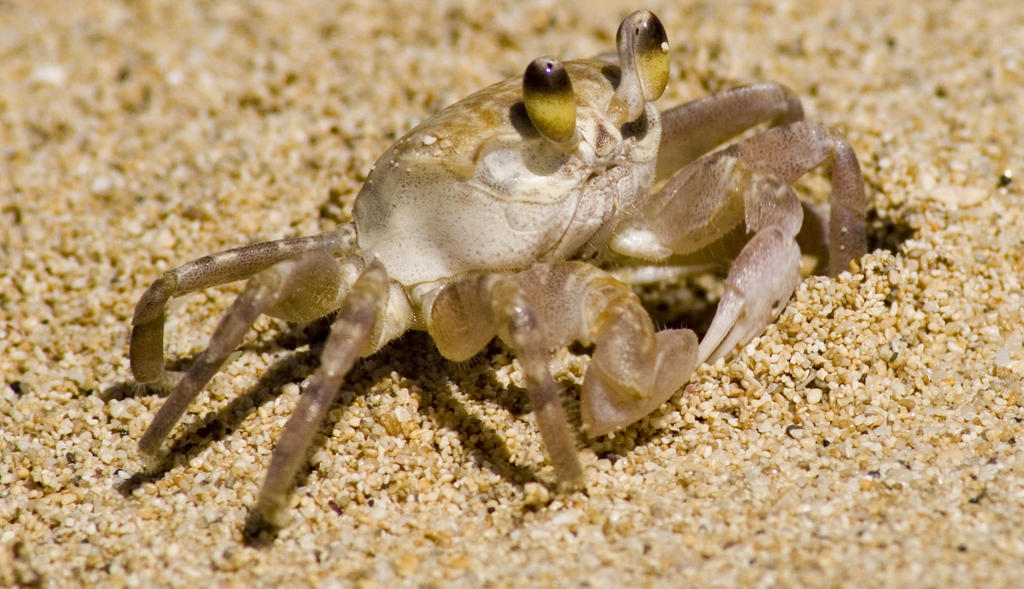
This little guy is a pallid ghost crab (Ocypode pallidula Jacquinot 1852). These crabs are small (usually under 3 cm carapace width) scavengers that live in high intertidal to supertidal areas where there is sand. They have an Indo-Pacific distribution, and are indigenous to the Hawaiian islands.

Photo taken 14 August 2005 at Kualoa Beach Park, Oahu
1/1000 sec at F11, 300mm lens.

Kansas BOE wants to lie to students - Part 3

It's time for our next look at the Kansas Board of Education majority's continuing crusade to push their own narrow-minded sectarian agenda at the expense of actual education. Today's entry can be found on page 80 of the draft science standards (available as a pdf on the Kansas Department of Eduation's website):

Grade 8-12 indicator 7: explains proposed scientific explanations of the origin of life as well as scientific criticisms of those explanations.


It's worth noting at this point that this particular indicator is not present in the March 9th draft of the science standards (also available as a pdf) - the one written by the science standards committee without excessive input from the elected BoE members. It is a recent addition by the Board of Education. I am not, however, planning to devote time and energy to discussing the indicator itself. My concern is more with the "additional specificity" points that they list with this new indicator.


7. Some of the scientific criticisms include:
a A lack of empirical evidence for a “primordial soup” or a chemically hospitable pre-biotic atmosphere;
b. The lack of adequate natural explanations for the genetic code, the sequences of genetic information necessary to specify life, the biochemical machinery needed to translate genetic information into functional biosystems, and the formation of proto-cells; and
c. The sudden rather than gradual emergence of organisms near the time that the Earth first became habitable.


It's really hard to figure out what the most objectionable part of that list is. There are just so many different objections.

It might be the highly questionable accuracy of those statements (for example, see Mark Isaak's Index of Creationist Claims entry CB035 for a discussion of the early atmosphere issue).

It is possible that it is the implication that a current lack of an "adequate" natural explanation is somehow positive evidence that a supernatural explanation is needed. It is also possible that the most objectionable component of this list is their failure to specify what they mean by "adequate".

It could even be the nonsensical nature of some of the "scientific criticisms" - what would a "gradual" emergence of organisms look like, and what evidence of that would reasonably be expected to be preserved?

Any of those things could be the the most objectionable thing about this list. Were the members of the KBOE's conservative majority hindered by even the slightest hint of honesty or ethical conduct, one of them might be. However, the KBOE majority has, yet again, demonstrated an unbelievable amount of sheer chutzpah - because those three items are all of the material that they have seen fit to place in the draft.

Let's look at this again. The KBOE's new indicator reads:
Grade 8-12 indicator 7: explains proposed scientific explanations of the origin of life as well as scientific criticisms of those explanations.
[emphasis mine]

7. Some of the scientific criticisms include...


Wow. Looks like they forgot to mention what the scientific explanations actually are. You'd think that they would at least try to make a point of demonstrating something that bears some faint resemblance to even-handedness, wouldn't you? After all, this is the same group of people who claim that their objectives are:

1) to help students understand the full range of scientific views that exist on this topic, 2) to enhance critical thinking and the understanding of the scientific method by encouraging students to study different and opposing scientific evidence, and 3) to ensure that science education in our state is “secular, neutral, and non-ideological.”


Is it just me, or is their failure to list any of the "proposed scientific explanations for the origin of life" just slightly inconsistent with all three of those stated objectives?

13 August 2005

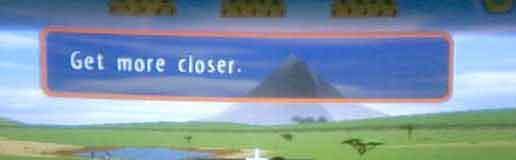
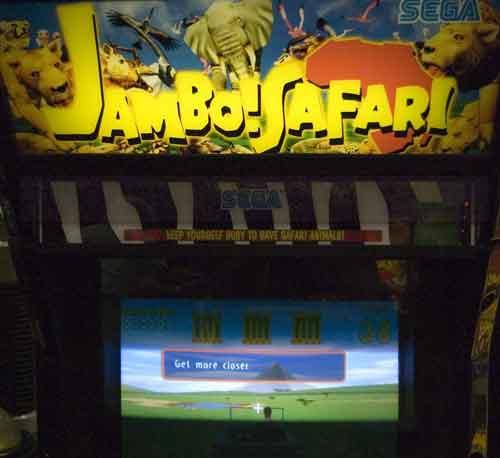
Why isn't our children learning?


I took these pictures, showing the screen of a Sega video game, at a nearby Chuck E. Cheese today. I think they definitely help answer Bush's question about education.

12 August 2005

Kansas BOE wants to lie to students - Part 2

The second entry in what is starting to look like a long series of posts on the Kansas BoE's attempt to uneducate their students comes from the same page in the standards as the item I discussed yeaterday:

c. Patterns of diversification and extinction of organisms are documented in the fossil record. Evidence also indicates that simple, bacteria-like life may have existed billions of years ago. However, in many cases the fossil record is not consistent with gradual, unbroken sequences postulated by biological evolution.
[italics denotes material added by the BoE in this revision]
There are many different ways that this statement could be considered to be objectionable. For the moment, I am going to focus on only one of them: the contrast between this statement, and the motives that the BoE claims on page iv of the Standards:

Regarding the scientific theory of biological evolution, the curriculum standards call for students to learn about the best evidence for modern evolutionary theory, but also to learn about areas where scientists are raising scientific criticisms of the theory. These curriculum standards reflect the Board’s objective of 1) to help students understand the full range of scientific views that exist on this topic, 2) to enhance critical thinking and the understanding of the scientific method by encouraging students to study different and opposing scientific evidence, and 3) to ensure that science education in our state is “secular, neutral, and non-ideological.”
In particular, I'd like to emphasize "objective" number one: "to help students understand the full range of scientific views that exist on this topic". One has to wonder why, if that is actually one of their objectives, they decided to parrot a highly objectionable creationist claim about the fossil record while simultaneously ignoring a real scientific controversy that covers the same material.

There have, in fact, been (and are) some scientists who feel that the fossil record indicates that evolution has not been a continuous, gradual process. Instead, they feel that the paleontological evidence supports a mode of evolution that they refer to as "punctuated equilibrium", in which a species does not appear to change substantially for long periods of change. Scientists who feel that the fossil record supports punctuated equilibrium more than continuous evolution do not doubt that evolution is a real phenomenon - the differences of opinion involve the pattern and process of evolution, not whether or not biological evolution has occurred. To put it another way, in addition to those who question whether or not the fossil record is consistent with a gradual evolutionary process, there also who question whether or not evolution should be expected to always (or even normally) be a constant, gradual process - at least in geological terms.

It is difficult to understand how the members of the Kansas Board of Education could be unaware of this issue - it has even gotten attention in creationist publications. In order to simply be ignorant about the scientific debate that punctuated equilibrium sparked, the KBOE would have to be totally and completely oblivious of a topic that has been prominently discussed in both the popular and scientific literature for over two decades.

It is possible that the majority of the KBOE are gibbering idiots when it comes to any actual knowledge of evolution, of course. However, that would hardly be an admirable quality in a group of people who are actively trying, against the advice of countless real scientists, to change the way evolution is being taught. Such ignorance could, at this point in time, only be willful in nature, and is no more excusable than outright dishonesty - particularly from those in a position of such responsibility.

Personally, I doubt that the KBOE majority is ignorant. They are simply determined to paint the theory of biological evolution in as unfavorable a light as possible. They have reluctantly determined that they cannot remove evolution from their curriculum, and that they cannot add a blatantly religious alternative. So they have, instead, decided to make sure that any mention of evolution is offset by as much creationist drivel as they can sneak into the curriculum as "evidence against evolution."

"[S]ecular, neutral, and non-ideological". Sure. You have to give them credit for that much, anyway - they are every bit as honest about their motives as they are about science.

11 August 2005

Kansas BOE wants to lie to students - Part I

As I mentioned in an earlier post, the Kansas Board of Education has given preliminary approval to a set of science standards that have a strong anti-evolution bias. This bias becomes apparent literally before page one of the standards, and is apparent in any number of ways. Previously, I blogged on a change in language early in the document that singles out evolution, making it appear to be more dubious than other theories listed. Today, I am going to begin to examine some of the actual standards and benchmarks most affected by the KBOE's efforts to "improve" the way evolution is taught in their state. This will be the first in a series of posts looking at the specifics, since there are way, way too many objectionable areas to cover in a single post.

I'm going to start with an addition that demonstrates true chutzpah. (For those of you not familiar with the Yiddish term, it is difficult to translate directly, but can best be described as the quality displayed by a man who craps on his neighbor's doorstep, then knocks and asks to borrow some toilet paper.) Kansas' contribution to the art of chutzpah is found on page 78 of the standards, which are available as a pdf file on the Kansas Department of Education website:

Additional Specificity: a. Biological evolution postulates an unguided natural process that has no discernable direction or goal.


That "additional specificity" is one of the items added to the standards by the Board of Education. Not satisfied with merely adding all sorts of completely false "evidence against evolution" to their curriculum, the KBoE has apparently decided to follow up by redefining evolution in a way that makes it explicitly atheistic. Apparently, they aren't sure if lying to their students with their bogus examples of "evidence against evolution" will be enough to convince everyone to abandon this "atheistic science", so they have decided to bear false witness about what evolution actually is, means, and implies.

An earlier version of this item, which shows up in one of the balloons on the side, actually had a little more detail:

Deleted: a. The National Association of Biology Teachers statement on teaching evolution acknowledges the unguided nature of the evolutionary process by explaining that the process “has no discernable direction or goal, including survival of a species.” (adopted 1995, revised May 2004).

I do have to admit that the more recent draft is an improvement over this, but only because the newer version contains one fewer lie. The National Association of Biology Teachers statement does not say that. The supporting material does contain that quote, but the usage in the KBOE draft is at least slightly - wait for it - out of context:

Natural selection is the primary mechanism for evolutionary changes and can be demonstrated both in the laboratory and in the wild. A differential survival and reproduction of some genetic variants within a population under an existing environmental state, natural selection has no discernable direction or goal, including survival of a species.


The difference between saying "evolution" and "natural selection" is subtle, but quite real.

There is a also a subtle but important difference between saying that something "has no discernable direction or goal" and saying that something is "unguided". The first statement is a description of a simple scientific fact. The second is a non-scientific, philosophical assessment, and does not necessarily follow from the first.

And this is not an innocent or innocuous mistake. The KBOE has been informed, repeatedly, that the statement in question is dangerously inaccurate:

The eight dissenting members worry that teaching evolution as suggested by the majority of the committee “will necessarily have the effect of causing students to reach an uninformed, but ‘reasoned’ decision that they, and all other human beings, are merely natural occurrences, accidents of nature that lack intrinsic purpose.” In reality, nothing in the standards suggested by the writing committee would cause students to reach such a conclusion. Ironically, only the statements suggested by the eight dissenting members would actually produce such a misconception: “1. a. Biological evolution postulates an unpredictable and unguided natural process that has no discernable direction or goal. (p. 14).” It is clear that the eight authors of the minority report strive so mightly to mislead students as to the meaning of evolutionary theory in order to “balance” their own distortions with a non-naturalistic (supernatural) story of origins that lies entirely outside the realm of science.
Kenneth Miller, review of Science Standards
Additional Spec. 1a. The Revisers use the NABT statement as a citation for the
following: “Biological evolution postulates an unpredictable and unguided natural process that has no discernable direction or goal. Actually, the NABT statement is:
“The diversity of life on earth is the outcome of biological evolution—an unpredictable and natural process of descent with modification that is affected by natural selection, mutation, genetic drift, migration and other natural biological and geological forces.”

Thus it is factually untrue that the NABT statement contains any wording concerning guidance, direction, or goal. This is disingenuous, at the least, on the part of the Revisers.
E. O. Wiley, review of Science Standards


5) (p. 14) Proposed change: “1. a. Biological evolution postulates an unpredictable and unguided natural process that has no discernable direction or goal. [see NABT Statement on teaching evolution]”
All scientific theories, including evolution, remain silent about “guidance”. Weather processes may be guided by a Deity, yet all meteorology assumes is that weather can be explained by appeals to highs and lows and cold fronts, etc. whether it is “guided” or not. Furthermore, the NABT statement does not support this proposed change, as the NABT statement mentions nothing about “guidance”.
Douglas Theobald, review of Science Standards


Those three are just a sampling from a set of reviews of the proposed standards that are available on the Kansas State Department of Education website. It is possible, if not probable, that some of the members of the KBOE have not actually read those reviews of their changes, since they admitted that they didn't read the standards, either. Ignorance and gross incompetance, however, are not exactly the best of excuses for the garbage that the KBOE is trying to teach innocent students.

The new public mantra f0r the religious, anti-evolution bigots may be "teach the controversy" or "teach the evidence against evolution", and it might sound appealing, but that's not really what they are asking. What they are asking is that they be allowed to take your tax dollars and use them to lie to your children so that their narrow-minded beliefs will not be hurt by the harsh winds of reality. They have no honor, no shame, and if they feel that their motives are pure, no morals when it comes to choosing their methods. But they are popular enough to win elections. They should scare you. They certainly scare me.

A disturbing conversation.

I had a conversation with my advisor not too long ago, about the project that I'm planning on doing for my dissertation. It didn't go quite the way I had expected.

"So, what are your thoughts on your dissertation project?"

"Well, I'd like to look at multiple loci in..." I briefly sketched out my ideas.

"That sounds like it has some potential. What do you think you should start out with?"

That was a question that I had expected, and was well prepared to answer. I spent the better part of the next five minutes making a case for starting out by collecting some sequence data for the alcohol dehydrogenase locus. I've worked with this professor for the last couple of years, and I get along with him pretty well, so I was confident that he'd see things my way and let me start work extracting DNA. I finished making my case, and sat back with a warm, comfortable feeling, totally unconcerned by the sadistic glint in his eye.

"Interesting idea, but I was thinking about having you start out with something else."

"Oh?" I said, certain that he was going to suggest that I start with a mitochondrial locus instead. "Where do you want me to start."

"With a dissertation proposal."

"I still think it might be better to start with a nuclear site instead of the mito..." I began, as my brain, paralyzed by the horror inspired by my advisor's remark, struggled to get my mouth's attention. "...what did you say???"

"Proposal."

"You know, I was really hoping to put that off for just a little bit longer. Not too long, just until I have a better feel for the project."

"And just how long did you think that might take?"

"I don't know, but not too long," I said. "I should be able to get it done right after..."

"Right after you finish the dissertation?" (Damn, how did he know what I was thinking.)

"Maybe not quite that long..."

"It's proposal time. No kidding. Time to get it done."

I took it well, I thought.

"Ok, ok, I'll get it done." Now on to the topic that is always central to every student's mind when an assignment is mentioned; "About how long does it need to be?"

"At least thirty pages, preferably not more than about fifty, and you should have around a hundred references."

"That's fantastic. I was expecting a dissertation to be a lot bigger than that. But what I meant to ask was how long the proposal needed to be. What's so funny?"

So now I know what I'll be doing this semester. Procrastinating. Maybe if I blog enough, the problem will go away on its own...