15 February 2006

Molecules and Evolution.

I spend a lot of time on this blog writing about evolution, and about Intelligent Design, and about why one is bad and the other good. This time, I'm going to try to do something a little different, and discuss one of the many lines of evidence for evolution: the similarities that we see when we compare DNA sequences from different animals.

The example that I'm going to use is hemoglobin from humans and chimps. Hemoglobin is a protein that is found in red blood cells. The hemoglobin picks up oxygen in the lungs and carries it to the different tissues. Hemoglobin is not a single molecule. It is a complex protein that is made of several smaller proteins. Each of those proteins is produced by a gene. We're going to look at one of those genes: alpha-globin.

The National Institutes of Health maintains a database known as GenBank. GenBank's basically Google for hard-core biology geeks. It's an international database where scientists store DNA and protein sequences. I rummaged around there, and came up with a alpha-globin DNA sequences from a human and a chimp. I'll put these sequences in pairs of lines, with the human sequence on top and the chimp sequence on the bottom.
Human: ACT CTT CTG GTC CCC ACA GAC TCA GAg AGA
Chimp: ACT CTT CTG GTC CCC ACA GAC TCA GAa AGA

Human: ACC CAC CAT GGT GCT GTC TCC TGC CGA CAA
Chimp: ACC CAC CAT GGT GCT GTC TCC TGC CGA CAA

Human: GAC CAA CGT AAG GCC GCC TGG GGT AAG GTC
Chimp: GAC CAA CGT AAG GCC GCC TGG GGT AAG GTC

Human: GGC GCG CAC GCT GGC GAG TAT GGT GCG GAG
Chimp: GGC GCG CAC GCT GGC GAG TAT GGT GCG GAG

Human: GCC CTG GAG AGG ATG TTC CTG TCC TTC CCC
Chimp: GCC CTG GAG AGG ATG TTC CTG TCC TTC CCC
That's only part of the sequence, but it's pretty representative. I showed the first 150 "letters" of the DNA sequence. There's one difference in these 150 bases, and the full sequence shows 99% similarity.

I've shown you that humans and chimps have very similar alpha-globin gene sequences, but so far that's all I've shown you. I haven't explained why I think that this similarity indicates evolution instead of something else. After all, it might just be that the gene does the same things, and that explains the similarity.

The gene does, in fact, do exactly the same thing in chimps that it does in humans. The gene makes a protein that is part of hemoglobin in both species. In fact, even though the genes are slightly different, the portion of the gene that I showed the sequence for makes exactly the same protein in both species. There is a difference in the DNA sequence, but not in the protein sequence.

Our proteins are strings of amino acids joined together in a line. There are twenty amino acids that we use in our proteins. The "genetic code" that tells our body the order that the amino acids should go in uses three letter DNA "words" to indicate each amino acid. There are four DNA letters, so there are 64 possible words. That's a lot more words than we need, so most of the amino acids have more than one "word" assigned in the code.

This means that there are literally hundreds of possible DNA sequences that could make exactly the same protein sequence that we see in human and chimp alpha-globin. The sequences that humans and chimps use are almost identical. They aren't exactly the same, but they are really close. The sequence for an orang-utan is a bit more different.

These slight differences, more than the similarities, are what makes us view this as evidence for evolution.

13 February 2006

Bloody stupid media

It looks like the media got a bit pissed at Scott McClellan during the press briefing today. Why? Because they weren't promptly informed that the Vice President accidentally shot his hunting partner.

Useless whining schmucks.

They have been routinely mushroomed by this administration over the past five years on a virtually limitless range of subjects. They have very rarely demonstrated anger about any of this. (Of course, it's possible that they still haven't noticed.) They could have gotten angry about being lied to on a policy story - it's not like that hasn't happened - but, no. Instead, they pitch a fit because they weren't told about a story that looks to be more fodder for the Daily Show than serious news.

12 February 2006

Dude, my bad.


Darwin Day

Today is the 197th anniversary of the birth of Charles Darwin. In honor of this, I've tried to pull together a mini-blog carnival of posts related to Darwin and evolution.

The Darwin Day website has a list of events from around the world that were (or are being) held today in celebration of Darwin's birthday. Scanning the list, it looks like most of these are scientific lectures about evolution and evolutionary biology.

Scientists aren't the only ones who are giving talks and making presentations today. Today is being marked as Evolution Sunday in hundreds of churches across the United States. This event was put together by a the same person who started the Clergy Letter Project, which has collected over 10,000 signatures of clergy who support teaching real science in the science classroom. For those interested, their website has a list of links to some of the sermons.

Darwin's birthday and evolution have gotten some attention from bloggers recently, too. PZ has a picture and an excerpt from a biography of Darwin. Actually, pictures seem to be a real theme for today. There are a couple of other photographs on blogs, Olduvai George has a nice portrait of a young Darwin, and Jennifer Forman Orth gives us an iconic image of Darwin in an unlikely place.

There are also several blog posts that have gone up in recent days that fit this occasion well. Tara Smith, over at Aetiology, was kind enough to write a post about how evolution relates to her own research. 10,000 Birds wrote a post earlier this week that presents a nice discussion of evolution and birds. Over at Daily Kos, there's a brief history of the evolution of humans since the big bang. Alun touches on the evolution of religion in a post, and there's an article on evolution written by Niles Eldredge over at The Virginia Quarterly Review. Finally, I wrote a small piece about how we get new species the other day that seems to fit the occasion.

Happy Birthday, Charles.

09 February 2006

A reality-impaired perspective on current events

As I mentioned a couple of days ago, NASA finally got around to firing the two-bit political hack that had been trying to make sure that their scientists published only those results that fit his restricted worldview. Today, the New York Times has his side of the story.

It's an interesting read. Apparently, he left because he was tired of being smeared by the media. The whole didn't actually graduate thing had nothing to do with it. Really. Trust him.

08 February 2006

Going Different Directions in the Same Space

As many of you know, I'm a graduate student in a zoology department. When I tell kids that, most of them think I'm studying to become a zookeeper. They also usually think that's something pretty cool. When I explain that I'm really studying to be a scientist who studies how animals change, it usually turns out to be a letdown. For some reason, kids are usually happier thinking that I might get eaten by the lion or stepped on by an elephant.

Anyway, what I actually study is speciation mechanisms. What that means is that I'm trying to look at the DNA of closely related species in order to figure out why they wound up as different species. There are a lot of questions left to answer, and lots of scientists are working in this area.

I'm guessing that right about now at least some of you are thinking something along the lines of, "Hey, wait a minute! Haven't you guys been telling us that Darwin figured that out way back when?"

What Darwin and that Wallace fellow that keeps getting left out of the story both managed to figure out is that new species are made by changing old species. They also figured out that natural selection was one way to make this happen - if some organisms are different from most of the rest of their species in a way that makes them more likely to survive and reproduce, and if the differences get passed to their offspring, then in time the bulk of the population will wind up with that trait. If this happens to only one population of a species, the changes can make that population so different that they won't be able to mate with the other populations. When that happens, you have two species where you used to have one.

That view is a little simplified, and we don't think that it is the only process that leads to the formation of new species, but it's more or less accurate. The reason that scientists are still gainfully employed working on the question of how you get new species is that the view is also a little bit corse-grained. It's like looking at a picture on a really old, low-resolution monitor. You can see things well enough to see what it is a picture of, but you don't see a lot of the details - and details can be very important.

Another way to look at this might be to use the way we grow up as an example. We know that there are children, we know that there are adults, and we know that adults happen when children grow up. You can look at a ten year old and a forty year old and know that one is a kid and one is an adult. Figuring out exactly when the change from child to adult took place is a lot harder, and so is figuring out what "growing up" actually means.

Those of us who study speciation spend a lot of time looking at geography. In part, we do this because looking at the geography can mean that you get to go lots of cool places to do your research. Mostly, though, we look at the geography because figuring out where the two populations were living in relation to each other when they split into different species can give us some good clues about how it might have happened.

There are basically three ways that you can arrange two populations in space relative to each other. Both populations can be living in the same place (we call this "sympatric"), the two populations can be living in different places ("allopatric"), or the two populations could be arranged so that they are mostly living in different places, but with an area of overlap between them ("parapatric"). That's a bit of a simplification, and there are some fairly obscure variations that can turn out to be important when you actually start to study things, but it's good enough for our purposes.

In theory, populations can split into different species in any of those three categories. There are some scientists who have developed mathematical models of the process of speciation, and those models all seem to indicate that it doesn't matter if the populations are allopatric, parapatric, or sympatric - given the right set of circumstances they can wind up as two different species.

That's the theory. When we take the theory to the field, what we find is that it's pretty easy to find examples of allopatric and parapatric speciation, but it's really hard to find clear cut cases where two populations living in the same place have split into different species. There are two resons for this. One is that it is a little easier for populations to split when they don't live in the same place. The other is that the way these things are defined makes it very hard to prove that the species were living in the same place when they split.

The exact definition of "sympatric" has actually been a little hard to pin down. For a long time, it basically meant that the populations weren't living in different places. For a long time this was good enough, but when people actually started to look at what happens to the individuals involved, it got a bit harder to pin down. For example, if one population of insects lives in the branches of the trees on a small island, while another population lives in the low bushes, are they really living in the same place? That might sound like it's just nit-picking, but when you go to look at the population genetics you find that seemingly trivial distinctions like that can make a really big difference in how likely it is that the populations will completely separate.

One of the researchers who models speciation recently came up with a more precise definition. He said that two populations can be considered to be truly sympatric when mating is random with respect to birthplace. Now that's pretty obviously an ideal that isn't often going to be achieved, but there can be situations that at least come close. You'd think that solved the problem, right? Unfortunately, you'd be wrong.

There are a fair number of scientists who really don't like the idea of sympatric speciation. For a long time, Ernst Mayr, who was an extremely influential evolutionary biologist, argued that populations could only separate into two species if they were separated from each other by some sort of barrier. He made a relatively persuasive case for that positio and argued his case with passion for decades, so it's no surprise that there are some scientists who are skeptical of the possibility of sympatric speciation. In the past, when scientists have presented cases where it looks like two species split while living in the same place, the skeptics have demanded proof that the species were never geographically isolated from each other during their divergence. Proving a negative like that is kind of tough, so the controversy over whether or not two species can actually split while living in the same place has continued.

In this week's issue of the journal Nature, two different papers are presented that offer pretty convincing proof that species have diverged in sympatry. In both cases, two species that are clearly more closely related to each other than to any other species are found living in places that make it extrordinarily unlikely that the populations were ever geographically isolated from one another.

In one case, two species of cichlid fish are found living in a small, isolated lake in Nicaragua. The habitat within the lake is relatively uniform, and the authors demonstrated that the two species are not reproducing with each other and are physically, ecologically, and genetically different. In technical terms, that's called a "grand slam." For this to be anything other than sympatric speciation, a founding population of fish would have had to arrived not once but twice. That's unlikely enough to begin with, before you start to take into account the similarities that these two species share with each other but not with any of their relatives in other nearby lakes. When you take that into account, it becomes extrordinarily improbable that they didn't split in that lake.

The second case involves two species of palm on Lord Howe Island off Australia. Here, again, the species seem to be reproductively, physically, and genetically distinct. They also flower at different times, and the genetic work showed evidence that selection was operating to increase the divergence between these species. This is another really solid case for sympatric speciation.

These discoveries should convince all but the most unreasonably skeptical that sympatric speciation almost certainly has happened. That means that we know that species can diverge in all three of the different geographic relationships, and that they probably have done so. That, in turn, tells us that speciation almost certainly doesn't always happen through the same mechanisms.

By this point, I've probably lost half the people who started to read this, and most of the rest of you are probably wondering why I thought something this confusing and boring is actually exciting enough to be worth blogging. In part, of course, it's because I am, as my brothers will cheerfully confirm, a hopeless science geek. But if you've read this far you're probably one too (or you're my mother), so that can't be all of it. Part of it is because this is hot research in my own field, but that's not all of it either - I don't write about every cool article I read.

The reason I thought this was worth writing about - the take-home message of this post - is actually pretty simple. Evolutionary biology is a very active field, and we continue to learn new and exciting things almost every day. It is a field populated by people who are eager and driven to learn new things about the way evolution works. It is not a cult of personality centered around one man who wrote one book almost 150 years ago, as some would have you believe.

07 February 2006

Nasa PR

A large number of bloggers this week have been all over the situation at NASA public affairs, where at least one presidential appointee has been attempting to silence any scientist that wants to report on things - like global warming - that don't fit well with the president's unreality-based worldview. (See my post earlier this week for links to some of the commentary.)

Blogger Nick Anthis reported yesterday that 24-year old Bush appointee and would-be scientific censor George Deutsch, who has been at the center of the scandal, did not actually graduate from college as his resume claimed. Today, the New York Times confirmed Mr. Deutsch's lack of degree. The Times also reports that Deutsch responded to this revelation by falling on his sword and resigning. One down, and an unknown number of unqualified political hacks to go.

Of course, this whole thing with Deutsch is just an amusing sideshow when viewed in light of the overall pattern of distorting science. It does, however, raise an important question: how did he get hired in the first place? Aside from his White House connections, Deutsch's only remotely relevant qualification was his alledged journalism degree. He has no background in science. His non-college experience is working on the Bush re-election campaign. The journalism degree seems to be it. Apparently, being an administration bootlicker is such a great qualification that nobody bothered to verify anything else.

Patronage - Gotta love it.

Educational Disparities

I had more fun than usual today - instead of doing labwork and going to class, I cut school and volunteered as a judge for the Hawaii Association of Independent Schools annual science fair. For those of you not familiar with our school system out here, HAIS covers the private schools on the island. Most are religious, but there are also a couple of private schools that don't seem to be religiously affiliated.

It was interesting, and it definitely wasn't what I was expecting. There were something like 45 entries in the category that I was judging (grade 9-12 research), and I got to talk to about 24 of the entrants. Along the way, I saw a couple of the worst research projects I'd ever seen, but I also saw some that totally blew me out of the water. There were several entries that could just as easily have been up at a scientific conference.

In some cases, the difference in quality was clearly related to the motivation and aptitude of the student. There were a couple of projects that were pure pseudoscience, and a few more that lacked any understanding of scientific method. There were also a couple of students who pretty obviously didn't know anything about what they were talking about. Other students knew more about their particular area of interest within their field than I did, and I wound up learning from them.

Unfortunately, a great deal of the disparity was also related to where the students went to school. This is great for the students that go to the schools that have extrordinary facilities. It's not so good for some of the others.

Some of the schools have science facilities available to their students that are better equipped than the lab I work in. One student, from Kamehameha Schools, did a project attempting to look at the structure of a particular enzyme across a range of taxa. Some of the work presented involved taking RNA, using an enzyme to convert it back to DNA, making a large number of copies of the DNA, and then sequencing the DNA. I asked the student where the work was done, thinking that it was a project done with a University of Hawaii researcher. The answer: "I did it at school." I said, "No, I meant where did you have the sequencing done." The answer: "Yeah, uh, we have our own sequencer." Their high school has a DNA sequencer. My lab doesn't have a sequencer.

Other students did not have access to anywhere near the same level of facilities. Where some students were doing their lab work in state of the art labs, and growing bacteria in temperature controlled incubators, others were doing their lab work on the kitchen counter and putting their bacteria out in the sun to incubate. Students at some schools had access to university researchers. Others did not. Some students participated in an intensive summer program that taught research methods. Others were being taught from the textbook, with the goal of being able to pass standardized tests.

Talking to the students was great. Some were clearly there because they had to be, and didn't really care about what they were doing. Others were highly motivated and extrordinarily enthusiastic - the type of student that you hope like hell goes on to a career in science.

Ranking their projects wasn't so great. I started from the bottom, and had no problems until I got up to the top half. That was when things started to suck. There were a few students there who were clearly motivated, intelligent, and creative, but who hadn't had access to anything near the level of resources that others did. Their projects, unsurprisingly, simply weren't as good as those with access to more people and equipment. Unfortunately, the student's potential isn't really something that I could give them a lot of points for - it was a science fair, it was about doing and presenting research, and the research just wasn't as good. And, if I did give them points for working with fewer resources, I'd be punishing others for having access to good resources. I just love problems that have no fair solutions, don't you?

I don't resent schools, like Kamehameha, that have lots of really, really good equipment, superb faculty, and special intensive science courses for interested students. I just wish everyone had access to that caliber of education. It would be expensive as hell, but we could do it. We could make teaching a high-paid, prestigious career. We could build the best education program in the world. It would even be the American thing to do, since it would give everyone a more level playing field for their career.

We won't, of course, because people don't like paying taxes, and the idiot with the Pennsylvania Avenue address isn't about to make the actual commitment to education that it would require.

But we should, damn it. We should.

06 February 2006

Support, my ass.

The White House has released the President's 2007 budget request, and there's not a lot of surprises there. Lots of projects are on the chopping block, defense and homeland security spending are up, the deficit is huge, the moron still wants to make his tax cuts permanent, and he wants the bill for that to mostly come out of programs that benefit the poor. Shocker, huh.

I'll probably blog some more on some of the science-related areas of the budget later on. Right now, there's one area that I want to look at first: the military pay raise. I know, it's not the most obvious place to start off, but that's where the vast bulk of our family income comes from these days, and it's always nice to see how the next year is looking. I also like to take a look and see if Bush is putting the government's wallet where his "support the troops" rhetoric comes from.

It will probably come as a shock to most of you (yes, that is sarcasm) to find that Bush talks a real good game, but when it comes time to go and actually do something, he's nowhere to be found. The proposed annual pay raise for the military next year is 2.2 percent. The economic assumptions that the budget is based on predict an inflation rate of 2.4 percent.

That's right. The same White House that tries to brand anyone who disagrees with their war as "unsupportive" of the troops has decided to show their support by suggesting a military pay raise that doesn't even match their own inflation prediction.

For some reason, that's not a level of support that impresses me.

05 February 2006

Clash of Values

I've read a few posts over the last few days, written by bloggers I usually enjoy reading, on the cartoons of the Prophet Mohammad issue. Wilkins comes closest to my own views, but none of the posts really manages to capture what I think is the essence of the issue.

This is both a simple issue and a complex one, all at the same time.

PZ is right about some of the complexities involved. There are some parallels between this situation and various ugly forms of discrimination and prejudice. There are also issues of perception and of national and ethnic identity. It is entirely possible, if not likely, that some of the anger these cartoons have inspired stems from the glaring economic disparity between the parts of the world doing the mocking and the parts being mocked. I think that those are real problems, but I think that the simpler issue is also the more important - at least at the moment.

That issue is freedom, and whether cultures based on the freedoms that provide the stable core for liberal democracies can coexist peacefully in the same world with cultures that demand that their values be given special treatment.

This case may have been started by a low-circulation Danish newspaper trying to piss off a religious group that is a distinct minority in their country, but it has rapidly turned into an international dispute involving the whole world. It has also brought to light an extremely alarming school of thought on freedom of expression.

The armed takeover or burning of embassies is bad, as are death threats. They're also nothing new in the stormy world of modern politics, particularly when we're talking about the Mideast. To put it another way, the violence is appalling but hardly surprising.

What's more alarming, at least in my opinion, are some of the views that various nations have expressed about what freedom of expression should mean. Newspaper editorials from Nepal and Bangadesh, demand that the freedom of expression be limited to exclude criticism of religion. Pakistan issued a statement declaring that freedom of expression does not extend to the freedom to insult someones religion, and the president of Afghanistan said that the publication of those comics was an act that, "must never be allowed to be repeated." Other Islamic nations have made similar statements.

The Muslim world wasn't the only place where governments have objected to the publication of the cartoons. A South African court has issued a ruling barring the publication of those images there. Our own State Department has been at best lukewarm in their support for press freedom in this case. And the Vatican informs us that, "the right to freedom of thought and expression...cannot imply the right to offend the religious sentiment of believers."

Of course, it should not come as a surprise that the Vatican is not in favor of the right to blaspheme. However, the right to blaspheme is absolutely critical in a secular society - and while people may bash secularism, the secular society has proven to be the single best way of creating an environment where everyone is free to worship (or not) as they see fit.

Without the freedom to blaspheme, there can be no true freedom of speech and there can be no true freedom of religion. These civil liberties are at the core of western democracy, and cannot be set aside just because religious people have had their feelings hurt.

The Commissar suggests that a good way to show support for the freedom of expression in this case is to reprint the cartoons in question. I am not going to do that. I fully support his right, and the rights of others, to piss off whoever they want. Personally, I think that the cartoons represent a gratuitous insult to Muslims, and I decline to personally participate in spreading them. Similarly, I fully support the right of the KKK to peacefully march through a community, but I refuse to put on a sheet and march with them.

The situation with these cartoons looks more and more like a clash of values with every day. I, for one, am not willing to have my freedom of religion and expression restricted to satisfy anyone's sensibilities. Many Muslims, on the other hand, appear unwilling to tolerate a society that allows people to insult Mohammad. I am optimistic enough to hope that we will be able to find a way to resolve this cultural divide to everyone's satisfaction, but I am realistic enough to realize that the hope appears faint.

04 February 2006

Politicizing Science

Work and a Blogger issue have kept me offline for the last day or two, and lots of other people have weighed in on the latest Bush administration attack on science, but I still wanted to throw in my .02.

The Bush administration apparently gave some political idiot with no experience or background in science a job as a public affairs hack at NASA headquarters. From this position, idiot-boy has seen fit to try (with a notable lack of success) to muzzle a well-known climate scientist, and to make sure that the NASA website doesn't do anything to piss off creationists.

The irony of all this going on at the same time that Bush is wandering around talking about the need to improve our standing in science is impressive, but that's really all that's remarkable about this event.

I'm pissed off about it, but entirely unsurprised. This is just the Imperial Presidency in action again. The sole mission of this administration right now is to make the president look good. Everything else comes later. We've seen it with regard to the warrentless wiretaps (sorry, I forgot, that's been rebranded as "terrorist surveilance"), we've seen it with Iraq, and we're seeing it now with science.

It's bad. It's fundamentally wrong. It's scary. It's threatening our democracy. But it's not a surprise.

01 February 2006

Tangled Bank #46

Tangled Bank 46 is now available at the new Adventures in Science and Ethics digs. Enjoy.

31 January 2006

reflexes

Wesley Elsberry, over at The Austringer, posted a link to a cool little test of reflexes. I blew about ten minutes on it, and found that it was difficult to make it past five seconds. Interestingly, though, I also found that if I could make it past the first five seconds, I would almost always survive for longer than 15 seconds. (Best time: a little over 22 sec).

One Nation, Divided.

There's an invitation, over at Radio Open Source, for bloggers to write their own version (BOTU) of the State of the Union address. It's a last minute kind of thing, so we get a few minutes or a couple of hours to pound out our attempts at something that the White House spends months at.

With that in mind, here's my take:
==

Today, more than at any other time since the Civil War, America stands divided. Half of all Americans, it seems, can almost always be counted on to have an opinion strongly opposed to the other half. The divide seems to stretch across almost every aspect of our culture.

We did not seek to become a nation divided, but that is what we are. The divisions have deepened in recent years, and at times it seems that the gap is unbridgable. But bridge it we must, for, as Lincoln said, "A house divided against itself cannot stand."

We cannot fail to close this gap, for if we do we will be faced with a crisis worse than what Lincoln was faced with. At that time, the divisions in the nation cut cleanly across geographical divides. Now they do not - colors on the map may paint a picture that looks clean, but these divisions run deeper, and they run through the middle of areas that are painted a single color on televised political maps.

How we choose to deal with this the divide will define our nation for years to come.

We have, at this moment, a choice between two paths. We can continue down the path that we have been - a path of ten-word policy soundbites, a path where distorting the arguments of your opponents is the norm, a path where every policy decision is treated as a win or lose contest by the two main parties.

That is the path to national destruction, but we can continue along it until it reaches its end. We can choose to fail.

We can also choose to succeed. That is the harder path, because it will require a massive shift in our political culture. It will require us to stop looking at our political opponents as the enemy, and it will require us to stop acting that way.

It will require us, most of all, to truly recognize that a diversity of ideas and ideals is a strength.

It may require us to compromise with each other, but it need not. Bipartisanship can be good, but sometimes a partisan position is the right choice, and sometimes it is better to pick one position than to try to blend two radically different approaches. The right choice will be different at different times, and on different issues.

We do not need to embrace the milquetoast middle. What we need is honest and open debate on the issues. We need to work with each other sometimes, and to not hold a grudge when we need to work against each other. We need to argue the issues fairly, and to conduct open debates.

We need, in short, to do nothing more than to recommit ourselves to a system of government that recognizes the value of opposition, and the strength of diversity.

30 January 2006

The Spineless

PZ Myers has posted two different installments of Circus of the Spineless over at Pharyngula. The first features some of our favorite invertebrate animals. The second features some of our least favorite invertebrate humans. Enjoy.

29 January 2006

All in a day's work...

There's nothing in the world like being a biologist on a beautiful Sunday in Hawaii.

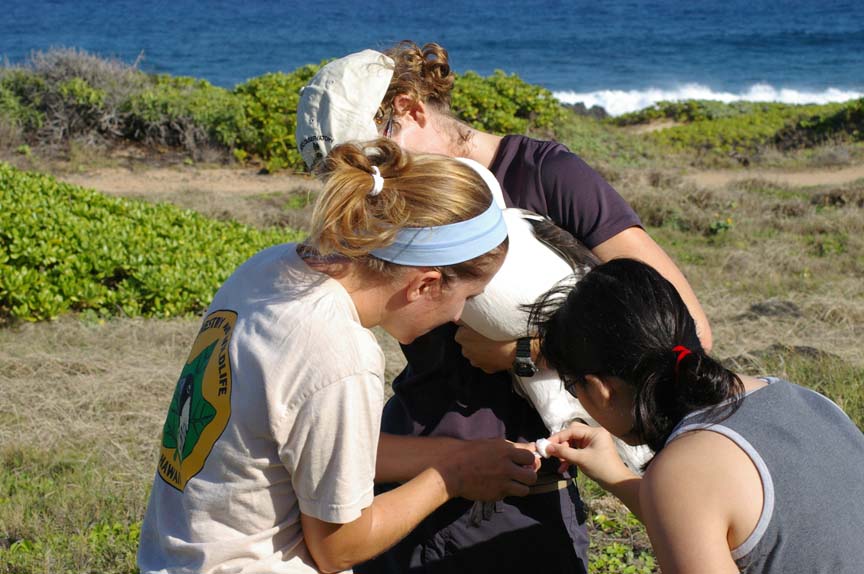
One of the other grad students in the lab, Lindsay, is doing her dissertation work on the Laysan Albatross, and offered to show the rest of us her field site at Kaena Point. For those of you who aren't familiar with it, Kaena Point is the northwestern tip of Oahu. A fair amount of the tip of the island is a nature preserve, with good reason. A number of seabirds have breeding colonies there, Hawaiian monk seals are frequently seen on the beaches in the area, and there is a great deal of native vegetation. Oahu's environment has been massively disturbed by humans, and Kaena Point is one of the few natural areas left that hasn't been entirely ruined by human contact.

Lindsay is keeping tabs on this particular colony, checking on the progress of nests and eggs, figuring out which birds are mates, and who is responsible for which nest, and other such things. The rest of us were there partly to assist her and partly to sightsee.

This group of birds are the unmated crowd. They haven't yet been able to successfully mate, and are just hanging around the edges on the colony. Most of these had run across Lindsey before, and had the leg bands to show for it. Another couple did not, but took off before we got close to them. One wasn't so lucky, and got grabbed.

Kim's holding the bird for Lindsay, who is taking a blood sample. Nori is all set to apply pressure to stop the bleeding. The blood sample will be used for genetic work later on. (It's so much more fun doing the population genetics for a real population than it is working on things that only live in the lab.)

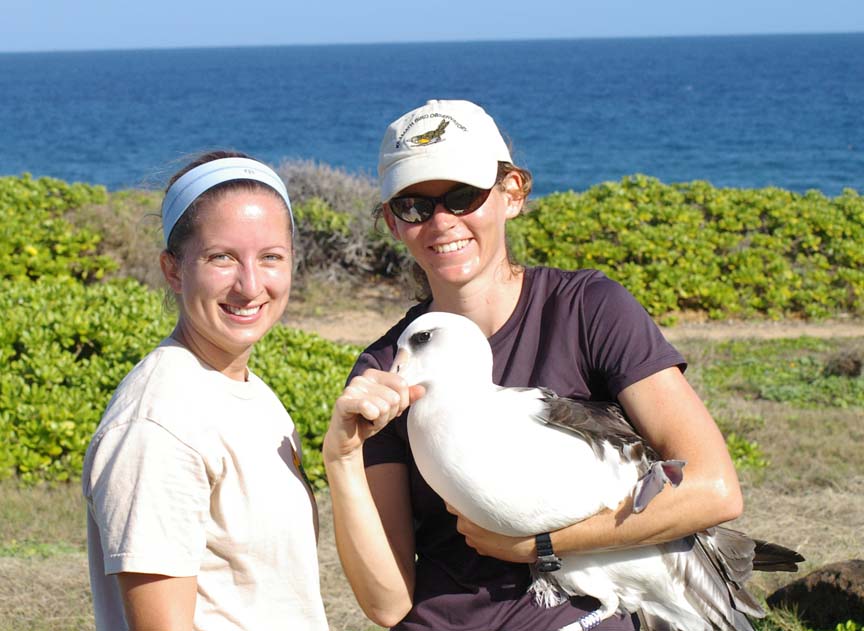
Lindsay and Kim take a second to pose for a picture with the bird. The bird is now wearing a pair of leg bands, and has donated a small amount of blood to further scientific advancement. Everyone looks so nice and calm. Even the bird almost looks content in this picture. It looked so nice and easy I figured I could give it a shot the next time. As it turns out, I was mistaken.


Yes, that is birdshit on my pants. A couple of minutes after that shot was taken, the bird managed to wiggle its beak free and take a couple of nips out of me. Lindsay got her blood sample, but I think the bird got more of mine.

By the time we got back to the parking lot, I was hot, tired, and sweaty. I had mud and birdcrap all over my clothes. I had a bit of sunburn on my face, except for a couple of little patches where the band-aids covered up some bird bites. I had scratches on my arms from albatross claws and from thorns. And I was totally and completely happy.

It wasn't just because we had seen monk seals and humpback whales, either. The charismatic megafauna are fun to look at, and it's nice to get some pictures of them, but the real joy comes from something else.

I'm not sure how to describe it, either. I think the closest I can come is that it's the joy of the active persuit of knowledge. It's what Feynman called the "kick in the discovery" and "the pleasure in finding the thing out." It's knowing that even if this isn't your project, your research, you are still part of something more than just a walk on the beach. It's wondering what makes things tick, and how this little piece fits into the puzzle of reality. It's the knowledge that no matter how much gets figured out this time, there will always be something else to learn later on. It's the childlike delight in poking at something just to find out what happens if you do. Being a part of the neverending story of science is just plain fun, and words alone simply can't do it justice.

27 January 2006

What a difference a day makes.

The Discovery Institute, over at their Media Complaints Division Blog, has posted yet another article castigating Judge Jones for ruling that Intelligent Design is unscientific.

This one, by a second-year law student, takes more or less the same tone as the others:
In this detailed analysis, I will take a close look at Judge Jones reasoning, and evaluate the potential legal basis for determining the scientific status of ID. Ultimately, I find that the Kitzmiller opinion has no legal basis to determine the scientific status of intelligent design, and as such, is merely the opinion of one man, not the law as proclaimed by a federal district court judge.
Ed Brayton, over at Dispatches, has already fisked the substance of that post. I'd like to take a second to look at something else: the Discovery Institute's pre-decision view of how the judge should rule.

Back on October 17th, in a press release titled, "Discovery Institute Tells Dover Judge Teaching About Intelligent Design is Constitutional," Robert Crowther had this to say:
Today, the Discovery Institute, the nation’s leading think tank researching intelligent design, filed an Amicus Curiae (i.e. “Friend of the Court”) brief in the Kitzmiller v. Dover Area School District case urging the judge to rule that it is not unconstitutional to teach about the scientific theory of intelligent design.
Let's be clear: they didn't ask the judge not to rule on the constitutionality of ID. They asked the judge to rule that ID was not unconstitutional.

That October release wasn't an anomoly; it was the pre-judgement norm. From a November article:
Although Discovery Institute does not support the particular policy adopted by Dover, it has been clear in supporting the principle of academic freedom when it comes to intelligent design. That is why the Institute supported filing a friend of the court brief on behalf of 85 scientists who sought protection of the freedom to research and write about intelligent design. That is also why the Institute itself filed its own brief defending the constitutionality of teaching about intelligent design.
Again, they weren't demanding that the judge stay away from the question of whether or not ID is constitutional. They were actively promoting the view that it is constitutional to teach ID. As recently as the day before the decision was released, Casey Luskin described the constitutionality of Intelligent Design as, "the big question at stake in the case."

The was the DI's view on December 19th was that the constitutionality of Intelligent Design was central to the Dover case. Starting on December 20th, they began to condemn Jones as, "an activist judge who has delusions of grandeur" for ruling on the constitutionality of Intelligent Design.

What a difference a day makes.

26 January 2006

Lonnig's "Dynamic Genomes" paper: A quick critique.

In the comments section of my most recent post on the Discovery Institute's publication track record, Spike made the following suggestion:
Here is the only scientific paper that one can link from the Discovery Institute’s list of “Peer-Reviewed, Peer-Edited, and other Scientific Publications Supporting the Theory of Intelligent Design (Annotated)” http://www.discovery.org/scripts/viewDB/index.ph… . (The rest you have to pay the publishers for, I suppose):

http://www.weloennig.de/DynamicGenomes.html

1. Can you, dear reader, understand it?
If so, could you explain it to us lay people?

2. Is it science?

Caveat Poster I have no special allegiance to “Darwinsists” (whatever those are), evolutionists, scientists or the people who feel they represent the Truth of Evolution. So don’t play into OSC’s hand and don’t use logical fallacies.

If you want to dismember this paper, do so on rational, scientific grounds. Por favor.
I started out intending to examine the entire paper, but it's taken me a while to thoroughly respond to (or dismember, if you prefer) just one of the claims. I do have other things to do, so I'm going to restrict my response to addressing his claims about the lack of differences seen between organisms. This doesn't mean I agree with the rest of the paper - it just means that I only have so much time available for this right now.

The bulk of Lonnig's paper, at least as I understand it, seems to center around the question of how, given the large number of different ways that it is possible for a genome to change, is it possible for any of the various features seen in organisms to remain the same. In other words, if mutations are common, then why don't we see more differences between different groups of organisms:
Becoming fully aware of the features specifying dynamic genomes as mentioned above, the overall impression most students of genetics inevitably have gained, could perhaps best be stated by the words assigned to the Greek philosopher Heracleitus of Ephesus (about 544 BC to ca. 475 BC), describing the essence of nature by his famous verdict: panta rhei, ouden menei (“all things flow, nothing abides”). For almost ‘everything’ in the plant and animal genomes seems to be in a permanent process of flux so that in the long run one should hardly expect any constant genomic (and corresponding morphological) characters at all. (p.104)
There is really no way to say this nicely, so I will be blunt. If Lonnig is trying to suggest that we should not see conserved genes-and as far as I can tell that is exactly what he is saying-then he has an abysmally appaling understanding of evolutionary biology.

Stabilizing selection (occasionally known as purifying selection)is a basic part of our modern understanding of evolution. In simple terms, stabilizing selection is nature's way of saying, "if it ain't broke, don't fix it." In slightly more technical terms, stabilizing selection is a type of natural selection that occurs when the version of a trait that is currently present in the population is the one that is associated with the highest fitness. The Wikipedia article linked to at the start of the paragraph cites human birth weight as one example of stabilizing selection.

Stabilizing selection is, at the absolute minimum, something that needs to be considered as a possible explanation for a lack of evolutionary change in a trait. Lonnig devotes something like half of that paper to discussing stasis, and why he thinks stasis is a problem for evolution, but he does not mention the concept of stabilizing selection anywhere in his paper. He is either unaware of the concept, or he deliberately decided to completely ignore the concept. Stabilizing selection is typically discussed in introductory biology classes, so it's difficult to believe that he didn't know about it.

Something else that Lonnig does not seem to mention is that we can actually predict, at least to a certain extent, how variable specific regions of DNA are likely to be within and between species. For example, the regions of DNA that code for proteins that are involved in basic cellular processes tend to be less variable than the regions of DNA that code for proteins involved in the organism's interaction with the environment.

But you really shouldn't take my word for it, especially when it's easy to look at examples. I'm going to try to err on the side of making the explanation too simple, so I apologize if I'm covering things that you already know.

Histones are a type of protein that is involved in packaging DNA. The shape of this protein is extremely critical to its function, and the sequence of amino acids in the protein determines its shape. Packaging DNA is a basic cellular function, and is critical to the function of the cell. This means that mutations that change the protein are likely to disturb the function of the protein. As a result, stabilizing selection will tend to weed out mutations that result in changes to the protein.

I'm going to list part of two DNA sequences. I'm going to give the first 30 letters of the sequences. Sequence 1 comes from a jellyfish (GenBank accession AY428830.1). Sequence 2 comes from a bivalve mollusk (GenBank accession AY654989.1). To make the differences between the sequences easier to spot, I'll use capital letters to mark the differences.
1: aga aaa tcA acC gga ggA aaa gcA cct CgT
2: aga aaa tcT acT gga ggC aaa gcC cca AgA
There are two things that you should notice about these sequences. The first is that there is actually a fair amount of variation between them - 6 of the 30 bases are different. The second is the way I've grouped the letters into sets of three. This is a portion of DNA that gets translated into a protein, and it takes three letters ("bases") to specify one amino acid. Next, I'm going to provide the protein translation for each of those sequences. Lower-case letters will be used to show differences.
1: RKSTGGKAPR
2: RKSTGGKAPR
As you can see, the DNA sequences are different, but the proteins that result are identical. (In fact, the entire protein sequences for this histone in these two species are identical, not just these ten amino acids.)

To an evolutionary biologist, this type of signal indicates that this particular gene is both very important to the proper function of the cell and very sensitive to change. That is certainly the case with histones.

Next, we'll look at a protein that is involved in interactions with the environment. The fly genus Drosophila has a protein called alcohol dehydrogenase (or "adh"), which it needs to live in areas where there is ethanol production, such as the rotting vegetation where many of these insects live.
The larger of the two flies in the picture is Drosophila differens. This is a species unique to Molokai, and is part of the Hawaiian Drosophila. The smaller fly is Drosophila melanogaster, the famous "fruit fly" used in genetics labs all over the world. I'm not going to go to the lengths that I did above to look at the genes, but a quick comparison of adh from these two species (GenBank accessions M63303.1 and M36580.1) showed that the DNA sequences were 78% similar, and that there were differences in the proteins. These two flies are much more closely related to each other than a jellyfish is to a clam, so it is clear that this gene is much more variable than the histone we looked at before.

When we see a protein that is more variable, it usually indicates that the protein can tolerate more change and still function properly and/or that the protein's primary function in some way involves the animal's environment. If the protein can function in a slightly changed form, then it becomes possible to pass on mutations that slightly change the protein. If the protein is involved in interacting with the environment, then it may need to be different in animals living in different environmental conditions.

Lonnig's list of possible ways for genomes to change is completely irrelevant to understanding why some proteins are evolutionarily conserved. The histone gene shows much less variability than the alcohol dehydrogenase did, but that doesn't mean that mutations occur any less often in the DNA that codes for the histone. It doesn't mean that any of the different ways that the gene could be mutated don't happen with histone genes. It just means that any mutations that do occur in the histone DNA can only get passed on to the next generation if they don't change the protein. Mutations that don't get passed on to the next generation are evolutionarily irrelevant.

Natural selection can be a force for change, but it can also be a stabilizing force. It all depends on the circumstances. In the case of basic cellular functions, it is usually a stabilizing force. We are separated from the first cells by an amount of time that is too vast to comprehend. The basic cellular processes were pretty much optimized a very, very long time ago. It should come as no surprise that selection usually acts to stabilize the genes responsible for basic cellular processes.

Looking up at this post, I see that I've written quite a bit more than I had intended to, and looking at the clock, I see that my "quick" critique has taken three hours, so I'm going to wrap things up. Even though I wasn't able to dismember the entire paper, I hope I've demonstrated two main things:

1. Even in cases where a protein is exactly the same in widely separated species, the DNA that codes for the protein may differ. In other words, the function may be static, but the genetics are not. In this sense, Lonnig's claim is somewhat misleading, if not just plain wrong.

2. A lack of divergence in a gene (or any genetic trait) between two different groups of organisms is not a problem for evolution. In fact, such similarities can (and do) often result from the stabilizing action of natural selection.

25 January 2006

How can you tell it isn't science?

Let's say that you are someone who is interested in science, knows a bit about it, but aren't an expert. You might be someone who reads a lot of popular science books, or who watches a lot of science programs on tv. You might read a lot of science fiction. It's even possible that you are a science fiction author.

You have heard a bit about the whole intelligent design thing, but you may not have been following it closely - particularly when it's not in the news. You are also at least a bit disposed to root for the underdog. It's a better story, and you know that it has been real sometimes. People really did laugh at Fulton and the Wright Brothers, and some scientific theories have faced opposition from entrenched opponents. So how do you know that this isn't the case with Intelligent Design? Why should you trust us when we tell you that the ID people aren't really doing science, and that their real motives are much, much more political than scientific. Why shouldn't you believe the DI's claims that we represent an entrenched "Darwinian orthodoxy?"

There are many different arguments that I could make right now, and many of them are valid. These range from the fairly basic ("Their arguments are just plain unscientific") to the completely obscure ("A simple Bayesian probability analysis can show that it is extremely unlikely that someone whose 'scientific theory' is being mocked is actually right"). Which argument you find to be the most convincing may vary. Personally, I think that the most damning argument can be made just by looking at what the Discovery Institute has published.

I've written about the Discovery Institute's list of documents that they claim as supporting ID before. The last time that I did, they were calling it a list of "peer-reviewed and peer-edited" publications. The last time I talked about their list, I pointed out that not only is "peer-edited" a term without scientific meaning, but that some of the publications on their list didn't even rise to that anaemic standard. The current title of the list is "peer-reviewed, peer-edited, and other scientific publications," but the items on the list are the same. I think that attitude says a little something right there - slap a new label on it, and everything will be fine.

But let's set that aside for a minute, and look at their claims. The list, as I have previously noted, contains some items that are trade press books. It contains some articles that are found in the philosophy literature. It lists a book as one item on the list, then goes on to use every chapter in the book as a separate entry. It even lists some articles both in a "featured articles" section at the start of the list, then lists them again later on. The total number of entries in their list, duplicates included, is thirty-four.

That's not a lot by scientific standards. Last semester, I wrote a review article for a class that discussed the geographic modes of speciation observed in Hawaiian insects and spiders. That's a limited group of organisms, living in a very limited area, and I was only looking at one aspect of evolution in the group. I still wound up citing 124 separate articles - almost four times as many as the DI lists as supporting their position. As a scientist, I do find the lack of publications to be a significant strike against them, but I can understand that a non-scientist might not see the significance as clearly.

So, instead of comparing the scientific output of the Discovery Institute to the scientific output of scientists, I'm going to compare it to something else. Let's see how their scientific output stacks up against their public relations machine.

In addition to containing a list of "scientific articles" supporting ID, the Discovery Institute lists favorable news articles. Some of these are written by reporters or op-ed columnists not affiliated with the Discovery Institute. Others are written by DI fellows. Many are press releases issued by the DI.

Let's see just how their PR output stacks up against their scientific output. To do this, I combed through the list of articles linked above, and counted only those articles that were both related to evolution or ID and that were written by someone affiliated with the Discovery Institute. What I wanted to see is how long it would take for me to reach a total of thirty-four of those articles - that's the same number as the number of items (duplicates included) on their list of "scientific" articles.

The first of the articles is dated today, and the 34th (working backward) is dated 10 November 2005. That's a period of 77 days. That works out to a rate of about 0.44 press releases per day. Now, let's look at the scientific output. The first article in the list of scientific articles is dated in 1985, but I'll be generous and round it to an even twenty years. If you do the math, that puts the scientific article production rate at 0.0046 per day.

Let's look at that again:
Press Releases: 0.44/day
'Scientific' pubs: 0.0046/day

To me, that's the comparison that shows the Intelligent Design Movement's priorities far more clearly than almost anything else. This is a group of people that are pumping out press releases and op-eds at about 100 times the rate that they are producing material that they claim is scientific.

One hundred times more PR than science. Still think Intelligent Design is the noble scientific underdog, fighting against the entrenched orthodoxy? Are they Fulton with a PR firm? Or are they just trying to conceal a political and religious agenda behind a (very) thin veneer of science?


Press releases/op-eds:
(1, 2, 3, 4, 5, 6, 7, 8, 9, 10, 11, 12, 13, 14, 15, 16, 17, 18, 19, 20, 21, 22, 23, 24, 25, 26, 27, 28, 29, 30, 31, 32, 33, 34)

24 January 2006

A non-update update

I'm trying to get back into the habit of posting something every day, so, without further ado...

something.

Seriously, I'm working on a couple of actual science posts. I was hoping to get one of them up today, but circumstances conspired against it. I got tied up with a car repair, then got home to find my dog missing. He was eventually located in the custody of the Humane Society, but that kind of blew the evening. Then I got to grade papers.

Grading papers, for those of you who have not had the experience, can actually be a very interesting study in human psychology and miscommunication. It's also a very good way to kill off neurons, without all those pesky side-effects that you get using chemical methods of brain-cell elimination.

Tonight, I was grading lab notebooks. This was the first time that the students have had to turn them in, so I wasn't expecting too much from them this time - and I almost got it.

Here's the breakdown:
Notebooks expected: 15
Notebooks received: 14

# of Students who followed
all directions correctly: 2

#of different ways
directions misunderstood: 12

Oy.

23 January 2006

The Koufax Awards

It would seem that I've picked a pretty bad time to take a few days away from the blog. I come back from the happy land of Amotivation to find that someone nominated me for Best New Blog over at the Koufax Awards.

I'm flattered by the nomination, but I won't be voting for me. I haven't decided who I will vote for yet, but there are quite a few blogs on the list that are much better than this one. Don't just take my word for it. There are something like 125 nominees right now. Browse the list and you'll probably find some really good blogs that you've never heard of before.

19 January 2006

Evolution in Action - H5N1 Influenza

The H5N1 strain of influenza, also known as "avian influenza" or "bird flu," has been in the news a lot, so I'm assuming that anyone likely to read this knows more or less what it is. If you don't, there's a five-part series over on the old Aetiology site that covers things in depth (1,2,3,4,5). As new cases of this disease are identified, samples of the virus are being shipped to labs and examined in detail. Viruses are notorious for evolving rapidly, and scientists are closely following the evolution of this particular virus.

A news item in this weeks issue of the journal Nature discusses three mutations that have been found in virus samples collected from victims of the H5N1 outbreak in Turkey. At least two of these mutations, according to the article, appear to make the virus better able to attack humans. All three of these mutations involve substitutions of one amino acid for another in a protein.

Two of the mutations involve a protein that allows the virus to bind to the cells of the organism that it is attacking. The researchers don't yet know if one of them has any effect on the way the virus works. The other definitely does. It makes it easier for the virus to bind to human cells, but at a cost: it makes it harder for the virus to bind to bird cells.

The remaining mutation is found in a protein that the virus uses to copy itself. This one is quite familiar to researchers - it is one of the mutations that was found in the Spanish Flu, which appears to have been an avian influenza strain that evolved into a human strain. According to the Nature article, this change makes it easier for the virus to function in primates.

Researchers say that both of these mutations have been observed before, but these cases mark the first time that they have been found together. It's still not certain what effect they will ultimately have on the way that this virus functions, but this is definitely not a comforting discovery, even if the disease does turn out to be less fatal than feared.

The situation with H5N1 illustrates a number of things quite well. First and foremost, it illustrates the power of both molecular ecology and evolutionary approaches in studies of infectious disease. It also demonstrates the value of studying viruses in other, non-human, systems. Viruses can, have, and will evolve the ability to jump from one species of host to another. Studying viruses in other organisms can provide us with a headstart on identifying and attempting to prevent human outbreaks. Such studies could also provide us with a better understanding of the way that populations of viruses function and evolve. Finally, and most importantly, studies like these clearly indicate something that Tara Smith has been saying over at Aetiology for a while now: we badly need to invest in both our public health system as a whole, and in infectious disease research in particular.

18 January 2006

Got Cheese?

Apparently not content with merely trumpeting their discontent with news articles as they are released, the Discovery Institute's Media Complaints Division has launched a preemptive whine at the New York Times.

Apparently, a reporter from the Times contacted them looking for comment on a recent pro-evolution piece in L'Osservatore Romano. The Discovery Institute, it would appear, is concerned that the Times might think that this somehow represents a stand that is being taken by the Vatican.

The DI's Rob Crowther quotes from some spinan email outlining the real facts of the matter that he sent to the Times' reporter:
Not surprisingly, The New York Times did not the cover the Pope’s approving mention of intelligent design in one of his Wednesday speeches last November, yet it seems to take seriously as Vatican policy an op-ed by a little known writer published in the L'Osservatore Romano. We reported about this at length ourselves at http://www.evolutionnews.org/2005/11/in_evolution_debate_the_media.html
The Discovery Institute is fond of citing this bit of so-called support from the Pope, so it might be good to refresh ourselves on exactly what it was that the Pope said about Intelligent Design:
With the sacred Scripture, the Lord awakens the reason that sleeps and tells us: In the beginning, there was the creative word. In the beginning, the creative word -- this word that created everything and created this intelligent project that is the cosmos -- is also love.
According to the DI, "intelligent project" should have been translated as "intelligent design." Call me crazy, but reading that as an unambiguous endorsement for the DI's policies seems to me to be a bit of a stretch. The statement is certainly compatible with ID, but it is equally compatible with theistic evolution, or a number of other positions. It does serve as a reminder that the Catholic Church believes that God is personally and continuously involved in His creation. But that is nothing new - the Church never has, and never will, taken any other position.

An op-ed in the official Vatican newspaper by an Italian evolutionary biologist is certainly not at the same level as a clear and unambiguous statement made by the pontiff. However, the material published in the Vatican newspaper is probably a better barometer of the Catholic Church's position on a subject than the views of some third-rate political and media hacks in Seattle.

17 January 2006

American Pride

My parents are currently visiting Honolulu, and last night my wife and I treated them to a luau. The tourist luaus don't really resemble the kinds of celebrations that locals throw, of course, but an "authentic" tourist luau, complete with Tahitian Hula and a Samoan Fire-knife dancer, should be a part of anyone's visit to Hawaii.

This particular luau took place at the Hale Koa hotel in Waikiki. The Hale Koa ("House of the Warrior") is the hotel at the Ft. DeRussey Armed Forces Recreation Center, and caters to the military. This means that pretty much everyone at the luau has some connection to the armed forces.

The people who set up the luau know this, of course, and they close the luau by recognizing and thanking the veterans of the various wars for their service, then by recognizing those who are currently in the service. The final song is a stirring rendition of Lee Greenwood's Proud to be an American, complete with a standing audience and candles.

Usually (we've taken family to this luau a few times now) I more or less blow off the conclusion. I mean, I stand and sing with everyone else, but it isn't exactly what I'd call a thought-provoking moment. Last night was different.

Last night, I started out by thinking about what I could do to show my pride in this country, and what I could do to defend America and American Values. I tried to join the military some years back, but was medically disqualified, so that was out, but I was still feeling a bit guilty. My wife is on active duty, and does her part, but what do I do? What could I do? Then, as I thought about the last verse of the song, it came to me:
And I gladly stand up,
next to you and defend her still today.
‘ Cause there ain’t no doubt I love this land,
God bless the USA.
In a sudden moment of clarity, I realized that there was something I could do, even if it wasn't much, to do my part to defend the things that this country stands for.

I went home, went online, and joined the ACLU.

That's not quite what you were expecting, was it?

I think that our country is really seriously threatened by terrorism. I think that the physical threat to Americans is very much real, and I think that we do need to use our military to protect ourselves. I disaprove of the way we went into Iraq, but I think that our action in Afghanistan was entirely appropriate - the government there was clearly sheltering and assisting groups that had killed large numbers of Americans, and which had every intention of doing so again. Doing our best to deal with that problem made sense.

The physical threat to Americans from terrorists is still out there, and still very much real. We will need to be alert to the possibility of further terrorist strikes for the forseeable future, because there are people who, for various reasons, hate America and want to kill Americans. But that's only part of the threat.

The threat to America goes far beyond the threat of physical attack. The terrorist activities are intended to - and do - create a level of fear in the public. People want to feel safe, and the threat of terrorism makes us feel unsafe. The danger is that we will do things in order to feel safe that threaten exactly those things that make America special - our civil rights.

The ACLU may be unpopular these days. They are the target of right-wing derision, and their willingness to take up unpopular causes doesn't do much to increase their popularity with most Americans. But now, more than ever, the ACLU and other similar organizations are an essential safeguard against attacks on our civil rights.

Dissent is patriotic. Standing up against the government on issues like illegal wiretapping is not only patriotic, it is a courageous stand against the terrorists. It tells them that we will not sacrifice the things that make America great just to protect ourselves against them. I am proud to be an American, and I am willing to do what I can to protect the things that make America special.

Joining the ACLU is the best way I can think of, at least right now, to do that.

16 January 2006

Talk about your first impression.

A News @ nature.com article discusses a study just published in Behaviour and Information Technology. It would appear that people can form snap judgements on websites given a view that is as short as 50 milliseconds. I guess finding a good template is more important than I thought.

11 January 2006

Applications of Evolution 3 - tradeoffs in resistance.

Someone just emailed me a copy of an interesting press release. Some time back, a particular mutation known as CCR5delta32 was identified as conferring greatly increased resistance to HIV in individuals who had two copies of that particular gene (in geek terms, those are individuals homozygous for that particular allele). According to the press release, a group of researchers have discovered that this resistance to HIV comes with a price. The individuals who are homozygous for the CCR5delta32 allele do have greatly increased resistance to HIV, but they also have greatly decreased resistance to the West Nile Virus.

This is interesting (to me, anyway) for a number of different reasons.

First, it shows that whether or not a particular mutation is beneficial, neutral, or harmful doesn't just depend on what the mutation does. It also depends on the conditions that the organism lives in. If this mutation is found in someone who lives in an area where West Nile is absent but HIV is common, then this is a beneficial mutation. If the same exact set of genes are found in someone living in an area where West Nile is common and HIV rare or absent, then the mutation is harmful. The environment is almost always important in determining the net effect that a particular mutation is likely to have on the organism.

I should probably stop for a second to make clear what I mean when I use the word "environment." In this case, I'm not just talking about the climate, or pollution, or the effects that humans are having on the natural world. In evolutionary biology (and ecology and other contexts), the "environment" that a particular organism lives in includes everything outside of the organism that has an effect on it. This includes the climate, of course, but it also includes things like predators, competition with other members of the same species, the presence or absence of alternative food sources, and a host of other such things.

In our case, as a species, our environment includes the various disease-causing agents that we are exposed to. As is the case with other environmental factors, like average temperature and rainfall, this factor can vary widely from one geographical location to another. This is true at both large and small scales. On a large scale, for example, leptospirosis is relatively common in Hawaii, but it is pretty much absent in the Northeastern US. On a smaller scale, strains of bacteria that are resistant to multiple antibiotics are more common in hospitals than they are in most homes.

If you want to look into this further, it gets more complex and more interesting, because pathogens are organisms too (that's arguable with viruses, but for these purposes they act like organisms so we'll treat them as such). Anyway, pathogens are organisms, and whether or not a particular mutation in a pathogen is beneficial will depend on the pathogen's environment. For pathogens that impact humans, humans are an environmental factor. Let's say that a strain of HIV mutates in a way that lets it attack people who have the CCR5delta32 resistance. Is that mutation beneficial? Maybe, but maybe not. It's going to depend on whether or not this gain comes with a corresponding cost, and whether the cost is worth the gain. That's going to depend in part on how common people expressing CCR5delta32 resistance are in that area.

Situations like this are things to keep in mind when you hear creationists and ID proponents making arguments like, "almost all mutations are harmful." Life is complex, environments are complex, and the relationships between organisms and environments are extrordinarily complex. The effects of a mutation will depend on an enormous range of factors, and a change in just one external factor can make a harmful mutation beneficial, or a beneficial mutation harmful.

In this case, this mutation was pretty clearly beneficial in North America just a few years back. Anyone who had two copies of the gene with this mutation was resistant to HIV, and until fairly recently West Nile wasn't present here, so the lack of resistance to West Nile wasn't a big problem. Now, it is entirely possible that the mutation is more harmful than helpful. Both HIV and West Nile are relatively uncommon in the US, but HIV transmission can largely be prevented as long as care and common sense are used, while West Nile transmission takes place through an insect vector, and is much harder to prevent. With West Nile now present in almost the entire country, we may well have seen this mutation change from being beneficial to harmful within just a couple of years.

Whether or not a particular mutation is helpful or harmful is very important to evolutionary studies, because it helps determine whether or not that particular mutant form (allele) of the gene is likely to spread, and whether it is likely to spread through the entire population or just certain geographic areas. If the allele is helpful in some locations and harmful in others, it can actually lead to a situation in which you get genetic differences in different areas of the population. That's cool, because it is one of the many scenarios that can lead to one species dividing into two.

This is a pretty cool finding, even if it isn't good news for the HIV research and treatment community. It has definitely taught us some things that are going to be really important to infectious disease specialists - not least, that the CCR5-inhibitors that are currently being tested in clinical trials may have a really big down-side - but also because it can give us some insight into the complex nature of the interactions between our genes and the environment, and how that impacts evolution.

This is interesting...

...apparently, yesterday's post about Casey Luskin's attempt to have his cake and eat it too may have actually been illegal. The only question is whether or not this blog qualifies as "anonymous." I don't use my name here, but I do over on Panda's Thumb.

10 January 2006

Spinning creationism back into the classroom

It didn't take long for the Discovery Institute to try to call "Darwinists" intolerant for attempting to keep religious advocacy out of the schools. Casey Luskin discusses, over at the Discovery Institute's Media Complaints Division, the lawsuit that Americans United for the Separation of Church and State just filed against a California school. (Ed Brayton discusses this suit in depth over at Dispatches from the Culture Wars.)

According to Casey, because the course is listed as a philosophy class, objecting to it, "represents the true heart of these Darwinists: they don't care about keeping religion out of the science classroom, their goal is to censor any non-evolutionary views in ANY venue regardless of whether or not it is religion or science!!" This misrepresents the actual situation.

The title of the course is "Philosophy of Design," but even Casey admits that there are some problems with that title:
"The course is misnamed--it actually advocates for young earth creationism and teaches out of the Bible. Such a course would have been more aptly titled something like "Philosophy of Origins" -- but not "Philosophy of design" because intelligent design has nothing to do with young earth creationism or Biblical views."
Strangely, though, after admitting that the course doesn't meet the DI's party line on definition of Intelligent Design, he goes on to castigate "Darwinists" for trying to exclude ID from schools:
Rev. Barry Lynn, who leads Americans United for the Separation of Church and State, apparently doesn't want ID even in a philosophy course, because it's too dangerous for young minds to learn about regardless of the venue.
Consistency is clearly not a hobgoblin of Casey's mind, regardless of its size. As Casey admits, this is a class that advocates for Young Earth Creationism and which teaches out of the Bible. Casey says that those positions aren't related to Intelligent Design, so why on earth would he think that objecting to a course that does such things is the same as objecting to a class on Intelligent Design?

Near the end of his diatribe, Casey poses a question, "What objection could one possibly have to having students learn about material some people consider religious in a philosophy course?" Casey clearly thinks that this question has a clear answer:
The answer is simple: Darwinists aren't interested in keeping non-evolutionary views just out of the science classroom, they want non-evolutionary views out of students minds completely. If anyone ever doubted the full measure of Darwinist dogmatism, this lawsuit should dispell those doubts.
Casey's answer is indeed clearly stated and simple. It is also wrong.

First, let's be clear about one thing: this is not a class that is having students "learn about material that some people consider religious." As Casey admits, this is a class that "advocates for young-earth creationism and teaches out of the Bible. [emphasis mine]" Advocating for something is not the same as teaching about it.

Second, the young-earth creationist position is not "material that some people consider religious." It is a religious position. You need look no further than the various statements of faith that the different young-earth groups support to see that.

Casey tries to squirm around the separation of church and state issue with a couple of quotes, neither of which actually applies in this case. In the first, he quotes a passage from a Supreme Court decision: "education is not complete without a study of comparative religion." I actually agree with that, but unless Casey can somehow manage to explain how a class that "advocates for young-earth creationism and teaches out of the Bible," is comparative religion. In the second, he quotes Barry Lynn, the head of Americans United: "when it comes to matters of religion and philosophy, they can be discussed objectively in public schools, but not in biology class." Here, again, Casey needs to show how this course manages to be "objective".

Objecting to having young-earth creationism taught in a public schools isn't a sign of dogmatism about "Darwinism," or about evolution, or about anything to do with science. This is about keeping the state from sponsoring any specific set of religious views at the expense of others. If that's dogmatism, than I guess this is an area where I get dogmatic.

06 January 2006

Airports and security

I'm sitting at the airport right now - I can really deal with this wireless hotspot thing. Anyway, we got here early enough that getting through security was a breeze. OK, so you have to give your life history to the security folks and submit to a body cavity search, but it really could have been worse.

I was reminded of one thing while we were going through, though, and that's the total and complete exclusion of common sense from the security screening process - particularly when it comes to who to pick for secondary screening. In case you're wondering, I'm not going to advocate for racial profiling, or anything like it. I think it's reasonable to assume that a terrorist could look like pretty much anyone, and I don't think there's any good reason to assume that the next attack (if any) will come from people who look arabic.

But sometimes it would be nice to see some common sense enter the process, if only a little bit. When we (a white family of four) went through security, the person in front of us (also white) was selected for the "secondary screening" patdown. I am aware that a terrorist could look like anyone, but this guy really just didn't seem to fit. I don't know what it was about him that cued me to this. It might have been that he was a very average looking middle-aged white dude. It might have been how tired he looked, or how well mannered. Mostly, though, I think it was the uniform.

Perhaps I'm wrong about this, and maybe nobody should be given a pass. But somehow, it just seems unreasonable to pull a soldier-wearing DCUs and clearly just out of the sandbox-for secondary security screening. Somehow, there's got to be room for common sense in the system somewhere.

Describing journals

As some of you might know, not all scientific journals are created equal. Some, like Science or Nature, are well known across the entire world, and their articles reach millions. Others, like the Journal of the Pharmacological Society of South-Central Los Angeles, have more narrow foci and restricted audiences. One thing that I've noticed is that scientists sometimes describe different journals almost in code. I've assembled a few observations to help people new to science determine what the description actually means.
If they say.... they really mean....
"It's one of the leading journals in the field."
("They accepted my last manuscript.")
"It's a good journal, but a bit picky sometimes."
("Sooner or later they'll take one of my papers.")
"They're a bit too narrowly focused."
("They rejected my paper without review.")
"Some of the reviewers there can be a little touchy sometimes."
("Four rounds of revisions is too much to take.")
"The lead time is a bit too long."
("Anybody know what happened to the manuscript I submitted in 1999?")

I'll be out of town for a few days, but feel free to add more in the comments.

04 January 2006

Somebody needs to buy that man a clue...

...I mean, you'd think that between the family money and the whole President thing, Bush would have one, but this is apparently not the case. I first found this quote via a Maureen Dowd article that my mother sent me, but was quickly able to confirm it on the White House website (both in print and video). One of the things that he said during his opening statement was:
As you can possibly see, I have an injury myself -- not here at the hospital, but in combat with a Cedar. I eventually won. The Cedar gave me a little scratch. As a matter of fact, the Colonel asked if I needed first aid when she first saw me. I was able to avoid any major surgical operations here, but thanks for your compassion, Colonel.
My first reaction when I read this was that it was a poor, mean-spirited attempt at satire by Dowd. Then I remembered that this is the same man who once literally invited our enemies to attack American troops ("bring 'em on"), and decided to see if he really said it.

He did. This man, this Commander-in-Chief, actually joked about sustaining an injury in "combat" with a tree while visiting a hospital full of troops that went into, and were injured in, battle at his command. They get shot, stabbed, and bombed. He gets a boo-boo playing at his ranch.

Watching the president's little act was like watching the three-year-old who needs a band-aid because his big brother is getting one, too. It's as if he can't stand the thought of someone else being the focus of attention, or, for that matter, the concept of someone else being more important than him. That man is a disgrace.